




How to Choose Between Amorphous and Semi-Crystalline Plastics
Select the polymer family before selecting the grade. That is the practical starting point for deciding between amorphous and semi-crystalline engineering plastics. An amorphous material is often the stronger first candidate when optical clarity, low and predictable molding shrinkage, tight molded tolerances, or easy visual inspection matter most. A semi-crystalline material usually deserves priority when the part must resist fuels, oils, moisture, wear, repeated loading, or elevated service temperatures.
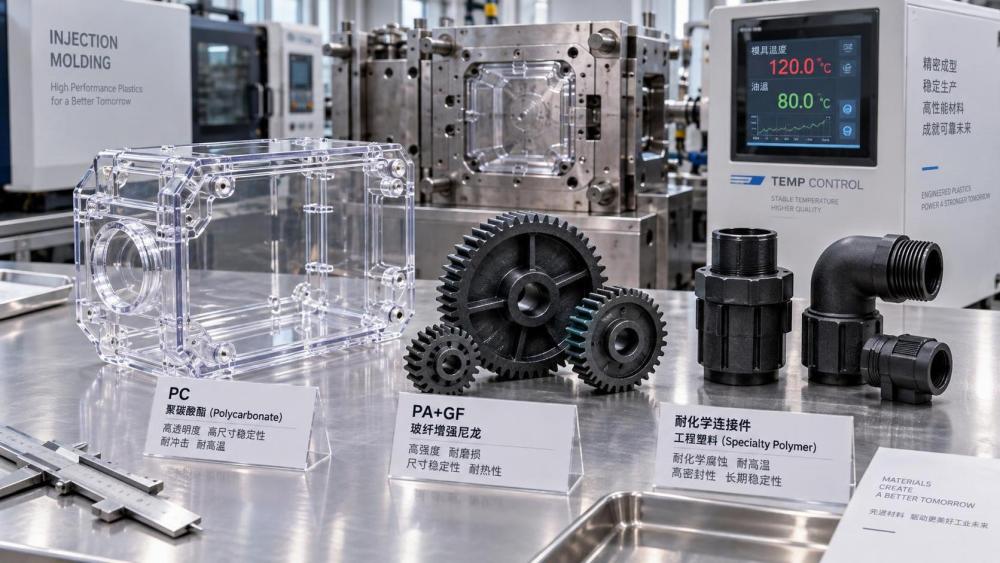
Those rules are useful, but they are not sufficient for a release decision. Reinforcement, flame-retardant packages, impact modifiers, wall thickness, mold design, assembly stresses, and the real chemical environment can shift the outcome substantially. A clear polycarbonate housing and a glass-fiber-reinforced nylon bracket may both be described as engineering plastics, yet they solve very different manufacturing problems. The material choice should follow the failure mode the product cannot tolerate.
This is how to decide between amorphous and semi-crystalline engineering plastics without reducing the comparison to a generic list of properties.
Start with the operating environment, not the data sheet headline
The first question is simple: what will make the part fail in service? Teams often begin by comparing tensile strength or heat-deflection figures, but those values can hide the factors that matter more in a finished assembly. A part may be structurally strong in a dry laboratory condition and still crack after contact with a cleaning agent, creep under a sustained clamp load, or distort after a thermal cycle.
Semi-crystalline polymers, including polyamide (PA), polyoxymethylene (POM), polybutylene terephthalate (PBT), polyethylene terephthalate (PET), polyphenylene sulfide (PPS), and PEEK, have ordered crystalline regions within the polymer structure. Those regions commonly improve chemical resistance, fatigue behavior, wear resistance, and retention of useful mechanical properties at higher temperatures. For gears, clips, fluid-handling parts, electrical connectors, under-hood components, and industrial wear elements, these characteristics can be decisive.
Amorphous polymers, such as polycarbonate (PC), acrylonitrile butadiene styrene (ABS), poly(methyl methacrylate) (PMMA), polyphenylene oxide blends, and many grades of polysulfone, do not form the same ordered crystalline structure during normal cooling. They often offer lower shrinkage, more uniform dimensional behavior, good surface reproduction, and, in some cases, transparency. They are common choices for enclosures, transparent covers, precision housings, display-related parts, medical-device components, and electrical equipment where appearance and tolerance control carry significant weight.
The distinction should be treated as a design filter rather than a performance ranking. For example, an indoor electronic enclosure may favor an amorphous resin because it needs good cosmetic quality, flame performance, stable dimensions, and simple molding behavior. A pump component that sees hot water, cleaning chemicals, and sliding contact will often point toward a semi-crystalline material, even if the component must be redesigned to accommodate greater molding shrinkage.
Use temperature correctly: heat resistance has more than one meaning
Temperature comparisons cause frequent selection errors because “heat resistance” can describe several different things. The relevant question may be whether the part carries load at temperature, survives short thermal peaks, remains dimensionally stable, resists thermal aging, or avoids softening during assembly. Amorphous and semi-crystalline plastics respond to these demands differently.
Amorphous polymers generally soften progressively as they approach their glass-transition range. That behavior can be useful for thermoforming and can support predictable molding, but it requires careful consideration when a component experiences sustained load near its upper service temperature. A housing may retain its shape in a warm environment yet show stress relaxation around screws, snap-fits, or metal inserts if the design margin is too narrow.
Semi-crystalline polymers retain their ordered regions until they approach their melting range, so they can preserve stiffness and shape at temperatures where an unfilled amorphous alternative may soften significantly. This is one reason materials such as PPS, high-temperature polyamides, and PEEK are considered for demanding electrical, automotive, and industrial equipment. Still, a high melting point alone does not establish suitability. Long-term aging, oxidation, hydrolysis, reinforcement level, and load duration may govern the actual performance limit.
A useful selection sequence is to define the temperature exposure in three layers:
- Normal continuous operating temperature at the point of highest material stress.
- Short-duration peaks from assembly, electrical events, sterilization, transport, or nearby heat sources.
- Thermal cycling range, including the number of cycles and whether the part is constrained by metal, glass, or another polymer.
Thermal cycling deserves particular attention in hybrid assemblies. Plastics expand differently from metals. A resin with good standalone heat performance can still produce seal failure, insert cracking, or warped interfaces if its thermal expansion and moisture response are not considered alongside the mating components.
Chemicals, moisture, and surface contact often decide the family
If the part contacts oils, fuels, hydraulic fluids, detergents, coolants, disinfectants, adhesives, or plasticizers, chemical compatibility should move to the front of the selection process. Semi-crystalline engineering plastics often have an advantage because their crystalline regions make it harder for many chemicals to penetrate the polymer. This is especially relevant for functional components in fluid systems, appliances, industrial machinery, and transportation equipment.
That advantage is conditional. Polyamide, for example, can absorb moisture, which may alter dimensions, stiffness, and electrical properties. In a connector, precision mechanism, or tightly toleranced assembly, moisture conditioning can be as important as nominal chemical resistance. Some semi-crystalline materials also require more demanding drying and processing control, and hydrolysis resistance varies widely by resin family and grade.
Amorphous polymers can be more vulnerable to environmental stress cracking when exposed to incompatible chemicals while under load. A transparent cover may remain visually intact during a basic immersion check but crack later around bosses, corners, or snap-fit features after exposure to a cleaner or solvent vapor. The combination of stress, chemical contact, and time is often more informative than a simple pass-or-fail compatibility statement.
For this reason, do not ask only whether a material “resists” a chemical. Ask how the part will encounter it: splash, immersion, vapor, wipe-down, accidental spill, repeated cleaning, or internal pressure exposure. Also identify whether the component will be under tensile stress, flexure, residual molding stress, or assembly preload during contact.
Dimensional stability is a system issue, not a shrinkage number
Amorphous plastics are often preferred for precision molded parts because their shrinkage tends to be lower and more uniform than that of semi-crystalline materials. They can therefore simplify tolerance control for thin-wall housings, flat surfaces, optical features, and parts with complex cosmetic geometry. In many cases, they also offer less pronounced anisotropy than fiber-filled semi-crystalline compounds.
Semi-crystalline materials shrink more as they cool because crystallization adds a structural change beyond ordinary thermal contraction. The effect can be directional, especially with glass fiber reinforcement and flow-oriented geometry. Warpage risk rises when wall thickness changes abruptly, flow paths are unbalanced, gates are poorly placed, or ribs and bosses concentrate material.
However, choosing an amorphous resin solely to avoid mold-development work can create a different problem if the application needs chemical durability or long-term load resistance. Semi-crystalline plastics can produce highly precise components, but the mold, filling pattern, cooling layout, fiber orientation, and post-molding conditioning need to be part of the engineering plan. A dimensionally critical PBT or POM component is not impossible; it simply should not be treated as an interchangeable substitute for an amorphous housing resin.
Do not confuse surface appearance with part robustness
Amorphous materials frequently provide excellent gloss, color consistency, laser marking response, and replication of mold texture. These qualities matter in consumer electronics, visible automotive interiors, appliances, instrumentation, and medical equipment. Their performance can support a cleaner part-design route when the component must look finished directly out of the mold.
Semi-crystalline materials often produce a more matte or less uniform appearance, and visible flow effects or differential shrinkage can complicate cosmetic requirements. This does not make them inferior. It means their value is often concentrated in functional reliability rather than show surfaces. For a concealed structural bracket, a cable-management clip, or a fluid connector, a material that resists fatigue and chemical exposure may be the stronger business choice even if its appearance needs less emphasis.
Where a component needs both a high-quality visible surface and demanding functional performance, avoid assuming one resin must solve every requirement. The part may be redesigned with a separate cosmetic cover, a coated surface, an overmolded feature, or a material combination. That approach adds manufacturing complexity, so it should be justified by the product requirement, but it can be more reliable than forcing a single resin into conflicting roles.
Processing capability can change the economics of the decision
Material selection is incomplete until the production route is evaluated. Amorphous resins generally offer a wider processing window around cooling behavior because they do not depend on crystallization to develop their final morphology. Their lower shrinkage can reduce some mold-tuning work and improve consistency for large cosmetic parts. Several amorphous materials are also available in transparent and flame-retardant grades suited to electrical enclosures.
Semi-crystalline resins can demand tighter control of melt temperature, mold temperature, cooling time, drying, and residence time. Molds often need to support temperatures that enable adequate crystallization and stable properties. Cycle time, tooling capability, and scrap sensitivity should be reviewed before approving a resin change. A conversion from an amorphous polymer to a semi-crystalline grade may require gate changes, revised cooling circuits, altered ejection strategy, and requalification of part dimensions.
The reverse conversion also has consequences. Replacing a semi-crystalline material with an amorphous alternative can reduce shrinkage but may require larger wall sections, redesigned fastening features, or improved chemical protection to maintain service life. Resin price is therefore only one part of the cost comparison. Tool modification, drying requirements, cycle time, reject rate, finishing, assembly performance, and validation effort can outweigh a modest difference in price per kilogram.
A practical decision path for engineering and procurement teams
When the requirement is still broad, begin with an amorphous candidate if the part is primarily a visible enclosure, transparent component, precision shell, or electrically insulating housing with modest chemical exposure. Begin with a semi-crystalline candidate if the part is functional under chemical contact, movement, sustained load, moisture, wear, or significant heat. Then test the initial assumption against the features that commonly overturn it.
- Check the weakest service condition. Identify the highest temperature, harshest chemical, maximum stress, and most demanding dimensional requirement rather than relying on average operating conditions.
- Map the geometry. Thin walls, long flow paths, thick-to-thin transitions, snap-fits, inserts, weld lines, and flat cosmetic surfaces affect the feasibility of both polymer families.
- Separate appearance requirements from functional requirements. A resin selected for gloss or clarity should still be evaluated for stress cracking, impact response, and long-term load behavior.
- Include moisture exposure in the specification. This is essential for moisture-sensitive materials and assemblies with close tolerances or electrical requirements.
- Compare qualified grades, not resin-family labels. Filled, impact-modified, flame-retardant, recycled-content, and UV-stabilized grades can behave very differently from their base polymer.
- Validate on parts, not plaques alone. The relevant evaluation should represent molding orientation, residual stress, assembly force, chemical exposure, temperature, and time.
Supplier documentation remains important, but it should support a defined requirement rather than substitute for one. Ask for the property conditions behind the data, recommended processing range, drying guidance, chemical-resistance information for the actual media, batch-control approach, and notification process for formulation or production changes. For regulated or safety-critical products, material traceability and grade consistency may be as significant as the initial performance comparison.
Where common shortcuts fail
One shortcut is to assume semi-crystalline always means “stronger.” Many semi-crystalline polymers have excellent toughness, fatigue resistance, and chemical durability, but their performance can be reduced by moisture uptake, poor weld-line design, inappropriate fiber orientation, or inadequate processing. An amorphous polycarbonate blend may outperform an unfilled semi-crystalline material in a high-impact enclosure application, particularly where dimensional accuracy and flame behavior are also needed.
Another shortcut is to assume amorphous always means better dimensional stability. The molded part may have lower initial shrinkage, but temperature, stress relaxation, solvent exposure, and creep can still affect dimensions. Conversely, a properly designed and processed reinforced semi-crystalline component may be more stable over a demanding thermal and chemical service life than an amorphous alternative.
The useful decision is therefore rarely “which family is better?” It is which failure mechanism deserves the largest design margin. When chemical contact, wear, fatigue, and elevated-temperature function dominate, semi-crystalline engineering plastics often provide the more durable platform. When appearance, transparency, low shrinkage, and controlled molded geometry dominate, amorphous plastics often make the selection and manufacturing process more straightforward. The final choice should be confirmed against the part's real geometry, processing route, and service conditions before the grade is locked into tooling and qualification.
Have questions about this sector analysis, or seeking best practices specific to your niche? Drop us a line below and let the senior consultants at APIM assist you.
We respect your privacy. Your information is strictly confidential.
Related News
- 00
0000-00
NAPCOR Report: US PET Bottle Recycling Rate Fell to 29% in 2025 - 00
0000-00
How does washing affect contamination in post-consumer recycled PP resins? - 00
0000-00
How does feedstock affect depolymerization equipment selection? - 00
0000-00
US Sets 213.44% Preliminary Antidumping Deposit on Chinese PTMEG - 00
0000-00
When should epoxy be used as a thermal interface material for semiconductors?