




How shear heating affects engineering polymers during extrusion
Shear heating raises the temperature of engineering polymers above what barrel settings alone predict. Mechanical work from the rotating screws and pressure-driven melt flow dissipates as heat, supporting melting and reducing viscosity. When that heat concentrates in restrictive passages or mixing zones, it can also accelerate degradation, alter reinforcement, and destabilize extrusion. The useful processing window therefore depends on actual melt temperature, exposure time, and material condition.
A barrel zone operating below its setpoint does not necessarily indicate an underheated melt. The polymer can generate enough internal heat to require barrel cooling while its core remains hotter than the measured wall temperature. Assessing polymer engineering materials under these conditions requires separating heater input, mechanical energy, and heat removal.
Where mechanical work becomes melt temperature
For simple shear flow, the local rate of viscous heat generation per unit volume is expressed as q‴ = τγ̇ = ηγ̇2, where τ is shear stress, γ̇ is shear rate, and η is viscosity at the local temperature and shear rate. This relationship explains why narrow clearances and strongly sheared melt layers can become concentrated heat sources. Complex screw flows also contain extensional deformation, so this expression describes the mechanism without capturing every contribution.
Most engineering polymer melts are shear thinning: their apparent viscosity decreases as shear rate increases. That reduction does not eliminate viscous heating. Shear stress generally continues to increase with shear rate, so heat generation can rise even as apparent viscosity falls. Rising temperature further lowers viscosity, changing torque, pressure, and flow distribution throughout the extruder.
Heat generation is uneven. Screw flight clearances, kneading elements, reverse elements, restrictive adapters, screen packs, and die passages produce different deformation histories. Relatively poor heat conduction through the polymer limits how quickly a hot region exchanges heat with surrounding material or the barrel. A single downstream temperature reading can therefore conceal an earlier local temperature peak.
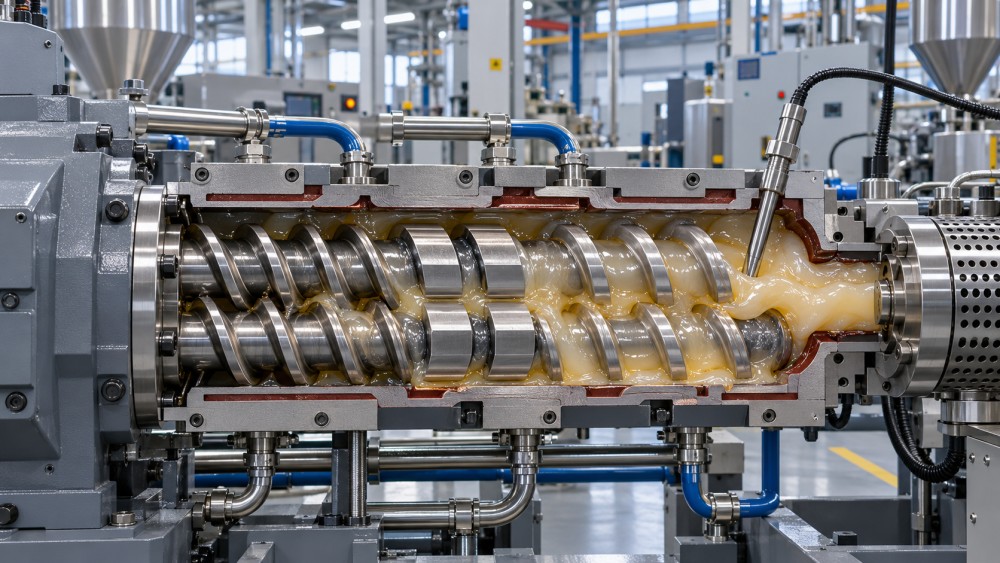
The temperature history also includes external heating, melting, and cooling. Semicrystalline polymers absorb energy during melting, while heat leaves through the barrel, screw, and downstream equipment. Consequently, equal mechanical energy inputs do not guarantee equal melt temperatures across materials or operating conditions.
Screw speed becomes meaningful only with throughput and screw geometry
Increasing screw speed generally increases deformation rates, but its thermal effect depends on the accompanying throughput change. At constant feed rate in a starve-fed twin-screw extruder, higher speed often lowers channel fill and increases mechanical work per unit mass. Residence time and mixing patterns also change. The resulting melt temperature must be measured rather than inferred from speed alone.
If throughput rises together with screw speed, the additional material carries away more heat. Mechanical energy per kilogram may then remain stable or decrease, although torque and pressure can rise. On a flood-fed single-screw machine, increasing speed also changes solids conveying and melting demand. If melting capacity becomes insufficient, unmelted particles can coexist with overheated melt regions.
Screw geometry determines where energy enters the material. Kneading block angle, element length, flight clearance, and restrictive elements affect pressure, filling, mixing, and residence time. A configuration that improves filler dispersion can impose excessive thermal exposure on a sensitive matrix. Replacing restrictive elements with conveying elements can reduce heating, but inadequate melting or dispersion would make that change unsuccessful.
Downstream resistance matters as well. A contaminated screen pack or restrictive die increases the pressure work needed to move the melt. A melt pump changes how pressure generation is divided between the screw and downstream equipment, but the pump also introduces mechanical work and heat. Temperature measurements around these components help establish where additional heating occurs.
Material chemistry changes the consequence of a hot spot
The same measured melt temperature has different implications for different resin grades. Molecular weight, moisture, stabilizer package, reinforcement, and prior processing history influence both heat generation and tolerance to exposure. A supplier’s processing window is a starting boundary; it must be interpreted alongside residence time and the actual compound formulation.
Moisture is especially important when interpreting a viscosity decrease. With PA, PC, PET, or PBT, hydrolytic chain scission can produce lower viscosity even when temperature appears controlled. Reduced torque after a process change is therefore ambiguous: it could reflect hotter melt, lower channel fill, moisture-related degradation, or a change in incoming resin viscosity.
Filled compounds introduce another distinction. Lower viscosity can improve fiber wetting, while intensive mixing can shorten fibers. A smooth strand or uniform pellet appearance does not establish that reinforcement performance has been preserved. Fiber length and application-relevant properties provide evidence that temperature and pressure traces cannot supply.
Measurements that distinguish useful heating from excessive exposure
Barrel thermocouples measure the barrel at their installation location. They do not directly measure the full melt temperature distribution. A melt-contact probe at the adapter or die provides more relevant information, but its reading still depends on immersion depth, response time, conduction through the probe, and position within the flow.
A wall-adjacent reading can differ from the hotter core. A probe also averages conditions over its response time and may miss short excursions. Where equipment allows, measurements at different depths or locations reveal gradients that a single sensor misses. Sensor placement and calibration should remain documented when comparing trials.
Specific mechanical energy, or SME, connects shaft power with mass throughput:
SME = net mechanical power delivered to the screws / mass throughput.
Using kilowatts and kilograms per hour gives kilowatt-hours per kilogram. Net screw power requires an appropriate allowance for drive losses; motor nameplate power is unsuitable. Comparisons also require the same calculation basis. SME tracks mechanical input, but it does not reveal how much energy melts solids, remains as sensible heat, or leaves through cooling.
The approximation ΔT ≈ SME / cp illustrates a temperature rise only when units are consistent and the assumed energy becomes sensible heat. It omits melting enthalpy, heat transfer, pressure effects, and temperature-dependent properties. It is useful for an energy plausibility assessment, not as a substitute for melt measurements.
Temperature, torque, throughput, die pressure, and barrel cooling demand are most informative when recorded together. A rising melt temperature accompanied by increasing SME and cooling demand supports excessive mechanical heating. Rising pressure across a screen pack points toward restriction. Pressure fluctuations with intermittent unmelted material suggest a melting or conveying problem that reducing barrel temperatures could worsen.
Separating thermal thinning from permanent material damage
A viscosity decrease caused solely by elevated temperature is reversible when the material returns to the same test conditions. A decrease caused by molecular-weight loss persists. Comparing samples at a common temperature, moisture condition, and test method helps separate these effects.
Melt mass-flow rate or melt volume-flow rate can reveal changes, provided test temperature, load, drying, and conditioning are consistent. An increased flow rate can indicate chain scission, but the result is not diagnostic by itself. Filler content, branching, contamination, and differences between incoming lots also affect flow. Crosslinking or gel formation can instead increase resistance or make the response irregular.
Rheological testing across relevant shear rates provides more information than a single flow value. Molecular-weight measurements, appropriate solution-viscosity methods, color evaluation, microscopy, and mechanical testing resolve different questions. Testing should follow the suspected failure mechanism: visible discoloration warrants a different investigation from reduced fiber-dependent strength without a color change.
Time remains part of the thermal assessment. A brief hot passage and prolonged stagnation at a lower temperature do not create equivalent exposure. Dead zones, extended low-output operation, shutdown delays, and repeated recycling through the extruder can damage material even when the steady-state outlet temperature appears acceptable.
Adjusting the process without creating a second defect
When excessive shear heating is supported by measurements, the adjustment should address its source. Lower screw speed is a useful trial when mechanical input per kilogram is high, but the new condition must still provide complete melting and adequate mixing. Increased throughput can reduce energy per unit mass on some configurations while increasing torque, pressure, and downstream cooling requirements.
Lowering barrel setpoints has limits. Colder melt near the wall has higher viscosity, which can increase mechanical dissipation. Aggressive cooling can also leave insufficiently melted material beside hotter regions. The useful temperature profile supports melting upstream and removes excess heat where it is generated.
Configuration changes offer a more direct response when overheating is concentrated around restrictive mixing elements. The evaluation should retain evidence of dispersion, venting performance, and melt uniformity. For fiber compounds, shifting intensive mixing upstream of fiber addition can reduce subsequent fiber exposure where the formulation and feeding arrangement support that approach.
A controlled trial should hold resin lot, moisture condition, and downstream geometry stable while changing a defined variable. After temperatures, pressure, torque, and output stabilize, samples should be associated with that operating condition. Material collected during the transition contains a mixed processing history and can obscure the result.
The resulting process window should specify actual melt-temperature limits alongside throughput, screw speed, pressure, material conditioning, and residence-related restrictions. Acceptance rests on retained material properties and stable extrusion behavior. A lower temperature reading alone does not establish improvement if it comes with incomplete melting, poor dispersion, or inconsistent output.
Have questions about this sector analysis, or seeking best practices specific to your niche? Drop us a line below and let the senior consultants at APIM assist you.
We respect your privacy. Your information is strictly confidential.
Related News
- 00
0000-00
NAPCOR Report: US PET Bottle Recycling Rate Fell to 29% in 2025 - 00
0000-00
How does washing affect contamination in post-consumer recycled PP resins? - 00
0000-00
How does feedstock affect depolymerization equipment selection? - 00
0000-00
US Sets 213.44% Preliminary Antidumping Deposit on Chinese PTMEG - 00
0000-00
When should epoxy be used as a thermal interface material for semiconductors?