




High Shear Polymer Processing: Key Signs of Degradation and How to Control It
Why high shear polymer processing fails differently across real production lines
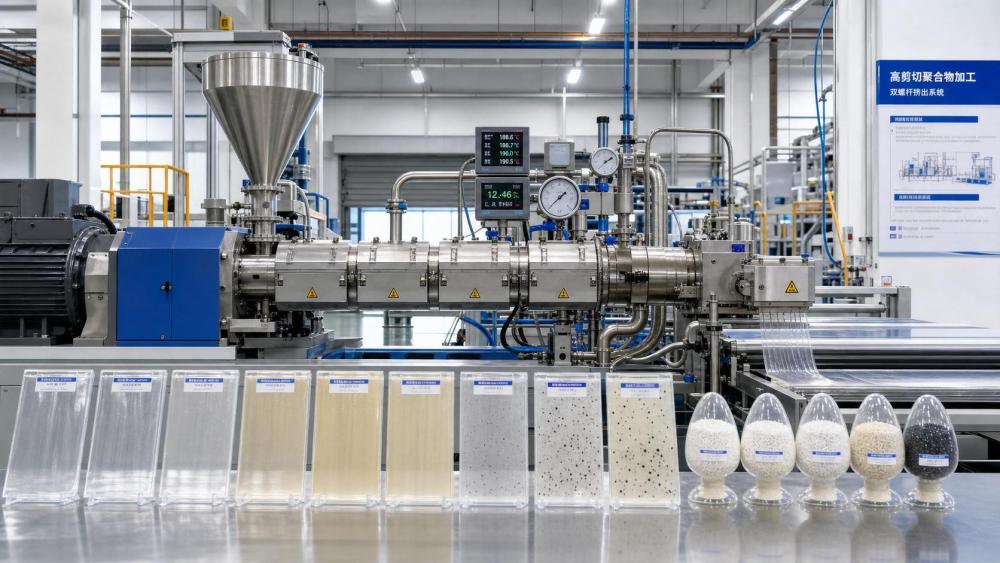
High shear polymer processing rarely breaks down in one dramatic step. More often, quality drifts first, then scrap rises, and only later does the root cause become obvious.
That pattern matters across extrusion, compounding, pelletizing, film conversion, and precision part production, where small thermal and mechanical shifts can damage polymers before operators see defects.
In practice, degradation is not just a resin issue. It is a process interaction involving shear rate, melt temperature, moisture, screw design, residence time, and the stability of fillers or additives.
The same high shear polymer processing window that works for a reinforced PA compound may be too aggressive for a transparent PC sheet or a recycled PET formulation.
This is why structured technical interpretation, the kind emphasized by APIM, becomes useful. Material performance only makes sense when it is read together with processing conditions and downstream requirements.
Actual warning signs are easy to miss when the line still seems productive
Early degradation in high shear polymer processing often appears as subtle instability, not immediate failure. A line may still run at target output while the material is already losing performance.
Common signals include yellowing, black specks, unusual odor, die drool, pressure fluctuation, unstable viscosity, brittle pellets, reduced gloss, and weaker impact or elongation values.
For engineering plastics, a slight color shift can signal oxidation or chain scission. In films, haze changes may appear before tensile loss becomes measurable.
Modified compounds add another layer. Glass fiber breakage, poor dispersion, additive volatilization, and filler separation can resemble normal process variation, even when degradation is already progressing.
- Sharp odor often points to overheating, trapped volatiles, or additive breakdown.
- Melt surging may indicate viscosity loss, inconsistent feed, or localized over-shear.
- Surface streaks can come from degraded residues, not only poor mixing.
- Unexpected brittleness may come from molecular degradation even when dimensions remain acceptable.
Different applications create different degradation risks
The main mistake in high shear polymer processing is treating every polymer line as if it responds to stress in the same way. Real applications create different tolerance limits.
Compounding lines usually face dispersion versus damage tradeoffs
In twin-screw compounding, stronger mixing improves filler distribution, color uniformity, and additive incorporation. Yet aggressive kneading can shorten fibers, overheat the melt, or destabilize flame-retardant packages.
This is common with glass-filled PA, conductive compounds, mineral-filled PP, and recycled blends. The target is not maximum shear. It is controlled shear that matches formulation sensitivity.
Film and sheet extrusion usually punish thermal history faster
Optical films, PET sheets, PMMA sheets, and barrier structures tend to reveal degradation through appearance first. Small defects become visible because clarity, haze, and thickness consistency are tightly controlled.
Here, high shear polymer processing must be judged against visual quality and surface stability, not only throughput. A fast line that causes gels or yellowing is already outside a usable window.
Precision parts and electrical components care about retained properties
For PBT, POM, PPS, PC, or high-temperature polymers, degradation may not show clearly during molding or extrusion. The concern appears later in impact resistance, insulation behavior, dimensional stability, or long-term heat aging.
That is why high shear polymer processing in these applications needs tighter control of residence time, moisture, and regrind ratio, especially where certification or repeatability matters.
Where the judging criteria change from one scenario to another
A practical review becomes easier when the line is judged by the failure mode that matters most. The table below shows how the same process variable can create different concerns.
This is also why material data sheets should not be used alone. They describe potential performance, while high shear polymer processing determines whether that performance survives production.
Control measures that work better than simply lowering temperature
A common reaction to degradation is lowering barrel temperature. Sometimes that helps, but it can also increase viscosity, raise mechanical stress, and create new shear heating downstream.
More reliable control starts with separating thermal load from mechanical load. In high shear polymer processing, both must be balanced together.
- Review screw elements and mixing sections before changing resin grade.
- Track actual melt temperature, not only barrel setpoints.
- Reduce unnecessary residence time during low-output operation.
- Dry hygroscopic materials consistently, especially PET, PA, and PC.
- Use filtration and degassing according to contamination and volatile load.
- Check feeder stability, because short-term starvation can create local overheating.
In many lines, the better fix is not slower production. It is a narrower and more stable process window, supported by cleaner startup, purge discipline, and better trend recording.
Misjudgments that create avoidable degradation
The most expensive mistakes are often judgment errors rather than equipment failures. High shear polymer processing becomes difficult when similar-looking materials are treated as interchangeable.
One common misread is blaming the resin when the real cause is dead spots, poor venting, or an oversized kneading section. Another is focusing on output rate while ignoring thermal history during stops.
Recycled and bio-based formulations deserve extra caution. Their stability can vary more by source, previous heat history, and contamination level than virgin engineering plastics.
There is also a cost misconception. A cheaper formulation may look attractive until degradation increases purge waste, screen changes, odor complaints, or downstream rejection rates.
How to build a more dependable high shear polymer processing routine
The strongest approach is to link process monitoring with application-specific quality signals. APIM’s broader materials perspective is useful here because polymer selection and processing stability should be reviewed together.
Start by defining which loss matters most in the actual application: appearance, toughness, electrical performance, barrier behavior, dimensional stability, or odor. That choice changes the control strategy.
Then compare resin sensitivity, screw configuration, moisture handling, filtration, and residence time against that requirement. High shear polymer processing is manageable when the line is judged by evidence, not assumptions.
A practical next step is to create a short review sheet for each material family. Record melt temperature, pressure trend, odor notes, color shift, property checks, and shutdown conditions on the same document.
That makes it easier to distinguish random variation from real degradation, compare conditions across applications, and set a process window that protects both output and final performance.
Have questions about this sector analysis, or seeking best practices specific to your niche? Drop us a line below and let the senior consultants at APIM assist you.
We respect your privacy. Your information is strictly confidential.
Related News
- 00
0000-00
Do polyolefin hot melt adhesives bond well to polyethylene? - 00
0000-00
Korean Study Finds PLA Barely Degrades in Landfill After 320 Days - 00
0000-00
How to assess batch consistency from a thermal potting compounds supplier - 00
0000-00
How much weight can carbon fiber reinforced plastics save in cars? - 00
0000-00
Switching from PS to ABS Sheet Extrusion: Equipment Checks