




Choosing plastics for chemical fluid handling based on chemical resistance
Chemical resistance is a system property, not a resin label
Selecting plastics for chemical fluid handling starts with a basic question: can the material retain its required function for the full service life of the component? A resin may appear compatible with a chemical in a reference chart and still fail in service because the chart does not capture the operating temperature, concentration changes, pressure cycling, stress at fittings, cleaning chemistry, or duration of exposure.
For technical evaluators, the practical task is to identify the actual exposure condition before comparing materials. A tank liner, pump housing, valve body, pipe, flexible hose, sight glass, and injection-molded fitting can all contact the same fluid but face very different failure mechanisms. A material that is satisfactory for a static, ambient-temperature container may be unsuitable for a pressurized circulation loop or a stressed threaded connection.
The best material is therefore rarely the one with the highest published chemical resistance in isolation. It is the one that combines adequate resistance with the mechanical, thermal, fabrication, cleanliness, and inspection requirements of the specific fluid system.
Define the chemical duty before opening a compatibility chart
Chemical name alone is not enough for material selection. The same substance can produce a very different result when its concentration, temperature, or impurities change. Dilute sulfuric acid, for example, does not create the same selection problem as a hot concentrated acid. A water-based alkaline cleaner can become more aggressive when heated. A solvent mixture may attack a polymer even when each listed component appears acceptable on its own.
Before narrowing the candidate list, document the service condition in a form that materials suppliers, component manufacturers, and internal testing teams can interpret consistently:
- Fluid composition: Include the primary chemical, concentration range, additives, dissolved salts, surfactants, oxidizers, solids, and expected contaminants.
- Temperature profile: Record normal operation, startup, shutdown, cleaning, upset conditions, and local hot spots near pumps, heaters, or mixers.
- Pressure and flow: Specify operating pressure, pressure peaks, vacuum exposure, flow velocity, pulsation, and the likelihood of hydraulic shock.
- Exposure pattern: Distinguish continuous immersion from intermittent splashes, vapor exposure, occasional cleaning, or short transfer operations.
- Mechanical condition: Consider tensile stress, clamp force, vibration, abrasion, impact, threaded joints, weld zones, and residual molding stress.
- Consequence of failure: Define whether leakage creates a safety concern, product contamination risk, unplanned shutdown, environmental release, or a manageable maintenance event.
This definition often changes the shortlist early. Polyethylene or polypropylene may be appropriate for many aqueous acids, alkalis, and process chemicals at moderate conditions. Fluoropolymers may be justified when solvents, oxidizing media, elevated temperatures, or permeation concerns make conventional polyolefins uncertain. Engineering thermoplastics such as PVDF, PPS, PEEK, or certain polyamides can be considered where chemical resistance must coexist with higher strength, temperature capability, dimensional control, or demanding component geometry.
However, broad material families should be treated as a starting point, not a final answer. Grade formulation, reinforcement, pigmentation, stabilizer package, processing history, and joining method may all affect the result.
The main ways chemically exposed plastics fail
Chemical attack does not always look like rapid dissolution. In many fluid-handling applications, damage develops gradually and becomes visible only after a seal leaks, a fitting cracks, a valve becomes difficult to operate, or a molded part loses dimensional accuracy. Understanding the failure mode makes the selection exercise more useful than a simple pass-or-fail compatibility rating.
Swelling and softening
Some liquids enter the polymer structure and cause volume increase, mass gain, reduced hardness, or a loss of stiffness. This is common with certain solvents, fuels, oils, and plasticizer-like substances. Swelling can be unacceptable even if the material remains intact. A swollen valve seat can alter sealing force; a swollen tube can lose clamp retention; a distorted pump part can reduce clearance or create rubbing.
For assemblies, differential swelling matters as much as swelling of the main body. A plastic housing, elastomeric seal, adhesive, and metal insert may all respond differently to the same chemical and temperature. The interface can fail before any individual material appears severely damaged.
Environmental stress cracking
Stress cracking is one of the most frequently underestimated risks in plastics for chemical fluid and handling. A fluid may have limited effect on an unstressed coupon yet trigger cracking in a part under residual or applied stress. Molded fittings, transparent covers, snap features, threaded ports, bent tubing, and regions around inserts deserve particular attention.
The risk rises when a material is exposed to detergents, surfactants, oils, alcohol-containing mixtures, or other stress-cracking agents while carrying load. Surface scratches, sharp transitions, poor weld-line performance, over-tightened fasteners, and excessive assembly force can make the outcome worse. In such situations, a compatibility chart that only reports immersion behavior is insufficient.
Permeation and contamination
A component can remain mechanically sound while still allowing molecules to migrate through its wall. Permeation is especially relevant for volatile solvents, gases, fuels, aggressive vapors, and high-purity fluid systems. It can cause emissions, odor, corrosion of external hardware, loss of fluid concentration, or contamination of a surrounding process.
Wall thickness reduces the rate but does not eliminate the underlying mechanism. For demanding service, the evaluation may need to compare barrier performance, vapor-side exposure, temperature effects, and the effect of pressure differences across the component. A material chosen primarily for bulk chemical resistance may not meet a containment requirement without a liner, multilayer construction, or alternative design.
Hydrolysis, oxidation, and property loss over time
Hot water, steam, acids, bases, oxidizing agents, and reactive cleaning media can degrade susceptible polymers through mechanisms that do not immediately show as swelling. Hydrolysis-sensitive materials may lose molecular weight and strength. Oxidizing media can embrittle some polymers. Repeated thermal and chemical cycles can accelerate deterioration at surfaces, joints, and thin sections.
For long-life equipment, ask for performance information after realistic exposure periods and temperature conditions, rather than relying only on the properties of unexposed resin. Retained tensile strength, elongation, impact resistance, mass change, dimensional change, and visual cracking can all be relevant, depending on the component’s function.
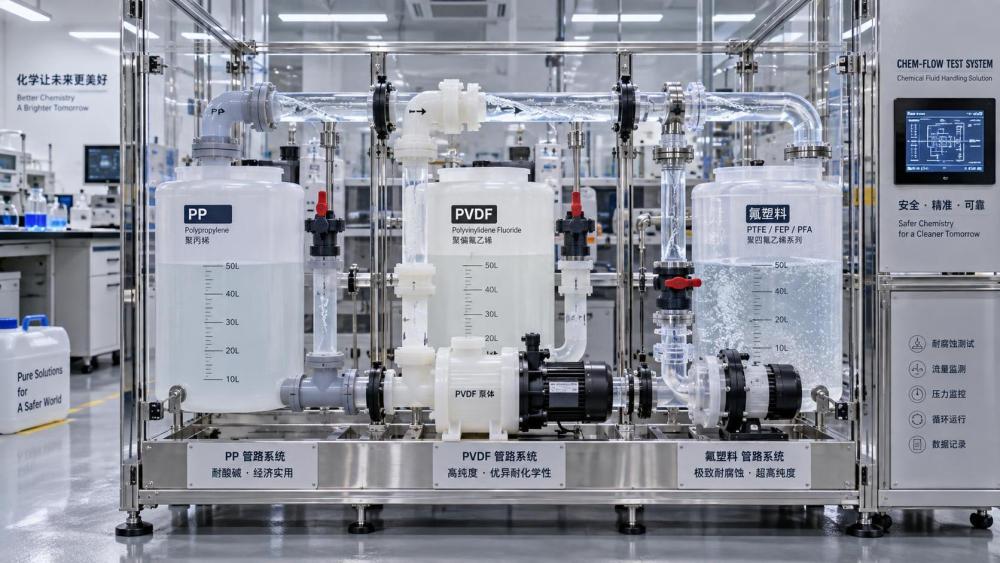
How common polymer choices should be framed
Material families are often discussed in terms of a single strength, such as “excellent chemical resistance” or “high temperature performance.” That shorthand can obscure practical limits. The following framing is more useful during early evaluation.
Polyamide, polycarbonate, acetal, ABS, and thermoplastic polyurethane may offer useful mechanical or processing advantages in selected systems, but they should not be assumed to be general-purpose chemical-fluid materials. Some are sensitive to moisture, hydrolysis, strong acids or bases, oxidizing chemicals, or solvent environments. Their suitability depends heavily on the exposure profile and the part design.
Reinforced grades require extra care. Glass fiber or carbon fiber can improve stiffness and reduce thermal expansion, yet reinforcement can complicate chemical exposure. The polymer matrix still controls much of the chemical compatibility, while fibers, interfaces, and orientation can influence surface quality, stress distribution, permeability pathways, and weld-line behavior. A reinforced grade should be assessed as its own material system rather than treated as equivalent to its unfilled base resin.
Temperature and stress often decide the outcome
Technical teams commonly begin with the fluid and the polymer, then add temperature as a secondary factor. For chemical service, temperature is often the factor that turns a workable selection into a poor one. Diffusion and reaction rates can increase sharply at higher temperatures. A chemical that produces little change at room temperature may soften, swell, crack, or degrade the same material in a heated process, during sterilization, or under a hot cleaning cycle.
Pressure introduces a different problem. Internal pressure creates hoop stress in pipes, fittings, tanks, and hoses; pressure pulsation adds fatigue. A chemical-resistant material with low modulus or pronounced creep may require thicker walls, external support, different joint geometry, or a lower operating pressure. In lined steel equipment, the liner may provide the corrosion barrier while the metal shell carries the structural load. This arrangement can be more reliable than asking a polymer wall to meet both duties alone.
Design details deserve the same scrutiny as resin selection. Sharp corners, sudden wall-thickness changes, threaded connections, molded-in inserts, unsupported spans, and poorly controlled welds can concentrate stress. Chemical attack frequently begins at these locations. A more resistant polymer may help, but redesigning the feature or changing the joining method can be the more effective solution.
Move from a paper shortlist to evidence that matches the duty
Compatibility tables are useful for screening, particularly when they identify obvious exclusions. They should not be treated as a warranty for a finished component. Published ratings may be based on ambient-temperature immersion, a specific concentration, a limited duration, or a resin grade that does not match the proposed compound. They may also say little about creep, stress cracking, permeation, weld performance, or cycling.
A disciplined validation path usually has three stages. First, remove clearly unsuitable materials using chemical, temperature, and regulatory constraints. Second, compare the remaining options against the actual component design: thickness, stress, manufacturing process, joint type, expected life, and consequences of leakage. Third, test representative parts or specimens under conditions that reproduce the most severe credible duty.
The test should reflect the decision being made. For a vessel or pipe, retained pressure capability, creep, weld quality, and dimensional stability may matter most. For a valve, evaluate torque, sealing, stem movement, and seat behavior after exposure. For tubing, examine flexibility, burst resistance, extractables, permeation, and clamp retention. For a transparent component, haze and crack initiation may be more important than strength alone.
Testing should also include the surrounding materials. Gaskets, O-rings, bonded joints, coatings, pigments, metal inserts, and cleaning agents are frequent sources of failure. A chemically resistant body paired with an incompatible seal is still an incompatible assembly.
A practical decision rule for technical evaluation
Material selection becomes more defensible when the team separates “chemical compatibility” from “service suitability.” A candidate can be chemically resistant yet unsuitable because it creeps under pressure, cannot be joined reliably, sheds contaminants, fails in thermal cycling, or creates unacceptable cost and lead-time exposure. Conversely, a material with only moderate chemical resistance may work well in a low-temperature, intermittent, low-stress application where its processing and mechanical properties provide better value.
For each shortlisted material, document the intended fluid range, maximum credible temperature, pressure condition, duration of contact, anticipated stress points, joining method, and required failure margin. Then identify which assumptions are supported by supplier data and which require representative testing. This record is useful beyond the initial selection: it gives procurement, quality, maintenance, and future design teams a clear basis for approving substitutions or investigating field issues.
Chemical resistance is most valuable when treated as part of the complete fluid-handling design. The resin grade matters, but the fluid definition, geometry, load case, temperature history, interfaces, and validation method determine whether the chosen plastic will remain reliable once the system moves from a compatibility chart into operation.
Have questions about this sector analysis, or seeking best practices specific to your niche? Drop us a line below and let the senior consultants at APIM assist you.
We respect your privacy. Your information is strictly confidential.
Related News
- 00
0000-00
How does washing affect contamination in post-consumer recycled PP resins? - 00
0000-00
How does feedstock affect depolymerization equipment selection? - 00
0000-00
US Sets 213.44% Preliminary Antidumping Deposit on Chinese PTMEG - 00
0000-00
When should epoxy be used as a thermal interface material for semiconductors? - 00
0000-00
US Midterm Results Unlikely to Quickly Shift Recycled Plastics Market or Legislation