




Which material REACH requirements apply to polymers sold in the EU?
Polymers sold in the European Union are often described as “exempt from REACH registration.” That statement is directionally correct, but incomplete enough to cause compliance mistakes. The polymer itself is generally exempt from registration under REACH, yet the substances used to make it, additives blended into it, substances released from it, and substances present in finished articles can all create obligations.
For a resin producer, compounder, importer, converter, or buyer, the practical question is therefore not simply whether a material is a polymer. It is whether the particular composition, supply-chain role, annual volume, and final form trigger registration, restriction, communication, notification, classification, or documentation duties.
A virgin polypropylene grade, a flame-retardant glass-fibre reinforced polyamide compound, a recycled PET sheet, and a multilayer barrier film may all be “polymeric materials,” but their REACH assessments can be materially different.
The basic rule: the polymer is exempt, the formulation is not invisible
REACH treats polymers differently from many other chemical substances. A polymer manufacturer or importer does not normally register the polymer as such. This exemption is commonly called the polymer exemption.
It does not remove the duty to understand what is in the material. The EU-based manufacturer or importer of a polymer may need to ensure that certain monomers and other chemically bound substances used in its manufacture have been registered. This becomes relevant where the substance accounts for at least 2% by weight of the polymer and the total annual quantity of that substance reaches one tonne or more.
The obligation does not necessarily mean that every company handling a polymer must file a new registration. Registration may already have been completed by an actor upstream in the supply chain for the relevant use. However, a company importing polymer materials directly into the EU cannot assume that a non-EU supplier’s declaration solves this question. Under REACH, the importing entity has its own position and must establish who has registered the relevant substances, for which uses, and at what point in the chain.
For this reason, “REACH compliant polymer” should be treated as a commercial statement requiring substance-level support, not as a complete regulatory conclusion.
Start with the company’s role and the material’s market form
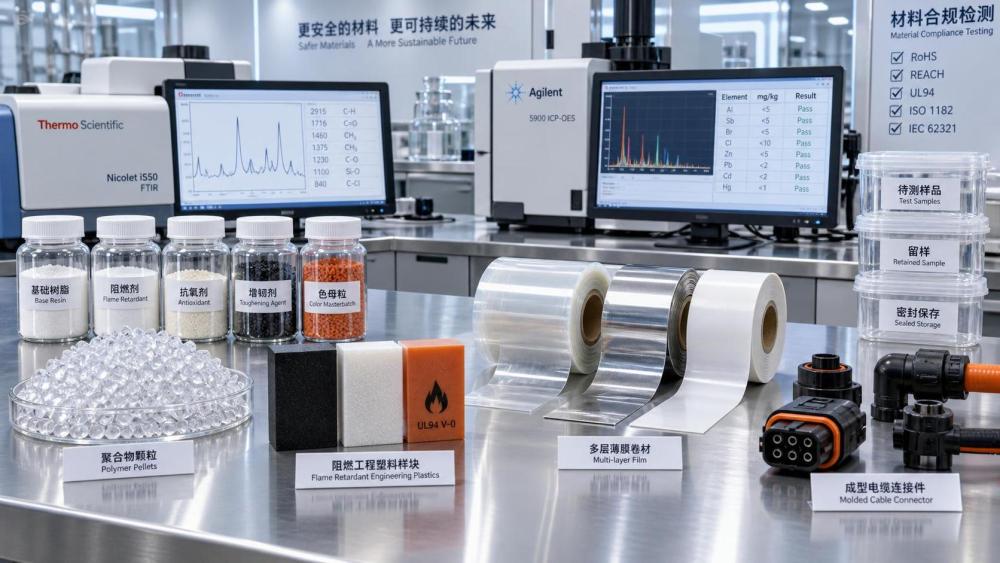
The same material may carry different responsibilities depending on whether it is supplied as pellets, a liquid adhesive, a film roll, a molded component, or a finished electrical assembly.
Resins and compounds are generally supplied as substances or mixtures, while a molded housing, a film laminate, a cable connector, or a vehicle component will usually be assessed as an article. That distinction matters because REACH imposes different duties on substances, mixtures, and articles.
An article is an object whose shape, surface, or design determines its function to a greater degree than its chemical composition. A polymer pellet is normally not an article. A molded polymer part normally is. A coated metal part, a multi-layer package, or an assembled electronic product may contain multiple articles, each potentially requiring its own assessment.
Monomers are often the first technical compliance check
The monomer issue is one of the most misunderstood areas of material REACH requirements. A polymer can be exempt from registration even though its constituent monomer substance is subject to registration requirements. The regulatory focus is not limited to residual monomer left in the finished resin; it concerns monomeric units chemically bound into the polymer as well.
For importers, this requires more than obtaining a generic certificate. A useful technical file should identify the polymer chemistry, significant monomer inputs, their concentration range in the polymer, annual imported volume, and the REACH status of those substances. Where an Only Representative has been appointed by a non-EU producer, the importer should confirm that the imported material, legal entity, tonnage, and intended use are covered by that arrangement.
This is especially relevant for specialty polymers and engineered materials where formulation chemistry is less transparent than in a commodity resin. Thermoplastic polyurethane, specialty acrylic systems, fluorinated materials, epoxy-based polymer systems, high-temperature resins, and reactive adhesive materials can involve a broader set of monomers, oligomers, catalysts, curing agents, or functional additives than a standard unfilled polyolefin grade.
A material safety data sheet can be useful, but it is not a complete monomer-registration dossier. Safety data sheets normally focus on hazardous constituents and safe handling, while a polymer registration assessment may require a wider view of chemically bound components and supply-chain coverage.
Additives can change the compliance position more than the base resin
A polymer grade is rarely just a base polymer. Stabiliser packages, pigments, plasticisers, flame retardants, lubricants, UV absorbers, processing aids, antistatic agents, fillers, compatibilisers, and blowing agents may determine whether a material is suitable for a specific application. They can also determine whether the grade faces a restriction or SVHC-related obligation.
For a compounder, an additive is usually handled as a substance or as part of a mixture. Registration and safety-data obligations may apply according to the substance’s classification, tonnage, and position in the supply chain. For a buyer of a finished compound, the immediate task is usually to identify restricted substances and verify that the intended use remains within regulatory limits.
Restrictions under REACH can apply to substances, mixtures, or articles. A material can therefore be commercially available and still be unsuitable for a specific EU application. Restrictions may be linked to concentration limits, product category, consumer use, indoor use, articles placed on the market, or conditions of manufacture and processing.
Common risk areas in polymer formulations include certain plasticisers, flame-retardant chemistries, pigments, stabilisers, residual solvents, and substances used in surface treatments or adhesive layers. The point is not that every additive is problematic. The point is that the base resin name alone is insufficient for compliance screening. “PA66 GF30,” “PC/ABS,” or “recycled PP” does not disclose the information needed to assess a regulated additive package.
SVHC duties matter most when polymers become articles
Substances of Very High Concern, or SVHCs, are substances identified for the REACH Candidate List because of properties such as carcinogenicity, mutagenicity, reproductive toxicity, persistence, bioaccumulation, toxicity, or equivalent concern. A polymer compound may contain an SVHC in an additive, impurity, residual component, or other constituent. The fact that the material performs well in processing does not affect this assessment.
When an article contains a Candidate List substance above 0.1% weight by weight, the supplier must provide sufficient information for safe use, including at least the name of the substance. This communication duty applies through the supply chain. On request from a consumer, the relevant information must also be supplied within the time period set by REACH.
For complex products, the 0.1% threshold is assessed at the level of each individual article within the product, rather than only against the weight of the complete assembled product. A cable assembly, appliance, vehicle subsystem, or electronic device may therefore require a component-level material review. Diluting a regulated component within a larger assembly does not remove the need to evaluate that component as an article.
Where Candidate List substances are present above the threshold, companies placing articles on the EU market may also have SCIP database obligations under EU waste-framework rules. SCIP is related to REACH but is not itself a REACH registration process. Treating it as a separate data-management task helps prevent a common error: having supplier communication in place but no structured product and component data for article reporting.
There can also be a REACH notification duty for SVHCs in articles where the total quantity exceeds one tonne per year, subject to statutory conditions and exemptions. Whether a particular exemption applies depends on the material, exposure scenario, and prior registration status. It should be assessed against the specific article and substance rather than assumed from a supplier declaration.
Recycled polymers require a more disciplined evidence trail
Recycled content does not exempt a polymer from REACH considerations. In fact, recycled polymers can require more detailed investigation because incoming feedstock may have variable composition, legacy additives, inks, coatings, contaminants, or substances from earlier product generations.
A recycler or buyer should distinguish between material quality data and regulatory composition data. Melt flow rate, ash content, odor, color consistency, tensile properties, and contamination levels are important for processing and end use. They do not, by themselves, demonstrate the absence of restricted substances or SVHCs.
The appropriate depth of assessment depends on the feedstock and application. Closed-loop industrial scrap with known prior composition may offer a more traceable starting point than mixed post-consumer feedstock. Food-contact packaging, children’s products, electrical equipment, medical applications, and consumer articles can require tighter control because they may also be subject to sector-specific rules beyond REACH.
For recycled compounds, a practical file often includes feedstock origin, sorting and decontamination steps, analytical control where relevant, declarations for intentionally added substances, and a change-management process for shifts in input streams. The goal is to detect a changing regulatory risk before it reaches a customer’s finished article.
Do not confuse REACH compliance with a single document
Buyers frequently ask suppliers for a “REACH certificate.” It can be a useful purchasing document, but it is rarely enough on its own. The value of any declaration depends on its scope. A meaningful document should state which material grade, revision, manufacturing location, and regulatory status it covers. It should also distinguish between Candidate List screening, Annex XVII restrictions, authorisation status, and any assumptions about use.
For a material-selection or supplier-approval process, the following questions are more useful than a generic compliance statement:
- Is the item a polymer substance, a mixture, an article, or a complex object containing multiple articles?
- Who is the legal manufacturer, importer, Only Representative, distributor, or downstream user for EU purposes?
- Which monomers and other relevant substances support the polymer chemistry, and is their registration status understood?
- Which additives, pigments, flame retardants, plasticisers, and processing aids are intentionally present?
- Does the material contain any Candidate List substance above 0.1% by weight in the relevant article?
- Do any REACH restrictions apply to the composition or intended end use?
- Can the supplier provide controlled declarations when the Candidate List or restrictions change?
Material changes deserve the same attention as initial approval. Switching an antioxidant package, changing a pigment source, introducing recycled content, replacing a brominated flame retardant, or moving production to a new site can alter the compliance profile without changing the commercial grade name. Procurement teams should therefore tie regulatory declarations to a specific grade and revision-control process, particularly for approved parts in automotive, electrical, industrial, and packaging supply chains.
A workable starting point for polymer buyers and researchers
The fastest reliable route is to build a composition-led screening process before final sourcing decisions are made. Begin with the material’s market form and intended application. Then identify the legal EU supply-chain role, request structured substance and article information from the supplier, and compare that information with the relevant REACH requirements.
For standard virgin polymers with transparent supply chains and limited additive packages, this process may be relatively straightforward. For imported specialty compounds, recycled grades, flame-retardant materials, coated films, adhesive systems, and complex finished articles, it can require deeper review.
The polymer exemption remains important, but it should be understood as a narrow rule about registration of the polymer itself. It is not a blanket exemption for the chemistry, additives, articles, or market responsibilities surrounding that polymer. A sound REACH assessment follows the material from monomer and formulation through to the finished article placed on the EU market.
Have questions about this sector analysis, or seeking best practices specific to your niche? Drop us a line below and let the senior consultants at APIM assist you.
We respect your privacy. Your information is strictly confidential.
Related News
- 00
0000-00
How does washing affect contamination in post-consumer recycled PP resins? - 00
0000-00
How does feedstock affect depolymerization equipment selection? - 00
0000-00
US Sets 213.44% Preliminary Antidumping Deposit on Chinese PTMEG - 00
0000-00
When should epoxy be used as a thermal interface material for semiconductors? - 00
0000-00
US Midterm Results Unlikely to Quickly Shift Recycled Plastics Market or Legislation