




When should manufacturers seek plastic resin regulatory support?
A resin can look fully qualified on a drawing, pass initial processing trials, and still become the source of a launch delay when its compliance status is reviewed too late. The issue often surfaces after a customer asks for a declaration, a market-specific substance statement, recycled-content evidence, food-contact support, or confirmation that a flame-retardant formulation is acceptable in the intended region. By that point, the selected grade may already be in tooling trials, quoted into a program, or tied to a supplier agreement.
Manufacturers should seek plastic resin regulatory support at material selection, before design freeze, whenever the formulation or supply chain changes, and whenever a product enters a new regulated application or market. It is not a last-stage document-collection exercise. Early support helps a project team determine whether the resin, additives, colorants, recycled feedstock, processing aids, and available documentation fit the product’s intended use. It also exposes gaps while a substitute grade, revised design, or additional test plan is still practical.
Start before a resin grade becomes difficult to replace
The right time to ask for regulatory input is usually earlier than teams expect. A datasheet may confirm mechanical, thermal, and processing properties, but it rarely answers every compliance question relevant to a finished part. A polyamide with glass reinforcement, a flame-retardant polycarbonate, a conductive compound, or a recycled polypropylene may be technically suitable while carrying documentation limits that matter to the final application.
Support should be requested during the material screening stage when any of the following applies:
- The part will be sold across more than one country or region.
- The product may contact food, drinking water, skin, pharmaceuticals, or sensitive electronic components.
- The resin contains flame retardants, pigments, stabilizers, plasticizers, conductive fillers, recycled content, bio-based content, or other functional additives.
- The customer specification requires material declarations, substance reporting, traceability, or controlled-substance confirmation.
- The resin is replacing an existing grade because of cost, availability, performance, or sustainability targets.
- The part is likely to be recycled, reused, exported, or incorporated into a larger regulated assembly.
In these situations, asking only “Is this resin compliant?” is too broad to produce a useful answer. Compliance depends on the intended article, the region, the material’s exact formulation, the way it is processed, and what claims the manufacturer intends to make. The better question is: “Can this identified grade, in this color and formulation, be supported for this product, use condition, and destination market?”
Situations that should trigger an immediate review
A specification change affects more than performance
Material substitutions are a common trigger. Procurement may identify an equivalent resin grade with a comparable melt flow rate, reinforcement level, and heat resistance. Engineering may see little risk in a change that preserves moldability and part strength. Yet the alternative can use a different flame-retardant package, stabilizer system, pigment carrier, recycled feedstock source, or filler treatment. Those differences may alter the available declarations or require a new assessment.
The same applies when a compounder adjusts a formulation to improve impact performance, reduce warpage, increase UV resistance, or meet a color target. A revised formulation is not automatically covered by the evidence for the previous one. Project managers should treat formula changes as controlled changes, even where the grade name or commercial family remains similar.
The application becomes more sensitive
A general industrial housing and a component inside a food-handling device may use the same base polymer but face different compliance questions. A packaging layer may be evaluated differently from an external shipping component. Medical, electrical, automotive, consumer, and building applications can each introduce their own material expectations, testing pathways, and customer documentation requirements.
Seek support when the part’s functional role changes. Examples include moving from an external cover to an internal electrical insulation component, using a resin in a product that will see elevated temperatures, or converting a non-contact component into one that may touch food or skin. The resin’s chemistry may be unchanged, but the use conditions—and therefore the evidence required—are not.
A sustainability claim is attached to the material
Recycled and bio-based resin programs require early attention because a sustainability statement is only as reliable as the supporting material records. A project may specify recycled content without defining whether the claim concerns pre-consumer or post-consumer feedstock, how the percentage is calculated, whether allocation methods are involved, or whether the content remains stable across batches and suppliers.
Regulatory support is useful before an environmental claim appears in a purchase specification, product label, customer presentation, or tender response. The team needs to understand what can be documented, what is merely a target, and what evidence must be retained. The same discipline applies to claims around recyclability, compostability, renewable content, or reduced material impact. Processing conditions, multilayer construction, additives, labels, adhesives, and end-use contamination can all affect how a finished product should be described.
What the review should cover before design freeze
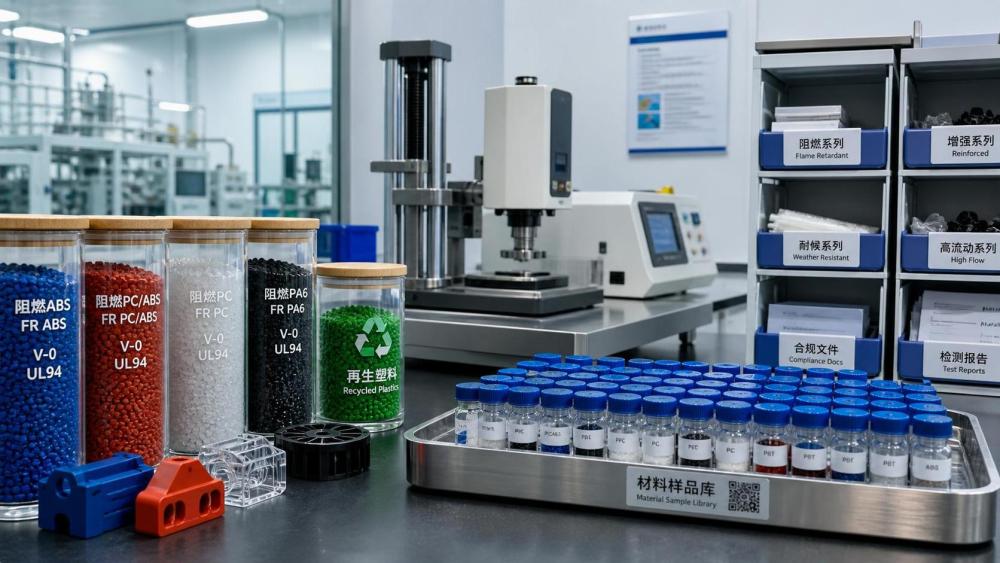
A useful review links the material to the finished article rather than collecting generic supplier files. Begin with a compact application brief. It should identify the exact resin grade, color or masterbatch, reinforcement, additive package where known, supplier and production site, part function, likely processing route, target regions, expected service temperature, contact conditions, and customer requirements.
From there, the team can separate questions into three groups: substance status, application suitability, and evidence quality. This prevents a common mistake: assuming that a general substance declaration is proof that a material is cleared for every end use.
Material identity deserves particular attention. “PA66 GF30 black” is not enough for a compliance file if several sources, color packages, or compounding sites are possible. The record should identify the commercial grade, version or formulation reference where available, approved alternatives, and any linked masterbatch, coating, adhesive, or insert material. This level of detail makes later change control manageable.
Do not wait for the customer document request
Customer requests often expose the weakness of a reactive process. A buyer or quality team may ask for a declaration near production approval because it is the moment the requirement becomes visible internally. But the underlying evidence may require supplier follow-up, formulation confirmation, third-party testing, migration evaluation, or interpretation of the finished article. None of these tasks is well suited to a compressed launch schedule.
Early plastic resin regulatory support is especially important when the project has long tooling lead times. Once a mold is designed around a particular shrinkage range, processing window, reinforcement level, or flow behavior, switching to another resin can affect dimensions, warpage, surface quality, cycle time, weld-line performance, and assembly fit. A regulatory gap can therefore become a mechanical and financial problem, not just a documentation problem.
A practical gate is to require a preliminary compliance review before the resin is marked as design-intent material. The review does not need to prove every final claim at that stage. It should establish whether the material is likely supportable, what documents already exist, what conditions apply, and which issues must be closed before production approval.
Build regulatory questions into the change-control process
Not every trigger occurs at the start of a project. Resin compliance can change during production because supply chains and formulations change. A supplier may relocate manufacturing, use a second compounder, replace an additive, change recycled feedstock, revise a color concentrate, or discontinue a raw material. Even a temporary shortage can lead to an emergency substitution that creates a long-term documentation gap.
The project process should identify changes that require review rather than leaving the decision to informal email exchanges. The following changes normally deserve a regulatory check before implementation:
- A new resin grade, alternate supplier, or alternate production location.
- A different reinforcement, flame-retardant system, stabilizer package, pigment, or impact modifier.
- An increase in regrind, recycled content, or use of a new recycled feedstock stream.
- A new coating, adhesive, ink, label, insert, overmolded component, or multilayer structure.
- A change in part use, customer, destination market, service temperature, or contact condition.
- A processing change that may affect residuals, degradation, extractables, contamination, or finished-part performance.
This does not mean every change requires the same level of work. A controlled review can classify the change as low, moderate, or high impact based on the article and available evidence. The important point is that the decision is documented. Without that step, teams often discover later that they cannot show which formulation was used in which production period.
Match the evidence to the actual claim
Documentation is valuable only when it answers a defined question. A safety data sheet supports workplace communication; it is not a complete finished-product compliance package. A technical data sheet describes typical material characteristics; it does not establish suitability for every regulated use. A supplier declaration can be highly useful, but its scope, date, grade coverage, and assumptions should be checked before it is passed downstream.
Ask for documents that can be tied to the specific project requirement. Depending on the application, this may include material declarations, statements regarding restricted substances, composition information under appropriate confidentiality controls, traceability records, food-contact support, recycled-content evidence, test reports, or change notifications. The appropriate set depends on the product, market, and customer specification. Teams should avoid requesting a large bundle of generic files simply because they are available; that approach creates volume without resolving uncertainty.
When the finished product contains more than resin, consolidate the evidence at assembly level. A compliant base polymer does not automatically make a complete part compliant if the part also includes a coating, printed marking, adhesive, metal insert, foam, sealant, or surface treatment. The resin review should therefore connect to the bill of materials and manufacturing route.
Recognize when internal review is no longer enough
Internal engineering and quality teams can often handle routine document collection and change tracking. More specialized support is justified when the material will be used in a sensitive contact application, when migration or extractables may matter, when a restricted substance is suspected, when conflicting supplier statements appear, or when a claim relies on complex recycled-content accounting. It is also appropriate when a product will enter unfamiliar markets or when a customer’s specification uses technical compliance language that does not clearly map to the available material records.
Escalation should happen before the team commits to a public claim, a production release, or a material substitution. The goal is not to create unnecessary approval layers. It is to resolve uncertainty while the project still has options: select another grade, limit the intended use, revise the construction, obtain further evidence, or adjust the release schedule.
Make compliance status visible to the project team
A short material compliance register is often more effective than storing declarations in disconnected folders. For each approved resin, record the exact grade, supplier, approved application, target markets, relevant evidence, document date, open limitations, next review trigger, and owner. A simple status such as “supported,” “supported with conditions,” or “open” helps prevent an incomplete file from being mistaken for approval.
The register should also distinguish between a material that is technically acceptable and one that is commercially ready for the program. A resin may pass molding trials but remain open because required declarations have not been received, an alternate source is not qualified, or a sustainability claim has not been substantiated. Keeping those states separate gives project managers a clearer basis for release decisions.
The most effective time to seek support is therefore before commitment, not after a problem appears. Treat the regulatory position of a plastic resin as a design input alongside modulus, heat resistance, shrinkage, color, cost, and supply availability. That approach reduces late substitutions, makes customer documentation easier to complete, and gives the project team a defensible record when the material, application, or supply chain changes.
Have questions about this sector analysis, or seeking best practices specific to your niche? Drop us a line below and let the senior consultants at APIM assist you.
We respect your privacy. Your information is strictly confidential.
Related News
- 00
0000-00
Do polyolefin hot melt adhesives bond well to polyethylene? - 00
0000-00
Korean Study Finds PLA Barely Degrades in Landfill After 320 Days - 00
0000-00
How to assess batch consistency from a thermal potting compounds supplier - 00
0000-00
How much weight can carbon fiber reinforced plastics save in cars? - 00
0000-00
Switching from PS to ABS Sheet Extrusion: Equipment Checks