




When do REACH-compliant films fit regulated packaging?
REACH-compliant films fit regulated packaging when chemical-substance control is a defined part of the package requirement and the film can still meet its functional duties after conversion, filling, sealing, transport, and storage. They are particularly relevant where a packaging structure contains additives, coatings, inks, adhesives, recycled content, or multilayer components whose composition must be traceable across the supply chain.
A declaration that a film is REACH compliant is a useful entry point, not a complete release decision. The wording can refer to the base resin, a supplied film grade, or a particular production period. It may not automatically cover printed surfaces, laminating adhesive, sealant layers, color masterbatch, slip additives, or later conversion operations. In regulated packaging, compliance needs to be evaluated at the level of the finished packaging article and its intended use.
Where REACH-compliant films are a strong fit
These films are well suited to packaging projects where material control has to be demonstrated alongside performance. Typical examples include primary or secondary packaging for products with controlled chemical specifications, protective films used around sensitive components, consumer packs sold into markets with substance-reporting obligations, and industrial packaging that may contact oils, cleaning agents, coatings, or other formulated products.
The fit becomes stronger when the pack design has a stable, documented bill of materials. A mono-material polyethylene or polypropylene film with a known additive package is generally easier to assess than a complex laminate containing several polymers, tie layers, pigments, metallization, primer, adhesive, printing ink, and a pressure-sensitive label. Complexity does not make a structure unsuitable. It raises the amount of evidence needed to show that the finished pack remains within the intended compliance position.
REACH-compliant films are also valuable during material substitution. A packaging structure may need a different slip system, pigment, adhesive, recycled feedstock, or barrier layer because of availability, process issues, or a redesign. When the replacement film is accompanied by current substance information and controlled change documentation, the qualification work can focus on the remaining performance questions rather than rebuilding the chemical baseline from scratch.
They are less sufficient as a stand-alone answer when the application is governed by additional, use-specific rules. Food contact packaging, pharmaceutical packaging, medical-device packaging, and packaging for hazardous chemicals can require separate assessments that address migration, extractables, sterility maintenance, product compatibility, labeling, transport classification, or package integrity. REACH information may support the file, but it does not replace the documentation or testing associated with those end uses.
Compliance language must match the supplied article
The first technical question is simple: what exactly does the supplier’s statement cover? A film roll is an article with a particular construction, thickness range, surface treatment, and additive system. A resin declaration alone may be inadequate if extrusion, coextrusion, coating, or corona treatment introduces other substances or changes the relevant composition.
For a multilayer web, the layers should be identified by function as well as polymer family. A barrier layer can be thin but material to the assessment. An EVOH core, polyamide layer, acrylic coating, polyurethane adhesive, or printed reverse surface may each have a different source and compliance record. Thin layers are sometimes overlooked because they represent a small fraction of total weight, yet their formulation or interface role may be central to the packaging design.
Special attention is needed where a declaration uses broad phrases such as “REACH compliant,” “SVHC free,” or “compliant to current requirements.” Those terms do not all establish the same facts. A usable document should identify the product grade or construction, the issuing entity, the date or revision, and the regulatory basis of the statement. Where the material contains a substance subject to information obligations above an applicable threshold, the issue is not necessarily that the film cannot be used; it is that the disclosure and downstream handling requirements need to be understood accurately.
Composition information also has a time dimension. The compliance status of a film cannot be treated as permanently fixed if an additive supplier changes, a pigment source is replaced, a recycled-content source varies, or a converter adopts a different adhesive. The release record should tie the evidence to the actual material code, supplier site where relevant, revision level, and lot or production window used for qualification.
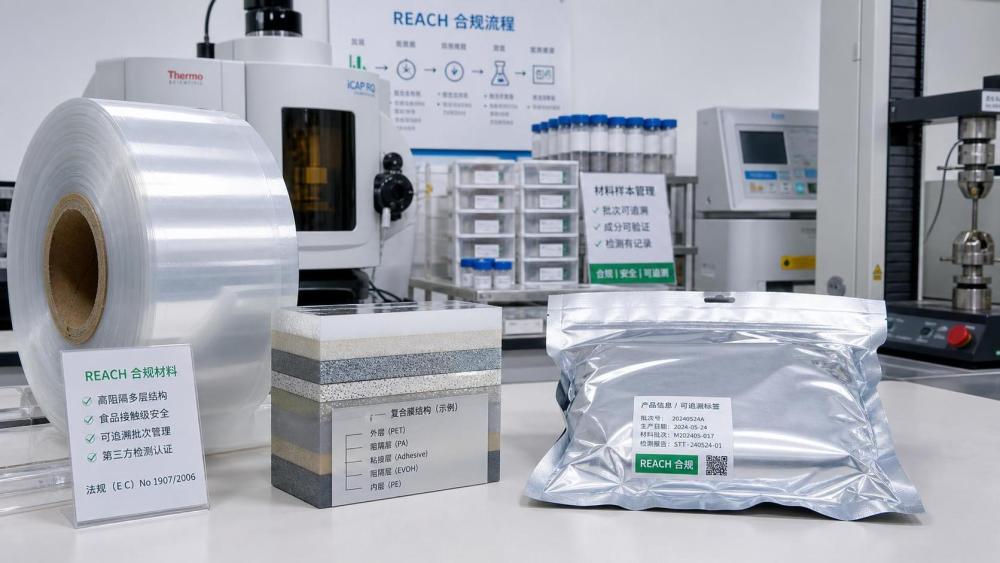
Barrier targets can change the material decision
A chemically documented film still fails the application if its barrier profile does not protect the product. Oxygen, moisture, aroma, light, grease, and chemical resistance are separate properties. A film that performs well against water vapor may offer limited protection against oxygen. A clear high-barrier structure may lose value if flex-cracking damages a coated layer during pouch forming or distribution. The selected film must be evaluated as a package structure under the actual storage and handling environment.
Barrier data should never be read without its test conditions. Temperature, relative humidity, test direction, film thickness, and whether the result represents a flat specimen or a converted package all affect interpretation. A quoted transmission value for an unprinted web does not establish the result for a gusseted bag with seals, folds, and handling damage. The gap is especially important when the barrier layer is brittle, very thin, or sensitive to humidity.
Conversion can alter both performance and documentation
Many packaging films become finished packaging only after printing, lamination, slitting, pouch making, thermoforming, or application of labels and closures. Each step introduces a potential mismatch between a compliant incoming film and a finished pack with incomplete traceability.
Corona or plasma treatment is often used to improve ink or adhesive anchorage. Treatment level can decline during storage, and attempts to recover adhesion through a different primer or adhesive may change the documented material structure. Similarly, changing ink systems to solve rub resistance, color density, or curing issues can affect chemical documentation even when the base film remains unchanged.
Heat sealing deserves separate review. Seal initiation temperature, dwell time, pressure, jaw geometry, contamination tolerance, and cooling behavior influence pack integrity. A film that seals cleanly on a development line can show narrow process latitude on a faster production line. Excessive heat can distort a thin film, weaken a barrier coating, create curl, or increase blocking. Insufficient energy can produce seals that look closed but open under peel, drop, or internal pressure.
For laminated structures, bond development time and storage conditions need to be incorporated into the schedule. Early trials can be misleading if the adhesive has not reached its intended cure state. Delamination, odor, haze, or seal contamination may emerge later, particularly where the packaged product contains oils, alcohols, volatile components, or aggressive cleaning residues.
Traceability needs to survive routine change
The practical value of REACH-compliant films comes from linking the declaration to the specific package configuration. That link often breaks during ordinary operational changes: a substitute roll is accepted to keep a line running, a converter changes a sub-supplier, a printed design moves to another site, or an approved film is combined with a new label stock. None of these events is unusual, but each can invalidate assumptions made during the original material review.
A controlled package record should distinguish between critical and noncritical changes. A width adjustment within an approved construction may only require process confirmation. A shift from one sealant formulation to another, an increase in recycled content, a different adhesive chemistry, or a new pigment source should trigger a targeted reassessment. The purpose is not to repeat every test for every change. It is to identify which property or compliance statement was tied to the original formulation.
- Film identity: retain the supplier grade, layer structure, nominal thickness, treatment side, and revision of the supporting declaration.
- Converted components: record the inks, coatings, adhesives, labels, closures, and any added protective layers included in the final pack.
- Process window: capture the settings that directly affect seal strength, web tension, cure, and appearance when these factors are part of approval.
- Change route: define how a proposed substitution is reviewed before material reaches filling or packing operations.
Recycled-content films require an additional layer of control because feedstock variability can influence odor, color, gels, contamination risk, and additive history. A recycled film may be appropriate for outer packaging or non-contact protective uses, yet its suitability should be decided from the exact layer position and exposure scenario rather than from recycled content alone. The same reasoning applies to bio-based or biodegradable films: the feedstock claim does not establish barrier performance, heat resistance, or chemical compliance for a specific packaging duty.
Separate chemical compliance from product-contact suitability
A frequent release error is assuming that REACH compliance proves suitability for any regulated package. It does not answer every product-contact question. A package intended for food or pharmaceuticals may need specific evidence for the relevant contact conditions, including the product type, storage period, temperature exposure, and the side of the film that contacts the contents. A film used only as an outer overwrap has a different exposure logic from a heat-seal layer directly facing the product.
Industrial applications have their own distinction. A protective film used on coated metal, electronic assemblies, or automotive parts may need low residue, controlled static behavior, clean removal after aging, and compatibility with coated surfaces. These are functional requirements. A REACH declaration does not predict whether adhesive residue will remain after heat exposure or whether a release coating will transfer to a sensitive surface.
Where the product contains solvents, plasticizers, oils, cleaning chemicals, or active ingredients, compatibility work should use representative contact conditions. Visual inspection alone is weak evidence. Swelling, embrittlement, loss of print adhesion, seal degradation, odor change, or stress cracking can develop without an immediate visible defect. The test plan should follow the actual contact side, anticipated temperature range, and duration rather than a generic exposure setup.
Specification language that prevents avoidable ambiguity
A functional specification should state the packaging duty first, then define the material evidence required to support it. Calling for a “REACH-compliant barrier film” leaves too much open: barrier against what, at what conditions, in which layer arrangement, and with which converted components? Better wording identifies the intended package construction, contact relationship, critical barrier property, seal method, appearance limits, and document-control expectation.
It is useful to state whether a declaration must apply to the film as supplied, the final converted structure, or both. Where printing and lamination are external operations, require the converter to maintain the component declarations that support the finished article. This avoids a late-stage situation in which the base film is documented but the finished pack cannot be substantiated.
Acceptance criteria should also reflect the risk of the application. A protective overwrap for a robust industrial item may prioritize clean removal and puncture resistance. A barrier pouch for a sensitive formulation may require tighter control of seal integrity, layer continuity, and product compatibility. Treating both packages as equivalent because both use a compliant film can lead to unnecessary testing in one case and insufficient evidence in the other.
REACH-compliant films fit regulated packaging best when they are specified as one controlled element of the finished pack: chemically documented, functionally proven for the relevant environment, and protected from unreviewed material changes. That approach keeps compliance evidence connected to the package that actually enters service.
Have questions about this sector analysis, or seeking best practices specific to your niche? Drop us a line below and let the senior consultants at APIM assist you.
We respect your privacy. Your information is strictly confidential.
Related News
- 00
0000-00
How does washing affect contamination in post-consumer recycled PP resins? - 00
0000-00
How does feedstock affect depolymerization equipment selection? - 00
0000-00
US Sets 213.44% Preliminary Antidumping Deposit on Chinese PTMEG - 00
0000-00
When should epoxy be used as a thermal interface material for semiconductors? - 00
0000-00
US Midterm Results Unlikely to Quickly Shift Recycled Plastics Market or Legislation