




What to Check Before Choosing a Flame Retardant Materials Manufacturer
Why does the choice of a flame retardant materials manufacturer matter so much?
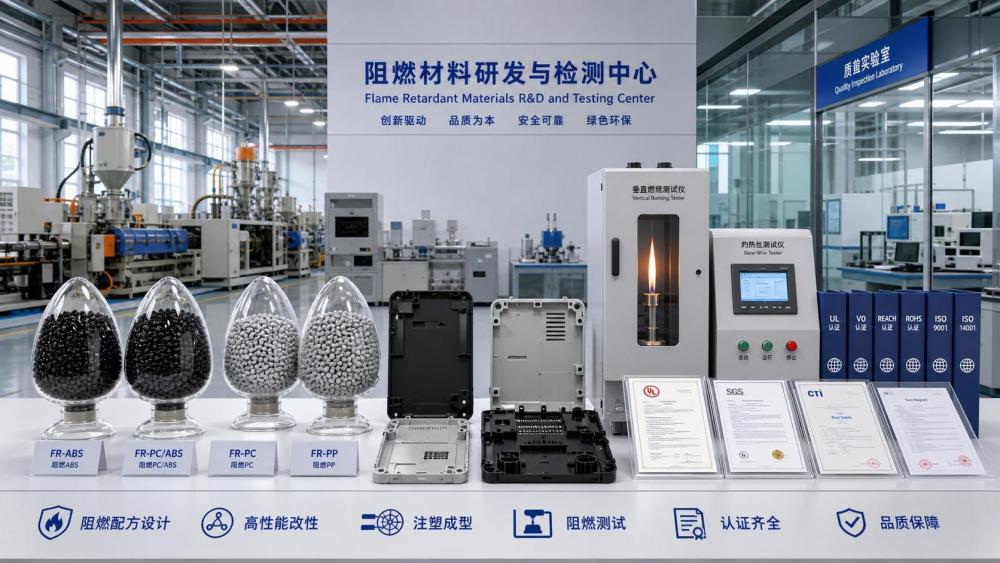
A flame retardant material is rarely a simple commodity. In many products, it affects safety, compliance, processing behavior, appearance, and warranty risk at the same time.
That is why choosing a flame retardant materials manufacturer should start with performance logic, not with a price sheet.
In electrical housings, connectors, automotive interiors, battery-related parts, appliances, and industrial equipment, the compound must do more than resist ignition.
It may also need dimensional stability, impact strength, color control, low warpage, and reliable molding behavior across different production runs.
A weak supplier match often appears later as failed UL testing, unstable lead times, scrap during molding, or expensive reformulation work.
A stronger flame retardant materials manufacturer usually brings formulation depth, compounding discipline, certification support, and better control of batch-to-batch variation.
This matters even more in advanced polymers and modified compounds, where additive selection and extrusion control directly influence final part behavior.
That is also why platforms such as APIM are useful in early supplier screening. They help connect resin family, processing method, application risk, and supply chain reality.
What should be checked first: certifications, resin base, or application fit?
The practical answer is application fit first, then certification proof, then processing and supply details.
A supplier may offer a certified grade, but that does not guarantee it will survive your wall thickness, mold design, thermal load, or chemical exposure.
A good starting discussion with a flame retardant materials manufacturer should include five points.
- The resin base: PC, PA, PBT, ABS, PP, TPU, or another polymer family.
- The target flame standard: UL 94, glow wire, automotive, railway, or customer-specific internal specs.
- The required thickness and part geometry.
- The actual process route: injection molding, extrusion, sheet, film, or overmolding.
- The service environment: heat, humidity, electrical load, chemicals, or outdoor exposure.
In real sourcing work, resin selection and flame package cannot be separated. A V-0 rating in one polymer does not mean the same mechanical and cosmetic results in another.
For example, a flame-retardant polycarbonate may support dimensional stability and electrical safety, while a modified polyamide may offer better strength-to-weight balance.
Needle-flame resistance, CTI performance, halogen-free requirements, and low smoke expectations can also change the best supplier choice.
The supplier that asks detailed application questions early is often the one worth testing further.
How can you tell whether a flame retardant materials manufacturer has real technical capability?
The quickest signal is whether the discussion goes beyond brochures and into formulation behavior, compounding control, and processing limits.
A capable flame retardant materials manufacturer should explain not only what the grade passes, but also why it performs that way.
Ask how the company manages dispersion, moisture sensitivity, filler distribution, color consistency, and regrind restrictions.
Ask what happens to impact strength after adding flame retardants. Ask what processing window is recommended and which defects are most common.
In advanced compounding, screw design, feeding precision, melt temperature, filtration, and pelletizing quality all influence consistency.
These are not small factory details. They affect molding stability, certification repeatability, and yield on the production floor.
The table below helps separate a trading-style offer from a technically reliable manufacturer.
This kind of check is especially useful when comparing suppliers across engineering plastics, modified compounds, and electrical applications.
Is low price ever enough when comparing suppliers?
Usually not. The lower material price can disappear quickly once hidden costs enter the project.
Common hidden costs include trial failures, excess drying time, mold deposits, slower cycle time, unstable color, and rejected lots after compliance review.
A cheaper flame retardant materials manufacturer may also have longer recovery time when a batch issue appears.
That delay can be more expensive than the material itself, especially for export products and regulated assemblies.
A better comparison method is total sourcing cost over the full program cycle.
- Unit price per kilogram or per part.
- Expected scrap rate during startup and stable production.
- Testing and recertification risk.
- Lead time reliability and safety stock pressure.
- Engineering support during design changes.
- Long-term reformulation risk if regulations shift.
This is where market intelligence becomes practical. APIM often frames material choices in terms of performance, processing, and supply chain tradeoffs, which helps avoid price-only decisions.
In many cases, a slightly higher-priced supplier reduces overall program cost because fewer downstream corrections are needed.
What documents and supply-chain checks should never be skipped?
This is often where sourcing reviews become either disciplined or risky.
Before approving a flame retardant materials manufacturer, confirm whether the documents match the exact grade, color, and production location being quoted.
Do not assume one family certificate covers every modified version.
The minimum review package usually includes:
- TDS and SDS for the exact commercial grade.
- UL file references or equivalent flame test records.
- RoHS, REACH, and other restricted substance declarations where required.
- Lot traceability method and certificate of analysis format.
- Change notification policy for raw materials or formulation updates.
- Production site information, backup capacity, and normal lead time.
For export markets, regulatory alignment can be as important as physical performance. A material that molds well but lacks document discipline can still delay a launch.
It is also worth checking whether the supplier depends heavily on one additive source. That creates exposure during shortages or policy-driven changes.
Where recycled content, halogen-free targets, or sustainability commitments matter, the supply chain review should go one step deeper.
Material traceability, consistent incoming quality, and end-use durability need to stay aligned. Otherwise, a compliance-friendly claim may hide a processing problem.
What are the most common mistakes before selecting a flame retardant materials manufacturer?
The first mistake is treating flame resistance as the only decision point.
In practice, flame performance must coexist with mechanics, appearance, processability, and supply continuity.
Another common mistake is approving a grade after lab data review without production-scale trials.
Small test conditions may not reveal moisture sensitivity, screw wear, surface defects, or long-run color drift.
A third mistake is missing the difference between a compound supplier and a true formulation partner.
When application demands change, a stronger flame retardant materials manufacturer can often fine-tune the balance between safety and manufacturability.
A final mistake is skipping cross-functional validation. Material selection affects tooling, processing, testing, logistics, and customer approval at the same time.
A short decision checklist can keep the process grounded.
So, how should the final decision be made?
The best final decision usually comes from a short list built around fit, proof, and resilience.
Fit means the material works in the real application, not just in theory. Proof means the documents and test records are complete and traceable.
Resilience means the flame retardant materials manufacturer can keep quality and lead time stable when demand, regulations, or formulation inputs change.
A practical next step is to score suppliers across technical capability, compliance support, commercial terms, and supply continuity.
Then run targeted trials on the most critical grades, especially where heat exposure, electrical safety, or thin-wall performance is sensitive.
Where the market is complex, structured reference sources such as APIM can help compare resin systems, modified compounds, processing implications, and supplier positioning more clearly.
That approach keeps the selection process tied to measurable risk, real cost, and long-term manufacturability rather than short-term price alone.
Have questions about this sector analysis, or seeking best practices specific to your niche? Drop us a line below and let the senior consultants at APIM assist you.
We respect your privacy. Your information is strictly confidential.
Related News
- 00
0000-00
Do polyolefin hot melt adhesives bond well to polyethylene? - 00
0000-00
Korean Study Finds PLA Barely Degrades in Landfill After 320 Days - 00
0000-00
How to assess batch consistency from a thermal potting compounds supplier - 00
0000-00
How much weight can carbon fiber reinforced plastics save in cars? - 00
0000-00
Switching from PS to ABS Sheet Extrusion: Equipment Checks