




What REACH documentation should a polymer compounds supplier provide?
What REACH documentation should a polymer compounds supplier provide?
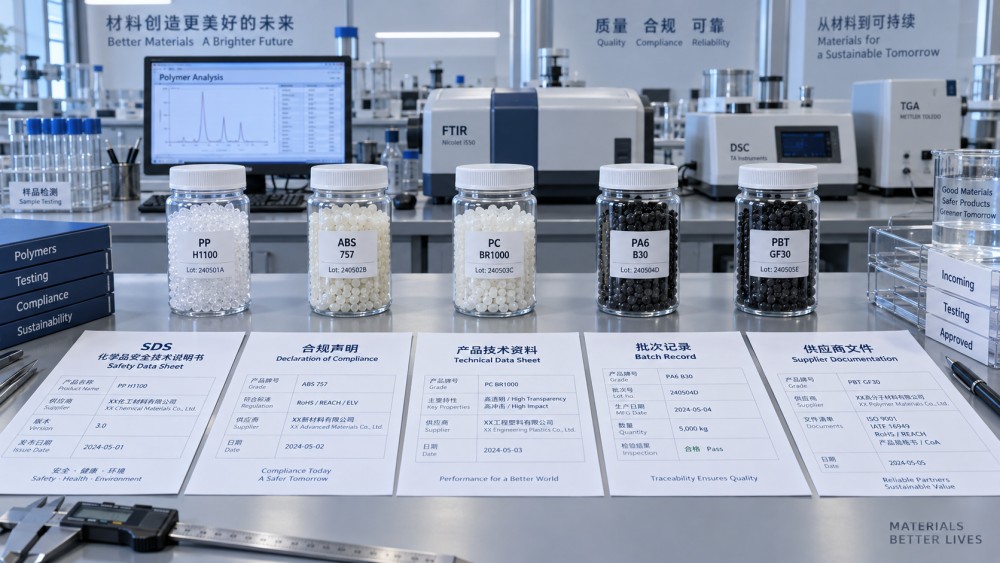
A missing or outdated REACH document can delay material approval and leave quality and safety teams unsure whether a compound meets applicable requirements. The difficulty is that there is no single document that proves everything. A safety data sheet, an SVHC declaration, and a registration statement answer different questions.
A polymer compounds supplier should provide the safety information legally required for the supplied material, together with grade-specific evidence supporting relevant substance restrictions, Candidate List status, and registration obligations. Some records are mandatory under defined conditions; others are contractual tools that make compliance easier to verify.
The review must connect three things: the exact compound purchased, the supplier’s regulatory role, and the intended processing and end use. A generic “REACH compliant” certificate rarely establishes that connection.
Start with the material and the supply-chain role
EU REACH, Regulation (EC) No 1907/2006, regulates substances on their own, in mixtures, and in articles. Compounded polymer pellets are generally supplied as mixtures, rather than articles. A molded component or finished film may instead qualify as an article because its shape, surface, or design determines its function more than its chemical composition.
This distinction changes the documentation duties. Article 33 communication for Candidate List substances in articles is not the same as the information requirements for a pellet mixture. Do not apply an article declaration to a compound without checking its scope.
Also establish who places the material on the EU/EEA market. An EU compounder, distributor, importer, and non-EU manufacturer have different responsibilities. If an overseas manufacturer uses an Only Representative, the buyer should confirm whether the relevant substances, imported quantities, and supply chain are covered. A non-EU supplier’s assurance alone does not remove an EU importer’s obligations.
Keep market scope explicit: EU REACH documentation does not automatically establish compliance with UK REACH or other national chemical regimes.
Which documents are mandatory, and which support approval?
Use the following distinction when building a supplier approval file. “Useful” does not mean optional for your purchasing process; it means REACH does not prescribe that particular certificate format for every compound.
Review the SDS as operating information, not a badge
Where required, the SDS must follow REACH Annex II, as amended by Regulation (EU) 2020/878. It should identify the supplied product and responsible supplier and be provided in the official language required by the destination Member State, unless that state provides otherwise.
Cross-check the product identifier against the purchase order and packaging. Review Section 1 for identified uses, Section 2 for classification, Section 3 for reportable constituents, Section 8 for exposure controls, and Section 15 for regulatory information. Section 10 is particularly relevant when processing heat could create decomposition hazards.
An SDS is not a full formulation disclosure. Section 3 follows disclosure rules, so an ingredient’s absence from that section does not prove its absence from the compound. Equally, “not classified as hazardous” does not automatically mean that no SDS or other safety communication is required.
REACH does not impose a universal annual SDS expiry date. Updates are required when relevant new information becomes available, including information affecting risk-management measures, and following specified authorization or restriction decisions. A recent date is useful, but the content and update basis matter more.
Ask what an SVHC declaration actually establishes
A useful declaration identifies the grade, covered color or formulation variants, issue date, and Candidate List publication date used for the assessment. It should state whether listed substances are present and clarify the concentration threshold behind the claim.
Avoid accepting “SVHC-free” without qualification. Does it mean no intentional addition, no detected substances within a test panel, or no Candidate List substances above a stated concentration? Those are materially different claims.
Candidate List inclusion does not itself create a general ban. For articles containing a Candidate List substance above 0.1% weight by weight, Article 33 requires sufficient information for safe use, including at least the substance name. In complex objects, the threshold applies to the constituent articles that retain their article status, not simply to the assembled product’s total weight.
For pellet mixtures, assess the applicable SDS and supply-chain communication rules instead of treating Article 33 as the direct legal basis. If the compound becomes a finished article, its composition data can help the converter assess subsequent obligations, including SCIP reporting where applicable. SCIP arises under waste legislation and is not replaced by a REACH declaration.
Restrictions and registration require separate checks
An SVHC declaration cannot substitute for an Annex XVII restriction assessment. Restrictions may address substances that are not on the Candidate List, and their conditions can depend on concentration, application, exposure, or whether the material enters a particular consumer product.
Ask the supplier to identify relevant restriction entries and explain the basis for its conclusion. For a flexible compound, plasticizers may deserve attention; for recycled material, legacy additives and contamination may require closer review. These are screening priorities, not assumptions that either material category is noncompliant.
Where an Annex XIV substance is involved, authorization needs a separate assessment of the use and supply-chain circumstances. A broad compliance statement should not conceal an unresolved authorization question.
Registration is another distinct issue. Polymers are generally exempt from registration under REACH, but qualifying monomers and other substances used to manufacture them may require registration. Additives and other constituent substances also need an appropriate regulatory basis. The compound mixture itself does not receive a single REACH registration number.
Request confirmation that relevant obligations have been addressed by the appropriate legal entities, with registration information where applicable or an explanation of exemptions relied upon. A registration number is not an approval of every use. Where exposure scenarios or safe-use information are supplied, check that they cover your processing conditions; not every compound SDS needs an exposure-scenario annex.
Connect the paperwork to the exact supplied grade
A declaration for natural polyamide should not automatically cover a flame-retardant, glass-filled black version. Pigments, stabilizers, reinforcement treatments, and flame-retardant packages can change the substance profile even where the base polymer is unchanged.
The approval chain should be traceable: purchase specification, supplier grade and variant, applicable document revision, and delivered batch. A family-level declaration can work if it clearly defines the grades covered and the supplier has a defensible assessment behind it.
Recycled compounds need particular attention to feedstock controls. Recycled content does not create a blanket exemption from REACH duties. Ask how the supplier manages input variability, screens relevant legacy substances, and determines when analytical testing is necessary. Where a recovered-substance registration exemption is claimed, request its specific basis rather than assuming that all recycled material qualifies.
Testing should answer a defined question. A laboratory report covering selected substances cannot demonstrate absence of every regulated substance. Check the sample identity, analyte list, detection limits, methods, and sampling date. Formulation knowledge and upstream declarations remain important; testing complements them rather than replacing them.
Resolve contradictions before releasing the material
Suppose a declaration reports no Candidate List substances above 0.1%, while the SDS lists a substance that appears on that list. This is not automatically a breach: concentration ranges, document dates, or product scope may explain the difference. It is, however, a reason to pause approval and obtain a documented explanation.
The same applies when a distributor provides an upstream producer’s statement without connecting it to its own product code. Request that link. Confidentiality may justify withholding a complete recipe, but it does not remove applicable safety-information duties.
Build a controlled approval file, not a folder of certificates
Before approval, record the document owner, covered grades, intended market and use, unresolved conditions, and review triggers. Useful triggers include Candidate List changes, relevant restriction amendments, formulation changes, new feedstock sources, and a change in importer or Only Representative coverage. Verify regulatory references against current ECHA information and the applicable legal text on EUR-Lex.
Keep technical and regulatory evidence separate but connected. A certificate of analysis supports batch acceptance; a technical data sheet supports material selection. Neither establishes REACH compliance. Likewise, RoHS, food-contact, and automotive declarations address different requirements and cannot replace the relevant REACH assessment.
Global Advanced Polymers & Industrial Materials Intelligence Network (APIM) connects material performance, processing conditions, and supply-chain questions across engineering plastics, modified compounds, and recycled polymers. That perspective is useful here: regulatory paperwork must describe the material actually entering the process, not merely its resin family.
The practical approval question is therefore specific: does the evidence cover this grade, from this supply chain, for this use, under the applicable requirements? If one of those links is missing, ask the polymer compounds supplier to close that gap before releasing the material.
Have questions about this sector analysis, or seeking best practices specific to your niche? Drop us a line below and let the senior consultants at APIM assist you.
We respect your privacy. Your information is strictly confidential.
Related News
- 00
0000-00
How does washing affect contamination in post-consumer recycled PP resins? - 00
0000-00
How does feedstock affect depolymerization equipment selection? - 00
0000-00
US Sets 213.44% Preliminary Antidumping Deposit on Chinese PTMEG - 00
0000-00
When should epoxy be used as a thermal interface material for semiconductors? - 00
0000-00
US Midterm Results Unlikely to Quickly Shift Recycled Plastics Market or Legislation