




Vietnam Tightens PCR Plastic Pellet Import Documents
On July 12, 2026, a new rule from Vietnam’s Ministry of Industry and Trade took effect for imported PCR plastic pellets, drawing immediate attention across recycled PET, PP, and PE trade flows between China and Vietnam. The change matters not only because it adds document requirements tied to REACH and RoHS compliance, but also because it is already affecting cargo release at Ho Chi Minh City port and extending procurement decisions, making compliance documentation a near-term operational issue for importers, suppliers, and supply chain teams.
What the new requirement now covers
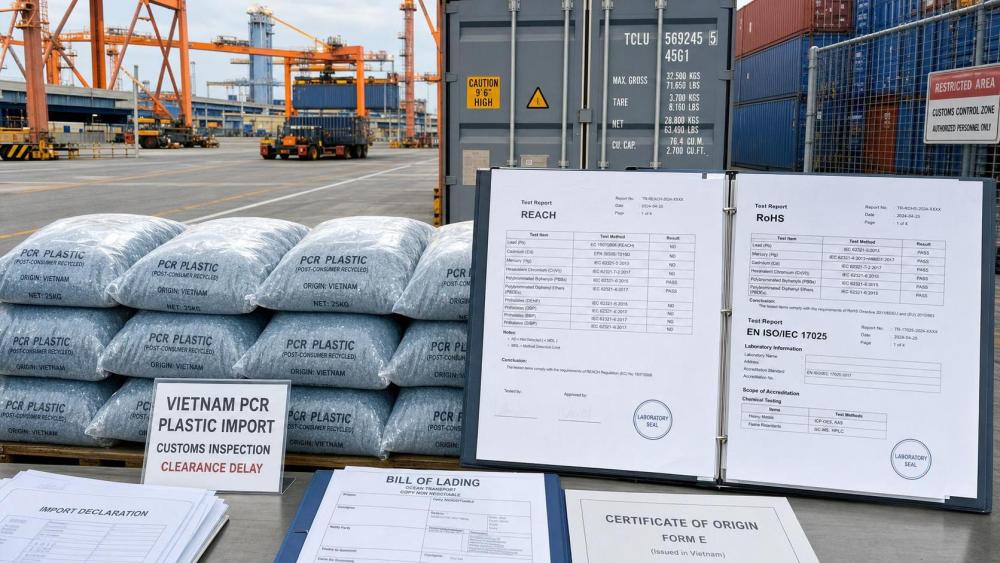
Based on the provided information, Vietnam’s new rule became effective on July 12, 2026 and applies to all imported PCR plastic pellets, including recycled PET, PP, and PE materials.
The rule requires each import shipment to be accompanied by a REACH/RoHS declaration of conformity from the manufacturing enterprise in the country of origin, identified here as China, together with a third-party test report issued by a laboratory accredited under EN ISO/IEC 17025.
The same information indicates that multiple containers of Chinese PCR pellet cargo have already been held at Ho Chi Minh City port. Importers are urgently asking suppliers to submit missing documents, and procurement decision cycles have lengthened to 14 to 21 days.
Where the pressure is likely to appear first
For import traders, the issue shifts from pricing to file readiness
From an industry perspective, import-focused trading companies are likely to feel the impact first because the rule directly affects customs-facing shipment documentation. The immediate pressure point is whether conformity declarations and third-party test reports are complete and acceptable before cargo arrival or clearance. What deserves closer attention is that procurement timing has already been extended, which can slow buying decisions even before a shipment is booked.
For Chinese pellet suppliers, compliance proof becomes part of delivery capability
Analysis shows that Chinese PCR pellet producers supplying Vietnam may now be assessed not only on material availability and price, but also on their ability to provide REACH/RoHS declarations and testing reports from EN ISO/IEC 17025 accredited laboratories. In practical terms, documentation preparedness becomes part of supplier qualification and may influence whether orders move forward on the original timeline.
For processors and manufacturers, raw material continuity becomes less predictable
Companies that rely on imported recycled PET, PP, or PE pellets for processing or manufacturing may face indirect disruption if upstream cargo is delayed or procurement approval takes longer. The main area to watch is production planning: even when material demand remains unchanged, document-related delays can affect arrival timing and internal scheduling.
For logistics and supply chain service teams, exceptions management rises
Observably, logistics coordinators, customs support teams, and other supply chain service providers may face more urgent requests tied to document checks, shipment status follow-up, and communication between importer and supplier. The operational burden is likely to concentrate around stalled cargo, missing paperwork, and revised lead-time expectations.
What companies should review now
Check whether document ownership is clearly assigned
Analysis shows that one immediate practical issue is responsibility: companies should verify who is expected to prepare, issue, collect, and review the REACH/RoHS declaration and the third-party test report before shipment. Where responsibility is unclear, delays can shift from customs clearance to order confirmation.
Separate policy wording from execution readiness
What deserves closer attention is the gap between a formal requirement and the ability to execute it consistently in real transactions. A supplier may be commercially ready to ship, but the shipment can still face delay if supporting files are incomplete, outdated, or not aligned with the importer’s document review process.
Reassess timing assumptions in purchasing and delivery
Given that procurement decision cycles have already extended to 14 to 21 days, companies involved in Vietnam-bound PCR pellet trade should treat lead-time assumptions with caution. Observably, this affects not only ordering decisions but also customer communication, shipment scheduling, and internal delivery commitments.
Keep watching for any further clarification
From an industry perspective, businesses should continue monitoring whether there are further official clarifications, procedural interpretations, or practical adjustments in how the rule is applied. At this stage, the confirmed facts point to immediate enforcement pressure, but the operational standard that market participants ultimately work to may become clearer only after more implementation experience.
Why this looks bigger than a routine paperwork update
Analysis shows that this development should not be read as a routine administrative change alone. It connects market access for PCR plastic pellets to compliance evidence from the producing factory and to third-party laboratory validation. That makes documentation quality a more visible part of cross-border recyclate trade execution.
It is more appropriate to understand this as a concrete near-term disruption with possible longer-term signaling value. The immediate result is already visible in held cargo and longer procurement cycles. The broader meaning still needs continued observation, especially around whether buyers begin treating documentation readiness as a standard sourcing threshold rather than a shipment-by-shipment exception.
How the market may best read this for now
At this point, the most balanced reading is that the rule has already moved beyond policy language into operational impact. The confirmed facts do not support broad conclusions about lasting market restructuring, but they do support a clear conclusion that PCR pellet trade into Vietnam now requires closer document discipline from both importers and Chinese suppliers.
Current industry attention is therefore best placed on execution: file completeness, supplier responsiveness, procurement timing, and shipment planning. It is more appropriate to understand this as an active compliance-driven trade development that deserves ongoing monitoring, rather than as a one-day customs incident or a fully settled long-term market outcome.
Basis of this report and what still needs verification
This article is based on the user-provided news title, event date, and event summary concerning Vietnam’s July 12, 2026 rule on imported PCR plastic pellets and the resulting cargo delays and procurement changes.
For this type of development, relevant source categories would usually include official government notices, company disclosures, industry association updates, authoritative media reporting, and standard-related documentation. No specific official source link was provided in the input, so the exact official reference link remains unconfirmed here and should continue to be verified.
Further follow-up should focus on whether additional official wording, enforcement clarification, or document interpretation emerges after implementation, and whether the observed port delays and extended procurement timelines persist.
Have questions about this sector analysis, or seeking best practices specific to your niche? Drop us a line below and let the senior consultants at APIM assist you.
We respect your privacy. Your information is strictly confidential.
Related News
- 00
0000-00
How does feedstock affect depolymerization equipment selection? - 00
0000-00
US Sets 213.44% Preliminary Antidumping Deposit on Chinese PTMEG - 00
0000-00
When should epoxy be used as a thermal interface material for semiconductors? - 00
0000-00
US Midterm Results Unlikely to Quickly Shift Recycled Plastics Market or Legislation - 00
0000-00
When should you choose carbon fiber over glass fiber composites for lightweight parts?
Tag