




UL94 Encapsulation Materials: Ratings, Limits, and Use Cases
Why do UL94 encapsulation materials matter beyond a pass or fail result?
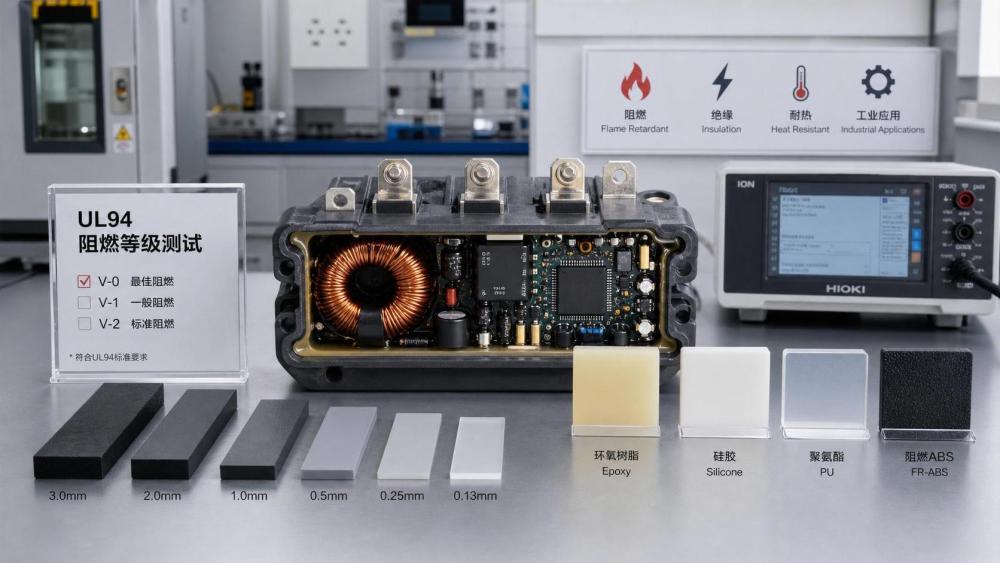
Encapsulation is often treated as a protective layer. In reality, it is also part of a product’s fire behavior, insulation stability, and compliance record.
That is why UL94 encapsulation materials deserve closer review than a simple test label. A V-0 rating may look reassuring, but context still matters.
The material sits around heat sources, terminals, coils, chips, or connectors. If it cracks, shrinks, drips, or carbonizes, the risk changes quickly.
In practical terms, the question is not only whether the material extinguishes. The real question is whether it stays reliable after thermal aging, humidity, vibration, and processing variation.
This is especially relevant in electronics, electrical insulation, automotive modules, power devices, potting systems, and compact industrial assemblies.
Across advanced polymers and industrial materials, APIM often frames flame performance this way: certification data is useful, but application logic is what makes it decision-ready.
What does UL94 actually measure in encapsulation materials?
UL94 measures how a plastic or polymer sample behaves when exposed to a controlled flame under defined test conditions.
For UL94 encapsulation materials, the common results include HB, V-2, V-1, and V-0. Some foamed materials may also be evaluated under horizontal or specialized methods.
The vertical ratings are usually the most discussed. They tell you how long the sample burns, whether it drips, and whether the drips ignite cotton below.
A simplified comparison helps clarify the difference:
Still, UL94 does not measure everything. It does not by itself confirm long-term dielectric strength, chemical resistance, adhesion to components, or mechanical durability after cure.
That gap is where many selection mistakes begin. A good rating is necessary in some projects, but rarely sufficient on its own.
If a material is V-0, is it automatically suitable for potting or encapsulation?
No. This is one of the most common misunderstandings around UL94 encapsulation materials.
A V-0 result only confirms flame behavior under the test setup. It does not guarantee process compatibility or stable performance in an assembled product.
For example, some flame-retardant systems affect viscosity, filler loading, cure shrinkage, or thermal conductivity. Those changes can create voids, stress, or weak adhesion.
In compact electronics, even a small void can trap heat. In transformers or sensors, resin shrinkage may stress wires or fragile internal joints.
A better evaluation path is to review the material from four angles at the same time:
- Flame rating at the tested thickness
- Electrical and thermal performance during actual service
- Processing behavior, including cure profile and moisture sensitivity
- Mechanical stability after aging, cycling, or chemical exposure
This is also why APIM places material data beside process data. In flame-retardant compounds, formulation and processing rarely act independently.
Which limits should be checked before approving UL94 encapsulation materials?
The practical limits are usually more important than the headline rating. Many approvals fail because those limits were reviewed too late.
One critical limit is thickness. UL94 ratings are tied to specific sample thicknesses. A material rated V-0 at 3.0 mm may not keep that rating at 1.0 mm.
Another limit is operating temperature. Encapsulation materials can harden, soften, discolor, or lose dielectric reliability after prolonged heat exposure.
Chemical exposure also matters. Flux residues, cleaners, oils, battery electrolytes, and humidity can alter surface behavior and flame performance over time.
Then there is process variation. Mix ratio error, incomplete degassing, filler settlement, and cure inconsistency can move a lab-qualified resin away from production reality.
A quick approval table makes these checkpoints easier to organize:
When these limits are documented early, material comparison becomes much more reliable and supplier discussions become more technical and less reactive.
Where are UL94 encapsulation materials most often used, and what changes by application?
The same UL94 encapsulation materials can behave very differently depending on the device, resin chemistry, and heat profile.
In power electronics, the focus is often flame resistance plus thermal management. A material may need both V-0 performance and acceptable heat dissipation.
In transformers and coils, insulation endurance and crack resistance become more critical. Here, thermal cycling can be more damaging than short flame exposure.
For automotive electronics, vibration, fluid exposure, and changing temperatures often shape the selection more than lab flame data alone.
Sensors and miniature modules usually add another constraint: low-stress encapsulation. A hard flame-retardant resin may protect fire safety but damage delicate internal structures.
In LED drivers, battery systems, and control boards, designers also watch color stability, outgassing, and compatibility with neighboring plastics or adhesives.
That broader view fits the industrial materials landscape APIM tracks. Polymer safety, compounding quality, bonding behavior, and end-use conditions usually intersect in one decision.
What are the most common mistakes when comparing UL94 encapsulation materials?
The first mistake is comparing only the rating line. Two V-0 materials can differ sharply in viscosity, thermal conductivity, moisture uptake, and adhesion.
The second mistake is ignoring the tested form. Was the result based on molded plaques, cast samples, or a cured system with a defined schedule?
Another issue appears during scale-up. A resin that works in prototype potting can behave differently in larger volumes because exotherm and cure uniformity change.
There is also a documentation gap in many projects. The datasheet, UL card, process window, and internal validation record are reviewed separately, not as one file set.
A more reliable comparison usually includes these questions:
- At what thickness was the UL94 rating achieved?
- Does the cured system match the intended dispensing or potting process?
- How does the material perform after heat aging and humidity exposure?
- Are there known interactions with substrates, films, or adhesive interfaces?
- Can supply consistency support repeatable flame and cure behavior?
Those questions sound basic, but they usually separate a paper-compliant material from a production-ready one.
How should the next evaluation step be structured?
Start by defining the real stress profile of the application. Heat, voltage, thickness, environment, and expected service life should be listed before material screening.
Then compare UL94 encapsulation materials using a short matrix, not a single certificate. Flame rating, process fit, electrical behavior, and aging stability should sit side by side.
It also helps to align test conditions with the actual build. Production cure cycles, part dimensions, and interface materials should be reflected in validation samples.
Where the design includes specialty films, engineering plastics, reinforced compounds, or industrial adhesives, compatibility should be checked as part of the same review.
In the end, the strongest choice is rarely the one with the simplest claim. It is the one whose UL94 rating, process window, and long-term behavior still make sense together.
That is the practical way to reduce compliance surprises, improve product robustness, and make material decisions with clearer technical evidence.
Have questions about this sector analysis, or seeking best practices specific to your niche? Drop us a line below and let the senior consultants at APIM assist you.
We respect your privacy. Your information is strictly confidential.
Related News
- 00
0000-00
How does washing affect contamination in post-consumer recycled PP resins? - 00
0000-00
How does feedstock affect depolymerization equipment selection? - 00
0000-00
US Sets 213.44% Preliminary Antidumping Deposit on Chinese PTMEG - 00
0000-00
When should epoxy be used as a thermal interface material for semiconductors? - 00
0000-00
US Midterm Results Unlikely to Quickly Shift Recycled Plastics Market or Legislation