




Reinforced Thermoplastics REACH Compliant: Key Checks Before Material Approval
Why does a reinforced thermoplastics REACH compliant claim need deeper review?
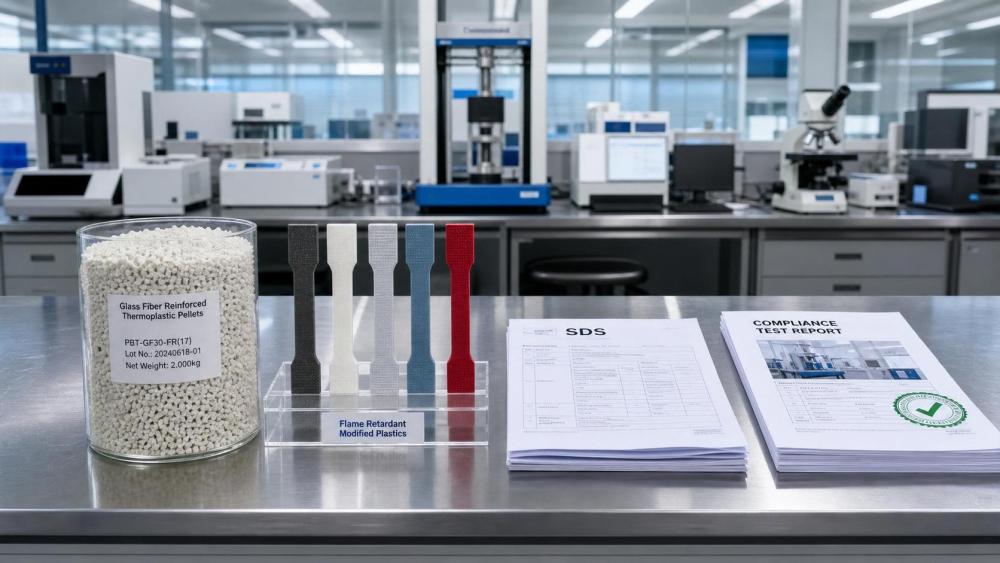
A simple declaration rarely tells the full story.
When reinforced grades enter regulated products, compliance depends on formulation detail, supplier control, and document freshness.
That is especially true for glass-fiber reinforced PA, flame-retardant PBT, mineral-filled PP, reinforced PPS, and other engineered compounds.
In practice, a reinforced thermoplastics REACH compliant statement should answer more than one question.
Does it cover the exact grade?
Does it reflect the current Candidate List?
Does it include additives, pigments, and processing aids?
Those checks matter because reinforced compounds often contain multiple inputs from different upstream sources.
A base polymer may be stable, while a flame retardant, coupling agent, lubricant, or color package creates the real exposure risk.
This is where structured material intelligence becomes useful.
APIM follows advanced polymers, modified compounds, processing systems, and industrial supply chains in a way that helps compliance reviews stay technical and practical.
Instead of treating compliance as a checkbox, the better approach is to connect chemistry, processing, application, and documentation.
What should be verified before accepting the supplier declaration?
Start with identity, not with claims.
The exact trade name, grade code, revision level, and intended use should match internal records.
A generic statement for a resin family is not enough for reinforced thermoplastics REACH compliant approval.
The next check is scope.
Some declarations cover only the supplied pellet.
Others cover article-level obligations, SVHC communication, or restricted substances.
Those are not the same.
It also helps to confirm whether the document is self-declared, third-party supported, or linked to a full material disclosure system.
More complete files usually include:
- REACH declaration with date and legal entity name
- SVHC statement aligned with the latest Candidate List
- Material Safety Data Sheet or SDS where applicable
- Change notification commitment
- Information about intentionally added substances in critical categories
Need extra caution when the grade includes recycled content, specialty pigments, halogenated systems, or externally sourced additive packages.
These areas often create documentation gaps.
Is SVHC screening enough, or do reinforced compounds need a broader check?
SVHC review is necessary, but it is rarely sufficient by itself.
A reinforced thermoplastics REACH compliant review should also consider Annex XVII restrictions, substance registration status, and foreseeable application exposure.
For example, an electrically used reinforced resin may pass a basic declaration, yet still require closer review of flame-retardant chemistry.
A food-contact adjacent component may need separate attention to additives, even if REACH paperwork looks complete.
A short comparison helps clarify what should be checked.
The broader point is simple.
Compliance is not only about what is in the compound today.
It is also about how confidently that status can be maintained.
Where do reinforced thermoplastics REACH compliant reviews usually go wrong?
The most common mistake is accepting a broad family statement for a very specific grade.
A 30% glass-fiber PA66 and a flame-retardant mineral-filled PA66 may sit in the same catalog, but their compliance profiles can differ sharply.
Another weak point is outdated paperwork.
REACH obligations evolve, and old declarations may not reflect the latest Candidate List or restriction updates.
There is also a process problem.
Material approval often sits far away from compounding reality.
If formulation changes, alternative fillers, pigments, or stabilizers may enter without immediate visibility.
That risk increases in global sourcing, toll compounding, and multi-site manufacturing.
A practical review should flag these warning signs:
- Declaration does not name the exact grade
- No mention of SVHC update timing
- No supplier commitment for composition change notice
- Different sites supply the same commercial grade
- Test reports and compliance statements use inconsistent sample references
When these signals appear together, a reinforced thermoplastics REACH compliant claim deserves escalation rather than routine approval.
How do traceability and test consistency affect final approval?
More than many teams expect.
A reinforced compound is not defined only by resin type and filler percentage.
Performance and compliance both depend on the additive system, process stability, and source control.
For example, twin-screw compounding settings can affect dispersion quality and batch uniformity.
That may not change the nominal product name, but it can affect test repeatability and confidence in the data package.
This is why technical review should connect compliance records with manufacturing logic.
APIM often frames materials through formulation design, processing control, and application behavior rather than isolated product claims.
That approach fits well here.
When traceability is weak, even valid documents become harder to trust over time.
A stronger approval file links declaration, test sample identity, manufacturing site, and revision history.
If any of those elements are missing, release decisions become vulnerable during audits, customer inquiries, or regulatory updates.
What does a practical approval workflow look like?
The useful workflow is disciplined, but not heavy.
It should separate routine grades from higher-risk materials and define when more evidence is required.
A workable sequence often looks like this:
- Confirm exact grade identity, supplier entity, and production site.
- Collect the latest REACH declaration and SVHC status statement.
- Check whether additives or reinforcements create higher restriction risk.
- Review formulation traceability and change notification commitments.
- Match compliance documents with test reports, sample IDs, and revision dates.
- Define revalidation timing for regulation updates or supplier changes.
This kind of workflow is particularly useful across automotive, electronics, industrial equipment, packaging, and specialty film supply chains.
Those sectors often rely on reinforced materials where performance pressure is high and substitution is not simple.
A reinforced thermoplastics REACH compliant claim becomes more reliable when the review path is repeatable and documented.
So when is a material ready for approval?
Usually when the claim is supported from several directions at once.
The exact grade should be identified clearly.
The declaration should be current.
SVHC and restriction checks should match the real application.
Traceability should cover formulation and source changes.
Test records should align with the same material identity.
If one of those pieces is weak, approval may still be possible, but the gap should be visible and controlled.
That is the real value of a reinforced thermoplastics REACH compliant review.
It reduces the chance of hidden compliance drift while keeping material decisions grounded in technical evidence.
As a next step, build a grade-specific checklist, align document review with formulation risk, and set a clear trigger for reapproval after regulatory or supplier change.
That creates a stronger basis for consistent approvals across advanced polymer applications.
Have questions about this sector analysis, or seeking best practices specific to your niche? Drop us a line below and let the senior consultants at APIM assist you.
We respect your privacy. Your information is strictly confidential.
Related News
- 00
0000-00
How does washing affect contamination in post-consumer recycled PP resins? - 00
0000-00
How does feedstock affect depolymerization equipment selection? - 00
0000-00
US Sets 213.44% Preliminary Antidumping Deposit on Chinese PTMEG - 00
0000-00
When should epoxy be used as a thermal interface material for semiconductors? - 00
0000-00
US Midterm Results Unlikely to Quickly Shift Recycled Plastics Market or Legislation