




REACH Compliance for Compounds: Key Testing and Documentation Steps
REACH compliance for compounds is no longer a narrow regulatory topic. For polymer processors, material suppliers, converters, and downstream product teams, it directly affects EU market access, product continuity, and documentation credibility.
That matters even more in compound-based industries, where a single formulation may include base resins, fillers, pigments, flame retardants, stabilizers, plasticizers, and processing aids from different sources.
In practice, REACH compliance for compounds depends on more than having a supplier declaration on file. It requires substance-level visibility, risk-based testing, and records that can stand up to customer review or regulatory scrutiny.
Why compounds create a different REACH challenge
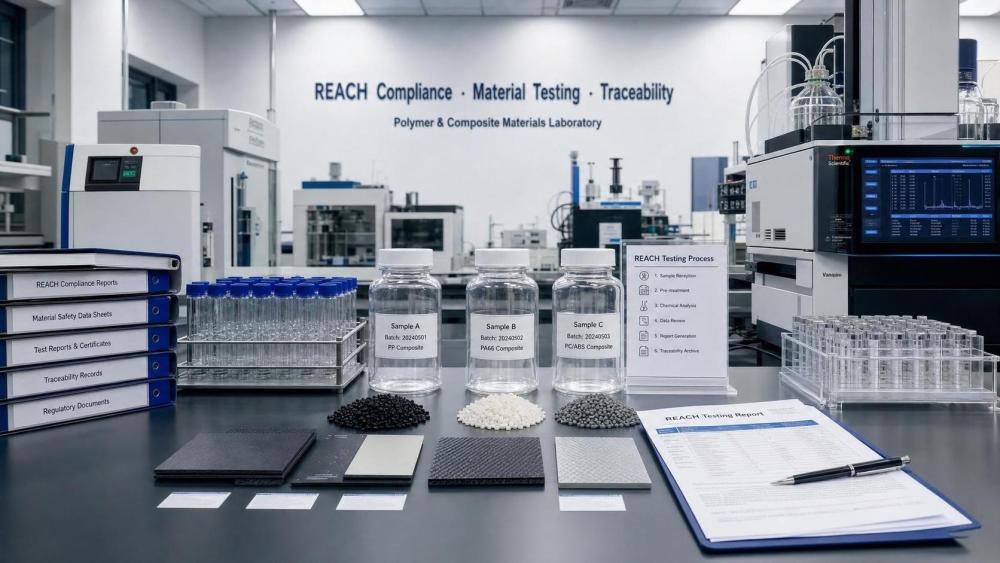
Unlike a single neat chemical product, a compound is a formulated material. It may be engineered for strength, conductivity, flame resistance, UV stability, barrier performance, bonding, or heat management.
This is common across engineering plastics, modified resins, specialty films, and industrial adhesives. Each added function can introduce extra compliance variables.
A glass-fiber reinforced PA, a flame-retardant PC blend, a conductive compound, or a recycled polymer formulation may all raise different REACH questions.
Some issues relate to registration status. Others involve substances of very high concern, restricted substances, impurities, or the quality of information received from upstream suppliers.
This is why REACH compliance for compounds should be treated as a structured material governance task, not a one-time paperwork exercise.
What REACH compliance for compounds actually covers
At a practical level, REACH compliance for compounds involves four linked questions.
- What substances are present in the formulation, including additives and known impurities?
- Are those substances registered, restricted, or listed as SVHCs under current EU requirements?
- Does the available evidence support the declared composition and safe use information?
- Can the company demonstrate ongoing control when the formulation, source, or regulation changes?
For compounds supplied into automotive, electronics, packaging, industrial machinery, or medical-related value chains, those questions often appear during qualification, audits, and customer approval stages.
Platforms such as APIM have made this topic more visible because material selection now combines performance data with compliance, traceability, and supply chain reliability.
Start with substance identification, not finished-part assumptions
The first weak point in many programs is incomplete identification. A compound may be sold under one commercial grade name, but REACH obligations are not based on trade names.
They are tied to actual substances, concentration levels, intended use, and supply chain roles.
A reliable review usually begins with the bill of substances behind the formulation. That means checking:
- polymer identity and relevant monomer information
- functional additives such as flame retardants, antioxidants, UV stabilizers, slip agents, and colorants
- fillers and reinforcements, including treated mineral or fiber systems
- residuals, by-products, and impurity profiles where applicable
- recycled feedstock inputs that may vary between lots or recovery routes
This step is especially important for modified compounds, recycled polymers, multilayer materials, and adhesive systems, where formulation complexity is higher than the external product description suggests.
Testing should answer defined compliance questions
Testing is useful, but only when it is linked to a clear decision. Broad screening without a compliance question often produces cost, delay, and ambiguous results.
For REACH compliance for compounds, testing plans are usually built around specific risks.
Common triggers for targeted testing
- supplier data is incomplete, outdated, or inconsistent
- the formulation uses additives with known regulatory sensitivity
- recycled content may introduce unknown contaminants
- a customer requires analytical confirmation beyond declarations
- the material is used in high-visibility sectors with strict audit expectations
Typical analytical focus areas
In other words, testing should reduce uncertainty. It should not replace basic formulation knowledge or supply chain communication.
Documentation is where many compliance gaps become visible
A compound can perform well in extrusion, molding, lamination, or bonding and still fail a compliance review because the document trail is weak.
For REACH compliance for compounds, documentation should be current, traceable, and consistent across internal and external records.
Core documents often include safety data sheets, supplier declarations, substance inventories, analytical reports, technical data references, and change control records.
The issue is rarely document quantity. The issue is whether the documents connect logically.
For example, a declaration may state REACH conformity, while the SDS revision date is old, the additive source has changed, and no updated SVHC review exists.
That kind of gap creates avoidable risk during customer review.
What a stronger document package looks like
- clear mapping between commercial grade and substance-level inputs
- latest supplier statements tied to current regulatory lists
- documented rationale for any testing performed or not performed
- batch or source traceability for sensitive ingredients
- version control for formulation changes and specification updates
Supply chain coordination is part of the compliance system
Compounds are rarely built from one fully transparent source. The compliance picture depends on resin producers, additive suppliers, masterbatch vendors, recyclers, toll compounders, and import channels.
That makes supply chain coordination central to REACH compliance for compounds.
A useful approach is to separate high-risk inputs from routine inputs. High-risk inputs often include flame retardants, plasticizers, pigments, recycled content, and proprietary additive packages.
Those materials deserve tighter declaration review, clearer change notification expectations, and more frequent reassessment.
This is particularly relevant in sectors covered by APIM, where advanced polymer materials are selected not only for performance, but also for long service life, safety, and global supply chain continuity.
Where practical risk tends to appear
The highest risks usually emerge when material performance priorities overshadow compliance visibility.
A formulation may be optimized for heat resistance, electrical insulation, adhesion, impact strength, optical clarity, or barrier behavior. Yet small compositional changes can shift the REACH profile.
Typical pressure points include:
- switching additive suppliers without full compliance revalidation
- using recycled inputs with unstable contaminant patterns
- relying on generic declarations for highly customized compounds
- missing updates when SVHC candidate lists change
- treating laboratory data as permanent, even after formulation revisions
These are operational issues, not abstract legal problems. They affect approvals, exports, customer confidence, and the speed of product introduction.
A workable next-step framework
For companies reviewing REACH compliance for compounds, the most useful next step is usually not more paperwork. It is a clearer internal framework.
Start by ranking formulations by regulatory sensitivity, supply chain complexity, and business criticality. Then match each group to the level of testing and documentation actually needed.
That creates a more defensible process for engineering plastics, modified compounds, films, adhesives, and recycled material systems.
It also helps separate materials that only need routine monitoring from those that require deeper analytical review and supplier engagement.
Where the material portfolio is broad, structured technical references such as APIM can support better cross-functional review by linking formulation logic, processing conditions, and compliance implications.
A sensible path forward is to recheck substance visibility, confirm document consistency, and update test priorities against current EU lists before the next customer request or market launch makes those gaps urgent.
Have questions about this sector analysis, or seeking best practices specific to your niche? Drop us a line below and let the senior consultants at APIM assist you.
We respect your privacy. Your information is strictly confidential.
Related News
- 00
0000-00
How does washing affect contamination in post-consumer recycled PP resins? - 00
0000-00
How does feedstock affect depolymerization equipment selection? - 00
0000-00
US Sets 213.44% Preliminary Antidumping Deposit on Chinese PTMEG - 00
0000-00
When should epoxy be used as a thermal interface material for semiconductors? - 00
0000-00
US Midterm Results Unlikely to Quickly Shift Recycled Plastics Market or Legislation