




REACH Compliance Documentation Checklist for Faster Material Approval
Material approval often slows down for a simple reason: the data package does not match the compliance risk. In chemicals, polymers, films, compounds, and industrial adhesives, incomplete REACH compliance documentation can hold back qualification, weaken audit readiness, and create uncertainty across sourcing, technical review, and release control.
A practical checklist brings order to that process. It helps confirm substance status, supplier declarations, SVHC communication, test evidence, and traceability before a material moves into production, pilot use, or customer-facing applications.
Why documentation has become a gate for material approval
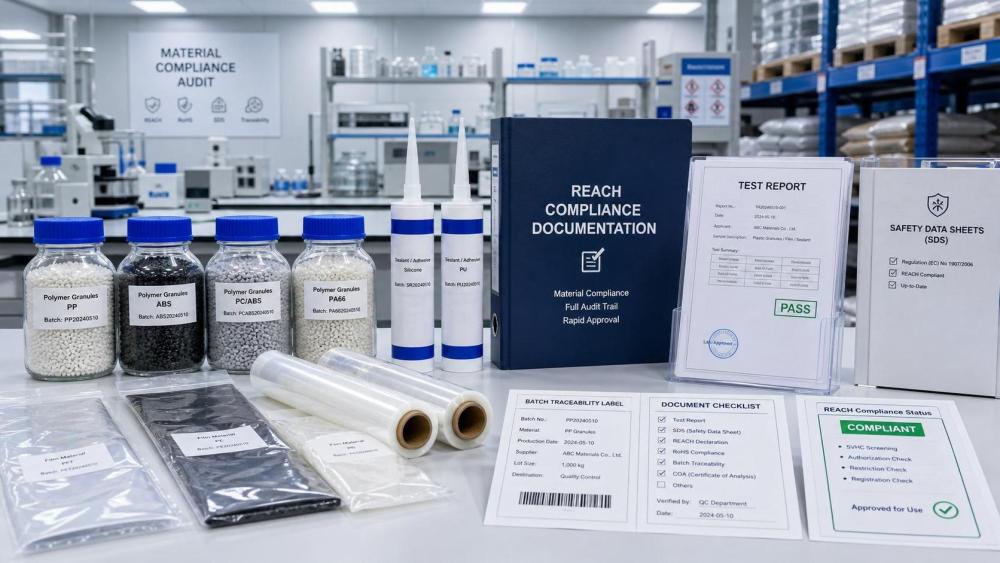
In many sectors, REACH is no longer reviewed only at contract stage. It now affects incoming material control, product change approval, export readiness, and customer declaration cycles.
That matters even more in advanced material supply chains. A reinforced polyamide, barrier film, conductive compound, or structural adhesive may include additives, pigments, fillers, or processing aids from several upstream sources.
When the documentation trail is fragmented, the review team spends time chasing basic facts. Which legal entity issued the declaration? Which grade does it cover? Does it reflect the latest SVHC list?
APIM follows these material categories closely because technical performance and regulatory transparency increasingly move together. In practice, a material that performs well but lacks reliable REACH compliance documentation is still a material approval risk.
What REACH compliance documentation should actually prove
The goal is not to collect paperwork for its own sake. Good REACH compliance documentation should answer a narrow but essential set of questions.
- What substance or mixture is being supplied, and under which exact product name or grade?
- Who is the supplier or importer responsible for the declaration?
- Does the material contain SVHCs above communication thresholds?
- Is the statement current, signed, and linked to the latest regulatory status?
- Can the document be traced to lot, formulation, or approved commercial specification?
This is especially important for engineering plastics, recycled polymers, specialty films, and formulated adhesives. These products may be exempt in one respect, but still require strong communication records, composition control, and downstream evidence.
In other words, REACH compliance documentation is less about a single certificate and more about a coherent evidence set.
Core checklist for a faster review cycle
The fastest approvals usually come from a structured first-pass review. The checklist below helps screen completeness before technical and regulatory escalation begins.
A checklist like this shortens review time because it separates missing paperwork from real compliance issues. That distinction matters when new material requests arrive under tight launch schedules.
Where problems usually appear in complex material categories
Not every material fails for the same reason. The weak points often depend on formulation complexity and the depth of the upstream supply chain.
Modified compounds and reinforced plastics
Glass fiber, flame retardants, impact modifiers, colorants, and mineral fillers may come from different suppliers. REACH compliance documentation should show whether the declaration covers the full compounded grade, not only the base resin.
Films, sheets, and multilayer structures
Barrier films, release films, and coated substrates often include tie layers, coatings, inks, or treatment chemistries. A broad statement for the visible substrate alone is usually not enough.
Industrial adhesives and sealants
These systems can involve reactive components, curing agents, solvents, or proprietary additives. Reviewers should confirm whether the REACH compliance documentation reflects the supplied form and intended use condition.
Recycled and bio-based materials
Sustainability claims do not replace compliance evidence. Recycled content can introduce variability, so traceability, screening results, and supplier control records become more relevant, not less.
How to judge whether a document set is approval-ready
A complete file is not always a reliable file. Approval readiness depends on document quality, internal consistency, and change control discipline.
- Check whether product names, grade codes, and revision numbers match across all records.
- Confirm that supplier declarations mention the latest applicable REACH status.
- Review whether test reports identify the same formulation or commercial grade under approval.
- Look for time gaps between declaration date, SDS update, and commercial shipment period.
- Verify who owns follow-up if formulation, source, or processing aid changes after approval.
This is where many organizations improve speed by using tiered review logic. Low-risk renewals can follow a shorter path, while new compounds, imported mixtures, or recycled formulations trigger a deeper check.
That approach supports both control and throughput. It avoids treating every submission as a full investigation while keeping higher-risk materials under tighter scrutiny.
Documentation control works best when linked to technical context
REACH review is stronger when it is not isolated from material knowledge. APIM’s coverage of engineering plastics, compounding, films, adhesives, and recycled materials highlights why this matters.
A thermally conductive compound may involve specialty fillers. A flame-retardant PC blend may depend on additive chemistry. A multilayer packaging film may combine several functional layers. Each case changes what robust REACH compliance documentation should include.
The practical lesson is simple. Compliance review becomes faster when document checks are connected to formulation logic, processing routes, and application exposure, rather than handled as a separate administrative exercise.
A workable next step for stronger approval control
If material approvals are frequently delayed, start by mapping the current document path. Identify which records arrive first, which are often missing, and where the handoff breaks between supplier management, technical review, and compliance signoff.
Then build a checklist that reflects actual material risk. Separate standard declarations, SVHC communication, test evidence, and traceability links into clear approval criteria. Keep the language precise enough for audits, but usable enough for daily intake review.
Over time, the value of REACH compliance documentation is not only legal confidence. It is faster qualification, cleaner supplier communication, and better control over the materials entering high-performance industrial applications.
For teams reviewing new grades, reformulations, or alternative sources, the next useful move is to compare current approval files against this checklist and close the gaps before the next submission cycle begins.
Have questions about this sector analysis, or seeking best practices specific to your niche? Drop us a line below and let the senior consultants at APIM assist you.
We respect your privacy. Your information is strictly confidential.
Related News
- 00
0000-00
Do polyolefin hot melt adhesives bond well to polyethylene? - 00
0000-00
Korean Study Finds PLA Barely Degrades in Landfill After 320 Days - 00
0000-00
How to assess batch consistency from a thermal potting compounds supplier - 00
0000-00
How much weight can carbon fiber reinforced plastics save in cars? - 00
0000-00
Switching from PS to ABS Sheet Extrusion: Equipment Checks