




Medical-Grade Polymer Testing: Key Tests for Biocompatibility and Traceability
Medical-grade polymer testing must establish a defensible link between the supplied resin, the finished device component, its intended patient contact, and the records that describe each material lot. A data sheet alone cannot establish that link. Published properties may describe a base resin tested under controlled conditions, while the delivered grade can include colorants, stabilizers, processing aids, reinforcements, residual volatiles, or an altered manufacturing route. The relevant question is whether the actual material configuration remains suitable after molding, extrusion, bonding, cleaning, sterilization, aging, and use.
Biocompatibility and traceability are therefore connected. Biological testing without reliable material identity leaves uncertainty about whether the tested article represents production. Traceability without chemical and biological evidence only proves where a material came from. A sound evaluation combines both: the chemistry and physical condition of the component must be characterized, and every relevant change must be visible in the documentation chain.
Start With the Finished Material State
A polymer should be assessed in the state in which it reaches the body or clinical environment. This distinction is especially important for materials exposed to high melt temperatures, radiation, aggressive sterilants, adhesive curing cycles, or solvent-based printing and coating processes. The finished part can contain substances that are absent from the incoming pellets, while molding heat and residence time can reduce, transform, or generate low-molecular-weight species.
Material definition should capture more than a commercial grade name. It should identify the polymer family, grade designation, supplier manufacturing site where relevant, formulation status, color, additive package, filler content, regrind policy, and permitted processing conditions. For a multilayer tube, film, or overmolded assembly, the definition must also distinguish each layer or component and any tie layer, ink, coating, primer, or adhesive that can contribute to extractables.
Contact classification shapes the test rationale. A short-duration contact surface and a long-term implanted component do not present the same exposure conditions. Tissue type, contact duration, external versus internal exposure, repeated use, and the possibility of fluid transport through the component all affect which hazards require examination. A polymer used only as a rigid housing may need a different evidence package from the same polymer used in a blood-contacting fluid path.
Chemical Characterization Before Biological Screening
Chemical characterization establishes what is present, what can migrate, and which compounds require toxicological review. It is often the most useful early-stage activity because it reveals whether a biological test result is likely to be representative or whether the material and process need further control first.
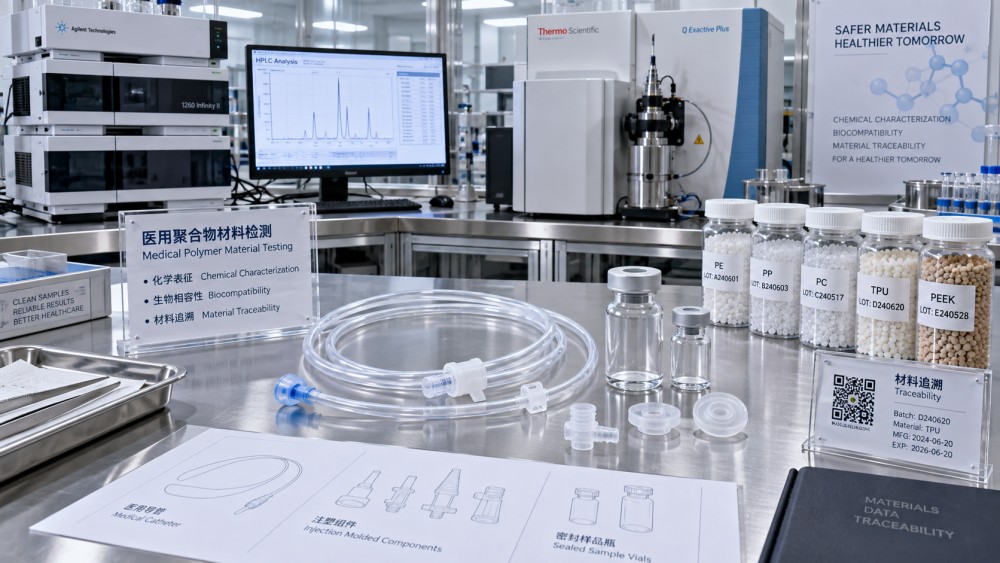
A characterization plan normally begins with known information: resin composition, additive disclosures, processing aids, cleaning agents, color masterbatch composition, packaging contact materials, and residual monomers or catalysts identified by the supplier. Analytical work then examines the finished article, using techniques appropriate to the suspected substances. Volatile and semi-volatile organic compounds, nonvolatile extractables, metals, ionic residues, and polymer degradation products may require different preparation and measurement methods.
Extraction conditions should be tied to the clinical exposure scenario, not selected merely because they are severe. A polar solvent may reveal hydrophilic residues; a nonpolar solvent can expose hydrophobic oligomers, lubricants, or antioxidant fragments. Elevated-temperature extraction may be informative for a component intended for sterilization or warm fluid contact, yet excessively harsh conditions can create compounds not reasonably available during actual use. The result is then a hazard-screening signal rather than a direct simulation of exposure.
Comparing extract profiles across lots is often more informative than treating every chromatographic peak as equally important. A stable profile supports process consistency. A new or enlarged peak may indicate a formulation change, inadequate drying, thermal degradation, contamination, altered cleaning, or interaction with a neighboring material. The identity, estimated amount, and toxicological relevance of unusual peaks should be assessed before relying on previous biological evidence.
Biocompatibility Tests Need an Exposure-Based Rationale
Biological evaluation should be built around the intended contact rather than applied as a fixed test menu. Cytotoxicity screening is frequently used because it can detect harmful leachables or surface-related effects from a representative material sample. A favorable result is useful evidence, but it does not prove suitability for every contact type, duration, or device configuration. Poor results also need interpretation: a response could arise from residues introduced during handling, extraction artifacts, incomplete post-processing, or the polymer system itself.
Where the exposure profile warrants it, the evaluation may extend to endpoints associated with irritation, sensitization, systemic toxicity, implantation response, blood interaction, or other biological hazards. The needed endpoints depend on contact classification and the chemistry already identified. Testing a finished, sterilized article is often preferable when sterilization or final packaging can affect the material. If the component is too small to test independently, a representative coupon must preserve the relevant material surface, thickness, processing history, and sterilization exposure.
Surface condition deserves separate attention. A nominally identical resin can present different biological behavior after plasma treatment, corona treatment, laser marking, lubricant application, or bonding. Surface treatments can improve adhesion or wettability while changing oxidation level, extractable residues, or surface energy. A test specimen molded on production-intent tooling but lacking the actual secondary process may therefore underrepresent the final article.
Why Cytotoxicity Results Are Often Misread
Cytotoxicity is sensitive to extraction method, sample preparation, surface-area-to-volume ratio, incubation conditions, and control performance. A negative result does not remove the need to understand chemical composition, especially when chronic contact or internal exposure is involved. Conversely, a borderline response should not automatically be attributed to the base polymer. Review the extraction blank, the sample cleaning method, lot history, sterilization status, and whether the tested article includes adhesives, inks, mold-release residues, or packaging-derived contaminants.
Changes in part geometry can also alter the test outcome without any formula change. Thin films and microtubing present a high surface area relative to mass. Thick molded parts may retain more thermal history at the core. Porous structures, textured surfaces, and fiber-reinforced compounds can retain process residues differently from smooth, unfilled materials. Test planning should account for the exposed surface actually present in the device rather than assuming that resin mass is an adequate proxy.
Sterilization Compatibility Is a Material-and-Process Question
Medical polymers are frequently selected before the final sterilization route is fully locked. That sequence creates avoidable rework. Steam, radiation, ethylene oxide, vaporized chemical systems, and other validated methods can affect molecular structure, color, mechanical properties, residual levels, and extractable profiles in different ways.
Heat and moisture may cause hydrolysis, stress relaxation, warpage, or changes in crystallinity. Radiation can lead to chain scission, crosslinking, oxidation, odor, discoloration, or a shift in impact performance. Chemical sterilants introduce a separate concern: residual sterilant or reaction by-products may require control, especially in geometries that trap gas or have limited aeration paths. The relevant assessment is not simply whether a resin is described as sterilizable. It is whether the finished component, at its maximum wall thickness and actual packaging configuration, remains within defined physical and chemical limits after the intended cycle.
Mechanical testing after sterilization should reflect the actual function. Tensile strength alone may be insufficient for a snap-fit, catheter hub, valve component, flexible connector, or thin-wall enclosure. Examine the property that governs failure: flexural fatigue, creep, compression set, burst resistance, torque retention, environmental stress cracking, or dimensional stability. A component can retain nominal tensile strength while becoming brittle enough to fail during assembly or clinical handling.
Traceability Must Reach Beyond the Resin Lot
Material traceability begins with the incoming polymer lot but cannot end there. The record chain should connect the incoming lot to internal blends, drying conditions, molding or extrusion batch, colorant or additive lot, rework status, secondary operations, sterilization load where applicable, and final component lot. This genealogy makes it possible to determine whether a nonconformance is isolated or whether it affects related production.
Certificates of analysis and certificates of conformance serve different purposes. A conformance statement may confirm that material was released against an agreed specification. A certificate of analysis should show the actual measured values or test results associated with the lot, where such testing is part of the specification. Neither document substitutes for a clear agreement on which attributes are controlled, what methods apply, and how deviations are handled.
Critical incoming attributes often include polymer identification, melt flow or rheological range, moisture condition where relevant, color, filler content, volatile matter, and contamination controls. The appropriate controls vary by polymer and process. Hygroscopic materials can suffer molecular-weight loss when dried incorrectly before melt processing. Reinforced compounds require attention to fiber content and dispersion because a change can affect part strength, surface quality, and flow. For translucent or optical components, a small color or haze shift may signal contamination, degradation, or an altered additive package.
Change Control Protects the Validity of Earlier Testing
A material is not unchanged merely because its grade name remains unchanged. Relevant changes can include a different raw-material source, catalyst system, antioxidant level, pigment carrier, compounding line, pelletizing method, packaging material, or manufacturing location. Some changes have no meaningful effect on a particular finished component; others can alter extractables or processing behavior enough to invalidate prior rationale.
The change-control record should state what changed, which lots were affected, why the change was made, and which properties or biological risks were reassessed. A supplier notification that says “no impact expected” is useful background, not a complete technical conclusion. The device-specific impact assessment should consider the approved process window, final sterilization method, patient-contact category, and previously characterized chemical profile.
Lot segregation is equally important when nonconforming material is discovered. Physical labels, electronic records, sample retention, and container status must agree. A traceability system fails when a lot can be identified in software but not on the shop floor, or when retained samples cannot be linked to the exact configuration used in testing. Mixed-lot storage, undocumented regrind, and unrecorded substitution of color masterbatch are common ways to break an otherwise complete documentation chain.
Build a Representative Evidence Package
The strongest evidence package is coherent across chemistry, biology, processing, and records. It describes the tested article clearly enough that another qualified reviewer can determine whether it matches routine production. It also separates material-level evidence from component-level evidence. A resin supplier’s data may support polymer identity and baseline quality, while the finished-device evidence addresses actual formulation, processing, sterilization, and contact conditions.
- Material specification: controlled grade identity, allowable additives or colorants, critical physical properties, and restrictions on substitutions or regrind.
- Lot documentation: incoming receipt records, supplier certificates, internal batch identifiers, retention-sample references, and disposition of any deviations.
- Process definition: drying, melt-temperature window, residence-time controls, mold-release policy, cleaning validation status, and secondary processes that contact the finished surface.
- Test article rationale: why the selected sample represents the highest-risk configuration, including thickness, surface treatment, sterilization, and packaging state.
- Change assessment: a documented basis for deciding whether a formulation, supplier, process, or sterilization change requires new chemical characterization or biological testing.
Testing should be revisited when evidence no longer represents the material in use. New analytical findings, an unexplained shift in processing behavior, a different sterilization exposure, or a supplier formulation update can all create that gap. Maintaining the link between the actual component and its supporting data prevents a common failure: treating an old favorable test report as permanent proof for a material configuration that has already changed.
Have questions about this sector analysis, or seeking best practices specific to your niche? Drop us a line below and let the senior consultants at APIM assist you.
We respect your privacy. Your information is strictly confidential.
Related News
- 00
0000-00
How does washing affect contamination in post-consumer recycled PP resins? - 00
0000-00
How does feedstock affect depolymerization equipment selection? - 00
0000-00
US Sets 213.44% Preliminary Antidumping Deposit on Chinese PTMEG - 00
0000-00
When should epoxy be used as a thermal interface material for semiconductors? - 00
0000-00
US Midterm Results Unlikely to Quickly Shift Recycled Plastics Market or Legislation