




Material Selection for Plastics Electrical Insulation: Dielectric, Thermal, and RoHS Factors
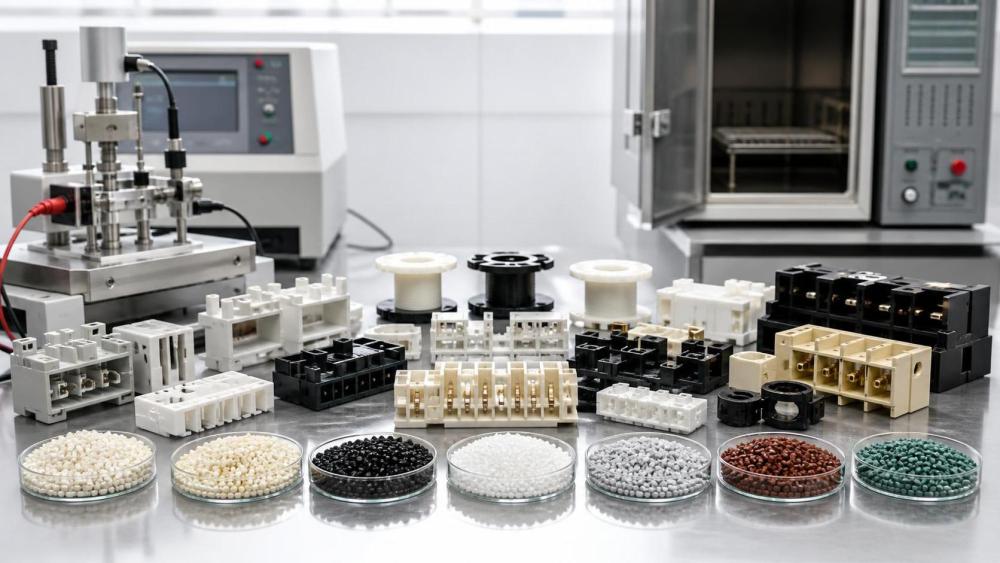
Material selection for plastics electrical insulation is rarely a simple resin-ranking exercise. A polymer that looks strong on a basic datasheet may still fail in service because dielectric performance changes with humidity, flame-retardant additives reduce tracking resistance, or processing conditions introduce voids that weaken insulation integrity. In electrical and electronic applications, the real question is not only “Which plastic insulates?” but “Which material will remain stable, compliant, and manufacturable in the actual operating environment?”
That is why technical evaluation usually moves across several layers at once: electrical properties, thermal aging, flammability, part geometry, molding consistency, compliance documentation, and supply stability. APIM often frames material decisions this way because advanced polymers are application systems, not isolated material names. A PBT, PA, PPS, or PC grade can look suitable in principle, yet the final outcome still depends on formulation, reinforcement, flame-retardant package, moisture behavior, and the way the part is processed.
Start with the insulation failure mode, not the resin family
For connectors, coil bobbins, switchgear parts, busbar carriers, sensor housings, terminal blocks, and power electronics components, insulation failure does not always happen as dramatic dielectric breakdown. More often, it appears as gradual loss of performance: surface tracking under contamination, embrittlement after thermal cycling, dimensional shift that reduces creepage distance, or additive migration that affects long-term stability.
This changes the selection logic. If the part is thin-walled and exposed to repeated soldering or elevated ambient heat, thermal endurance may matter more than a headline dielectric strength number. If the application is in humid automotive or industrial environments, comparative tracking index, water absorption, and dimensional stability may be more decisive than the base resin’s reputation. If the product will enter regulated electronics supply chains, RoHS and related substance declarations become part of the technical qualification, not an afterthought from procurement.
Good decisions usually begin with a failure map: bulk insulation breakdown, surface leakage, thermal deformation, flame propagation, cracking after assembly stress, or compliance risk. Only after that does resin comparison become meaningful.
Dielectric performance: what matters beyond a single test value
When engineers discuss plastics for electrical insulation, dielectric strength is often the first property mentioned. It is useful, but not sufficient on its own. Dielectric strength is sensitive to specimen thickness, test method, and condition. A material may show strong lab performance and still become a poor choice if its dielectric constant, dissipation factor, arc resistance, or tracking behavior do not fit the application.
For high-voltage or compact designs, three questions are usually more practical than one headline number:
- How stable are the electrical properties over temperature and humidity?
- Does the formulation maintain surface insulation under contamination and long-term stress?
- Will molding, welding, or assembly create defects that reduce local insulation margins?
This is where material family differences start to matter. Polyamides are widely used in electrical parts because of their mechanical strength and processability, but moisture uptake can shift electrical and dimensional performance. PBT is often favored in connectors and electrical housings because it balances insulation, dimensional control, and processing efficiency, though flame-retardant systems and hydrolysis exposure still require review. PPS is attractive where heat resistance and dimensional stability are critical, but its brittleness in certain designs or high material cost may narrow the business case. High-performance materials such as PEEK can solve demanding thermal and chemical exposure problems, yet may be unnecessary for applications where the design margin can be achieved with lower-cost engineering plastics.
For technical evaluators, the lesson is simple: compare conditioned properties, not only dry-as-molded values, and ask how the compound behaves after aging, humidity exposure, and real processing.
Thermal resistance is not just about maximum temperature
Many insulation parts fail because teams interpret thermal capability too narrowly. A material may survive a short peak temperature yet still creep, crack, discolor, or lose electrical margin over time. Continuous operating temperature, thermal aging behavior, heat deflection under load, and resistance to repeated thermal cycling all influence whether a plastic remains a reliable insulator.
In practice, the thermal question usually has several parts. Is the component near a motor winding, power module, or transformer? Will it see local hot spots? Does assembly involve reflow, overmolding, ultrasonic welding, or potting cure exotherm? Is the part carrying structural load while also serving as an insulator? These are not minor details. They shape whether a standard flame-retardant PBT is enough, whether a reinforced PA will distort, or whether PPS or another high-temperature polymer is justified.
Compounding quality also matters more than many sourcing teams expect. Fillers, reinforcement, and flame-retardant systems can improve one aspect of performance while weakening another. Glass fiber may support stiffness and dimensional control but can influence surface behavior and tool wear. Certain flame-retardant packages may affect toughness, color stability, or processing window. APIM’s coverage of modified compounds and processing technologies is useful here because material reliability is often created in the compounding line and molding process before it appears in field performance.
Flame behavior and electrical safety cannot be separated
In many electrical insulation applications, flame retardancy is part of the selection baseline. But a common mistake is to reduce that discussion to a single flammability class. Flame behavior needs to be viewed together with wall thickness, heat source, enclosure design, and the effect of additives on electrical properties and processing stability.
A flame-retardant grade that meets the required fire performance on paper may still create engineering tradeoffs: lower impact resistance, more brittle knit lines, reduced tracking resistance, or narrower molding conditions. This is particularly relevant in compact electrical architectures where thin walls, sharp corners, inserts, and tight tolerances already push the process window. A technically acceptable compound that cannot be molded consistently is not a low-risk choice.
That is why evaluation should include the finished-part context: creepage and clearance distances, gate location, weld line position, local thickness transitions, and the possibility of voids or burn marks. Electrical safety is as much about part quality and design execution as about resin selection.
RoHS compliance: necessary, but not the same as application approval
RoHS is often treated as a box to tick at the end of supplier onboarding. That approach creates avoidable risk. For plastics electrical insulation, RoHS compliance should be checked early because additive chemistry, pigments, stabilizers, and flame-retardant systems all influence declaration status. A compound may be electrically suitable but still require document review for restricted substances depending on the target market and product category.
It is also worth separating three things that are frequently blurred together: RoHS compliance, halogen-free requirements, and broader customer-specific restricted substance lists. They overlap, but they are not identical. Some OEMs or electronics supply chains ask for substance declarations that go beyond the minimum legal requirement. Others may require additional support on REACH-related concerns, material disclosure formats, or evidence from upstream suppliers. The exact documentation package should be confirmed against the end-use market and customer specification, not assumed from a generic certificate request.
For evaluators, the practical move is to request current compliance statements, understand the formulation control process, and confirm whether any future raw material substitutions could trigger requalification. Compliance risk often enters through change management, not initial sampling.
A short comparison view for common engineering plastics
This kind of comparison is useful only as a starting screen. Final selection still depends on grade-specific data, end-use conditions, and whether the supplier can support stable compounding and documentation.
Processing and supply-chain factors often decide the real winner
Two compounds with similar datasheet values may behave very differently in production. Drying sensitivity, melt stability, residence time tolerance, mold corrosion risk, fiber dispersion, and color consistency all affect yield and long-term reliability. This is one reason APIM pays close attention to extrusion, compounding, and downstream processing conditions. Material performance is not only designed in chemistry; it is preserved or degraded by process control.
For sourcing and engineering teams, that means supplier evaluation should include more than a technical data sheet. Ask how the material is compounded, how lot-to-lot consistency is managed, what testing is standard versus optional, and whether there is support for application-specific validation. In insulation applications, a marginal material problem may appear months later as field failure, so process discipline upstream matters.
A practical decision path
If the goal is smarter material selection for plastics electrical insulation, keep the workflow grounded:
- Define the actual electrical, thermal, and environmental stress profile.
- Screen resin families based on failure mode, not popularity.
- Check conditioned electrical data, flame behavior, and thermal aging together.
- Review processability in the intended part geometry.
- Confirm RoHS and any customer-specific substance requirements early.
- Validate with supplier documentation and project-relevant testing, not generic assumptions.
In many projects, the best answer is not the material with the highest specification ceiling. It is the compound that delivers stable insulation performance, manageable processing, credible compliance support, and acceptable cost over the product life cycle. That balance usually becomes clearer when teams compare materials through application logic rather than through isolated datasheet numbers. If any part of the requirement remains uncertain, the next step is not to guess—it is to narrow the test plan, confirm the standard, and challenge the material choice under the same conditions the finished product will actually face.
Have questions about this sector analysis, or seeking best practices specific to your niche? Drop us a line below and let the senior consultants at APIM assist you.
We respect your privacy. Your information is strictly confidential.
Related News
- 00
0000-00
How does feedstock affect depolymerization equipment selection? - 00
0000-00
US Sets 213.44% Preliminary Antidumping Deposit on Chinese PTMEG - 00
0000-00
When should epoxy be used as a thermal interface material for semiconductors? - 00
0000-00
US Midterm Results Unlikely to Quickly Shift Recycled Plastics Market or Legislation - 00
0000-00
When should you choose carbon fiber over glass fiber composites for lightweight parts?