




Material Compliance Checklist for REACH, RoHS, and FDA
Why does material compliance become complicated once REACH, RoHS, and FDA overlap?
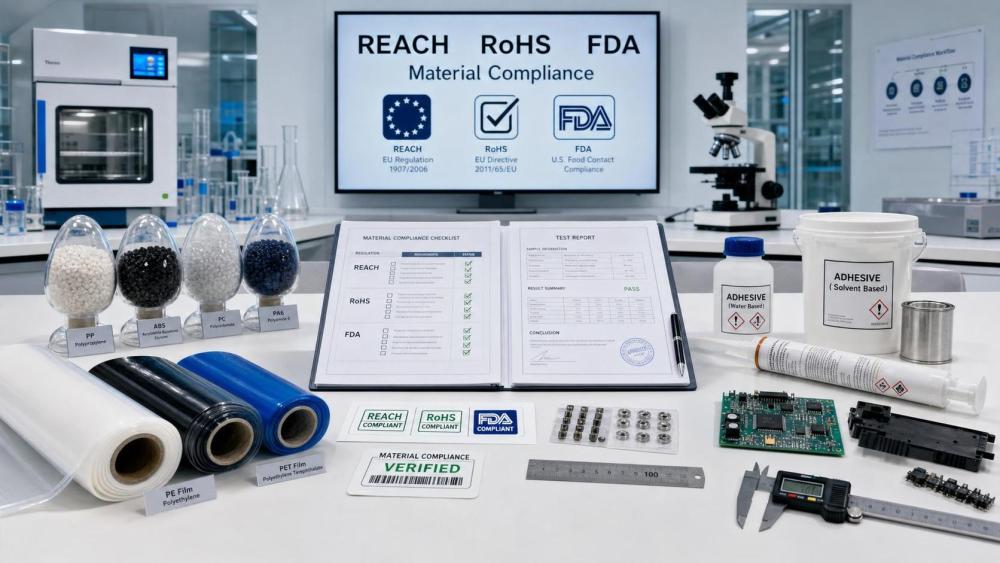
Material compliance looks simple on paper, yet it becomes difficult when one product serves several markets and applications at once.
A polymer housing, multilayer film, adhesive, or compounded resin may face chemical restrictions, electrical substance limits, and food-contact expectations together.
That is why a checklist matters. It turns scattered regulatory questions into a structured review before sourcing, production, and product approval.
In practical terms, REACH, RoHS, and FDA do not ask exactly the same thing.
REACH focuses heavily on substances of very high concern, registration logic, and communication duties across the supply chain.
RoHS is narrower, but stricter in its concentration limits for electrical and electronic products.
FDA review is different again. It depends on food-contact use, migration risk, formulation details, and processing conditions.
For advanced materials, the challenge grows when flame retardants, stabilizers, pigments, fillers, plasticizers, or curing agents sit deep inside the formulation.
APIM often tracks these material decisions through application logic, not regulation in isolation.
That approach helps when engineering plastics, specialty films, recycled polymers, or industrial adhesives must meet both performance and compliance targets.
What should a material compliance checklist include before any document is requested?
A useful material compliance review starts with product definition, because wrong scope creates wrong paperwork.
Before collecting declarations, confirm four basics:
- The exact material form: pellet, sheet, film, adhesive, molded part, coating, or multilayer assembly.
- The intended market: EU, US, or multi-region distribution.
- The end use: electronics, packaging, industrial equipment, medical-adjacent, or food-contact exposure.
- The full bill of materials, including additives, colorants, recycled content, and process aids.
Once scope is clear, the checklist becomes much stronger.
A sound material compliance checklist usually covers substance screening, supplier declarations, test evidence, traceability, revision control, and change management.
It should also identify whether a declaration is enough or whether analytical testing is justified.
That distinction saves time. Over-testing increases cost, while under-checking creates audit exposure.
For compounded plastics and specialty films, formulation drift is a common blind spot.
A supplier may keep the same trade name while changing additive packages, recycled fractions, or stabilizer systems.
Material compliance controls should therefore link the declaration to a grade, version, manufacturing site, and effective date.
A practical review table for day-to-day checks
The table below works well as a first-pass decision tool when reviewing technical files and supplier submissions.
How are REACH, RoHS, and FDA different when reviewing polymers, films, and adhesives?
This is where many teams lose time, because the same declaration package is often used for very different rules.
REACH is substance-driven and communication-driven.
It matters for resins, compounds, additives, and finished articles placed on the EU market, even when the material is not electronic.
RoHS is product-scope driven.
It mainly affects electrical and electronic applications, so a polymer connector, insulated cable layer, potting compound, or display film may all be relevant.
FDA is use-condition driven.
A PET film, barrier layer, sealant, or adhesive might be acceptable for one food-contact condition and unsuitable for another.
The practical lesson is clear: material compliance cannot rely on one generic supplier letter.
Each framework should be checked against actual function, exposure, and region.
For example, a flame-retardant polycarbonate may satisfy electrical design needs, yet its additive package still requires close review under REACH and RoHS.
Likewise, a multilayer packaging film may look compliant at the outer structure level, but food-contact review depends on the specific contact layer and migration scenario.
Where do material compliance failures usually start?
Most failures do not begin with a missing test. They begin with a wrong assumption.
A few examples appear again and again in plastics and industrial materials:
- Assuming base resin compliance automatically covers pigments, fillers, flame retardants, and stabilizers.
- Treating a distributor statement as equal to a manufacturer-backed declaration.
- Using old REACH or RoHS documents after formulation updates.
- Claiming FDA suitability without checking food type, temperature, and contact duration.
- Ignoring adhesives, inks, coatings, and tie layers in multilayer constructions.
Recycled polymers deserve extra attention.
They can support sustainability goals, but variability in feedstock and contamination history may complicate material compliance review.
That does not make recycled content unusable. It means traceability and verification need to be stronger.
APIM frequently highlights this connection between sustainability claims and formulation control, especially for packaging, consumer electronics, and industrial components.
When is a supplier declaration enough, and when should testing or deeper review follow?
A declaration is often the starting point, not the end point.
If the material is standard, low-risk, and sourced from a controlled supplier with stable formulation history, a current declaration may be sufficient.
The threshold changes when risk rises.
Testing or deeper review becomes more reasonable when the material contains recycled content, complex additive systems, color concentrates, or frequent supply chain substitutions.
It also matters when the application is safety-sensitive, food-contact related, or tied to customer audits.
A good material compliance decision usually weighs these factors:
- How transparent is the formulation?
- How current is the document set?
- How sensitive is the end-use environment?
- How costly would a recall, requalification, or shipment hold be?
In real projects, the most efficient path is often layered verification.
Start with declarations, then add targeted testing or technical review only where the risk profile justifies it.
How can a checklist reduce audit pressure and keep material compliance current over time?
The best checklist is not a one-time file. It is part of change control.
That means linking material compliance to supplier onboarding, new material approval, annual review, and engineering change procedures.
For polymers, films, compounds, and adhesives, three habits make a visible difference.
- Keep one controlled record for each material grade, including declarations, test evidence, and revision dates.
- Trigger re-review when supplier site, additive package, recycled content level, or end-use scope changes.
- Match every compliance claim to the actual application, not just the generic material family.
This is especially important in sectors using engineering plastics, barrier films, electrical insulation materials, and bonding systems.
Performance improvements often come from formulation changes, and those same changes may affect material compliance status.
A disciplined checklist helps separate valid evidence from inherited assumptions.
It also makes audits easier, because every declaration, restriction review, and application note can be traced to a clear decision record.
If the next step is unclear, begin with a simple matrix of material, market, end use, and regulation.
Then review where REACH, RoHS, and FDA obligations overlap, where supplier data is weak, and where testing would reduce real risk.
That kind of structured material compliance review is usually more effective than collecting more certificates without context.
Have questions about this sector analysis, or seeking best practices specific to your niche? Drop us a line below and let the senior consultants at APIM assist you.
We respect your privacy. Your information is strictly confidential.
Related News
- 00
0000-00
Do polyolefin hot melt adhesives bond well to polyethylene? - 00
0000-00
Korean Study Finds PLA Barely Degrades in Landfill After 320 Days - 00
0000-00
How to assess batch consistency from a thermal potting compounds supplier - 00
0000-00
How much weight can carbon fiber reinforced plastics save in cars? - 00
0000-00
Switching from PS to ABS Sheet Extrusion: Equipment Checks