




Low Outgassing Polymers Market in 2026: Demand Drivers and Compliance Pressure
The low outgassing polymers market is moving into a more strategic position in 2026. Material selection is no longer driven only by mechanical strength, heat resistance, or price.
Across electronics, aerospace, medical devices, optics, and sealed industrial systems, volatile emissions can damage performance, contaminate sensitive parts, and create costly compliance problems.
That shift is pushing the low outgassing polymers market beyond a niche technical topic. It now sits at the intersection of product reliability, supplier qualification, processing control, and regulatory readiness.
Why low outgassing matters more in 2026
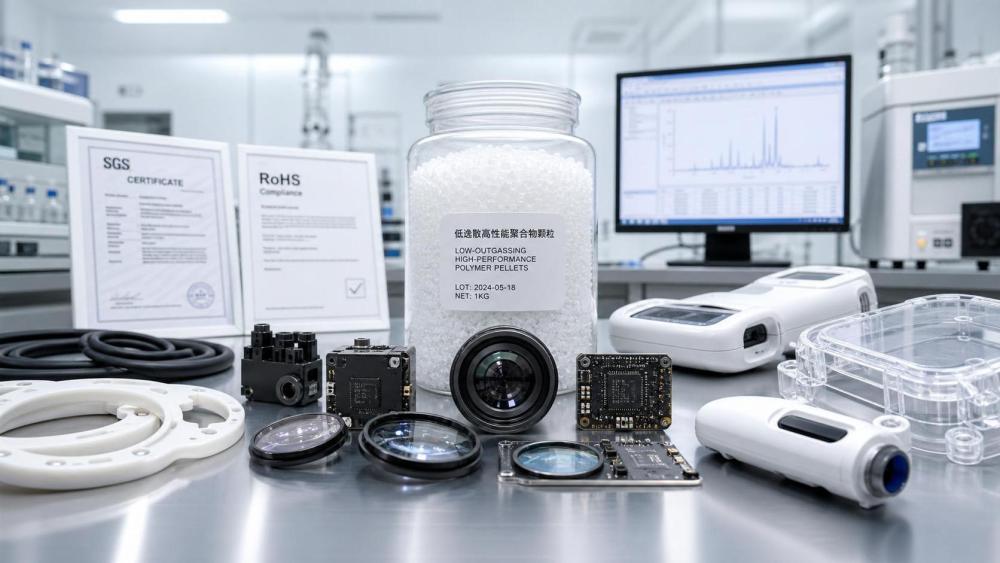
The issue is simple in principle. Some polymers and polymer-based compounds release volatile organic compounds, condensable substances, or residual low molecular weight materials over time.
In ordinary applications, that may be manageable. In tightly enclosed, high-temperature, vacuum, optical, or electronic environments, it becomes a direct business risk.
Residue can fog lenses, contaminate sensors, interfere with adhesion, reduce insulation reliability, or compromise clean manufacturing conditions. In aerospace and medical settings, the threshold for tolerance is often especially narrow.
The low outgassing polymers market is therefore benefiting from a broader industrial trend. End users want materials that perform predictably not only when installed, but throughout storage, assembly, sterilization, and long-term service.
What qualifies as a low outgassing polymer
Low outgassing does not refer to a single resin family. It describes a performance requirement shaped by formulation, purity, additives, processing history, and the target environment.
High-performance polymers such as PEEK, PPS, PEI, fluoropolymers, selected polyimides, and carefully controlled specialty compounds often appear in this space. Some modified engineering plastics also qualify.
The important point is that base resin alone does not decide success. Lubricants, plasticizers, flame retardants, residual monomers, colorants, fillers, and moisture content can all change outgassing behavior.
That is why the low outgassing polymers market is closely tied to compounding discipline and process engineering. Vacuum degassing, melt filtration, drying control, residence time, and contamination management all matter.
This is also where APIM-style market intelligence becomes useful. Structured comparison of material grades, process stability, and application fit helps reduce guesswork in early screening.
The main forces shaping the low outgassing polymers market
Demand is rising for several reasons, and most are linked to product miniaturization, reliability pressure, and more demanding validation standards.
Electronics and precision assemblies
Compact devices leave less room for contamination. Sensitive connectors, housings, optical modules, thermal interfaces, and display-related parts are increasingly affected by emission control requirements.
Aerospace and vacuum environments
Materials used near optics, sensors, insulation systems, or enclosed cabin components face strict testing. Total mass loss and collected volatile condensable materials remain critical decision factors.
Medical and laboratory equipment
Sterilization exposure, purity expectations, and enclosed fluid or diagnostic systems raise the value of low emission materials. Odor, extractables, and stability after processing all receive more scrutiny.
Advanced industrial systems
Semiconductor handling, automation, clean manufacturing, battery systems, and optical inspection equipment all support growth in the low outgassing polymers market.
Compliance pressure is changing buying logic
In 2026, compliance pressure is broader than one test standard. Businesses must consider internal customer specifications, external certifications, documentation traceability, and region-specific material restrictions.
A material may pass a lab test and still fail a commercial review if its supply chain lacks consistency. Batch variation, incomplete data sheets, or weak process documentation can delay approvals.
This is one reason the low outgassing polymers market increasingly rewards suppliers with strong technical files. Reliable data on VOC behavior, thermal aging, extractables, and processing windows now supports sales as much as price.
For many applications, compliance is not just about passing one requirement. It is about proving that the same performance can be delivered repeatedly across geographies, production lines, and product revisions.
Where the business value shows up
The low outgassing polymers market creates value in ways that are often easier to measure after failure is avoided.
- Lower contamination risk in optical, electrical, and sealed assemblies.
- Fewer validation delays during customer qualification.
- Reduced field failure exposure linked to fogging, deposits, or unstable interfaces.
- Better fit for premium applications where documentation quality affects supplier access.
- Stronger control over long product life cycles and replacement part consistency.
In practice, low outgassing performance often supports a broader quality story. It signals material purity, disciplined compounding, and better understanding of end-use conditions.
Applications are broad, but requirements are not identical
A useful way to read the low outgassing polymers market is by application logic rather than by resin category alone.
This variation explains why blanket claims are weak. A grade that works in one electronics enclosure may not be suitable for vacuum optics or a sterilized diagnostic cartridge.
How to evaluate supply options more carefully
Material selection should connect polymer chemistry, processing capability, and supplier transparency. That is especially true in the low outgassing polymers market, where small formulation differences can create large qualification gaps.
Look beyond the resin name
Ask how the compound is formulated, dried, pelletized, packaged, and tested. Residual moisture and additive choice can change downstream performance more than expected.
Review process control, not just test reports
Stable extrusion and compounding matter. Screw design, vacuum degassing, filtration, residence time, and contamination prevention affect volatile content and lot consistency.
Match testing to the actual use case
A general VOC result may not answer a vacuum, optics, or sterilization question. Test conditions should reflect temperature, enclosure type, service duration, and contamination sensitivity.
Check adjacent materials too
Adhesives, films, seals, and coatings can undermine an otherwise strong polymer choice. In many assemblies, outgassing risk comes from the full material stack.
Why market intelligence is becoming part of material strategy
The low outgassing polymers market is technically specialized, but it is no longer isolated. It touches engineering plastics, modified compounds, specialty films, clean-processing equipment, and industrial bonding systems.
That wider context matters when product teams compare alternatives. A polymer grade may look attractive until film compatibility, adhesive behavior, or downstream thermal cycling is considered.
This is where platforms like APIM add practical value. Structured information on material performance, processing methods, application trends, and supplier capability supports better cross-functional decisions.
It also helps separate marketing claims from manufacturable reality. In a market shaped by precision and compliance, that distinction has direct commercial value.
What to watch next
The next phase of the low outgassing polymers market will likely be defined by tighter documentation expectations, broader application adoption, and more integration with sustainability screening.
Bio-based or recycled content will attract attention, but acceptance will depend on whether purity and emission performance can be maintained. That balance will not be simple.
A practical next step is to map where outgassing risk actually affects product value. Then compare candidate materials by test relevance, processing stability, and supplier evidence, not by headline claims alone.
In 2026, the low outgassing polymers market deserves attention because it turns a subtle material property into a visible business outcome. The companies that evaluate it carefully will make fewer compromises later.
Have questions about this sector analysis, or seeking best practices specific to your niche? Drop us a line below and let the senior consultants at APIM assist you.
We respect your privacy. Your information is strictly confidential.
Related News
- 00
0000-00
How does washing affect contamination in post-consumer recycled PP resins? - 00
0000-00
How does feedstock affect depolymerization equipment selection? - 00
0000-00
US Sets 213.44% Preliminary Antidumping Deposit on Chinese PTMEG - 00
0000-00
When should epoxy be used as a thermal interface material for semiconductors? - 00
0000-00
US Midterm Results Unlikely to Quickly Shift Recycled Plastics Market or Legislation