




Is UV-328 an SVHC in your plastic compliance review?
Is UV-328 an SVHC in your plastic compliance review? The short answer is yes. UV-328 is included on the European Chemicals Agency (ECHA) Candidate List of Substances of Very High Concern (SVHCs). For quality, EHS, regulatory, and product safety teams, that status is not simply a line item in a supplier declaration. It can affect material approval, REACH communication duties, SCiP reporting, customer questionnaires, recycled-content strategies, and the evidence needed to keep products moving through the European market.
UV-328 is widely associated with weatherability and light protection, so it may appear in places where teams do not immediately expect a compliance issue: engineering plastic housings, automotive components, protective films, coated surfaces, cable materials, adhesives, seals, and recycled polymer compounds. A part may perform beautifully under UV exposure while still carrying an unresolved regulatory risk in its formulation history.
Why UV-328 is on the SVHC Candidate List
UV-328, formally known as 2-(2H-benzotriazol-2-yl)-4,6-di-tert-pentylphenol, is a benzotriazole ultraviolet absorber. Its principal job is practical: it absorbs UV radiation that could otherwise contribute to discoloration, embrittlement, surface cracking, loss of gloss, or reduced mechanical performance in polymers and coatings.
ECHA added UV-328 to the Candidate List in January 2023 because it meets the criteria for a very persistent and very bioaccumulative substance, commonly abbreviated as vPvB. In regulatory terms, this means the concern is not limited to immediate workplace handling or one specific finished product. The concern relates to long-term environmental persistence and the potential for the substance to accumulate in living organisms.
For a plastic compliance review, the important distinction is this: UV-328 is an SVHC under REACH, but the exact obligation depends on how it is supplied and used. A masterbatch, polymer compound, coating, adhesive, and finished molded part do not all trigger the same documentation pathway. Teams need to identify whether they are assessing a substance, a mixture, or an article.
The 0.1% threshold: where many reviews become complicated
For articles supplied in the EU, the familiar reference point is 0.1% weight by weight (w/w) of the article. If an SVHC such as UV-328 is present above that threshold, suppliers have communication obligations under REACH Article 33. Professional recipients must receive sufficient information to allow safe use of the article, including at least the name of the SVHC. Consumers may also request this information, and suppliers must respond within the required timeframe.
Yet “0.1% of the article” should not be treated as a simple calculation based only on the weight of a final assembled product. In complex products, the “once an article, always an article” principle matters. A plastic connector, film layer, cable jacket, gasket, housing, or coated component may remain an article within a larger assembly. Compliance teams therefore need to assess relevant component articles, not dilute an SVHC concentration by dividing it across the total mass of a finished machine, vehicle module, or consumer product.
This is particularly relevant for multi-material products. A small UV-stabilized polymer film may represent only a fraction of the final packaging structure, while its own UV-328 concentration could still exceed the threshold. Likewise, a UV-protected exterior plastic component in an automotive assembly may require its own evidence even when the overall vehicle-level concentration is very low.
What quality and safety teams should check before approving a material
A declaration stating “REACH compliant” is often too broad to close an UV-328 SVHC review. It may refer to a supplier’s general regulatory awareness rather than the current Candidate List, the exact grade being purchased, or the specific manufacturing site. The more useful question is: What evidence demonstrates the UV-328 status of this material, revision-controlled against the current regulatory list?
For new material approvals, start with the exact commercial grade, color, reinforcement level, and processing form. A natural resin, black compound, glass-fiber reinforced grade, and UV-stabilized version of the same polymer family can have very different additive packages. Do not assume that a declaration for a base resin applies to a compounded or colored grade.
A practical review file may include the following:
- A current supplier declaration that specifically addresses UV-328 and the Candidate List.
- Full product identification, including grade name, supplier legal entity, production site where relevant, and document revision date.
- Material composition information or a controlled statement of SVHC content.
- Safety Data Sheet review for mixtures such as coatings, adhesives, masterbatches, and liquid formulations.
- Evidence for articles where the 0.1% w/w threshold may be exceeded.
- SCiP submission status or data support where the organization has a notification duty.
- Change-control commitments covering additive substitutions, recycled-content changes, and reformulations.
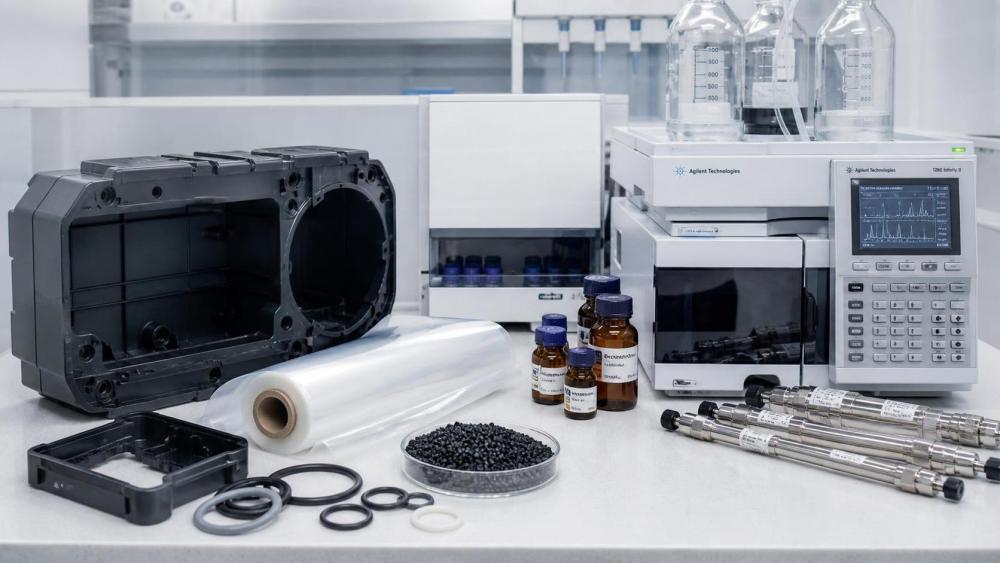
Testing can be valuable, but it should not be treated as the only answer. UV-328 analysis may require suitable extraction, chromatographic methods, calibration, and an understanding of the material matrix. A single test result can also miss variation between batches, suppliers, or recycled feedstock streams. Supplier knowledge, formulation control, procurement traceability, and targeted analytical verification work best as a combined system.
Recycled plastics deserve a separate risk lens
Recycled polymers are one of the most important areas for UV-328 due diligence. A recycler may not have intentionally added the substance, but legacy additives can remain in post-consumer or post-industrial feedstock. This is especially important when recycled material is sourced from mixed waste streams, imported scrap, unknown historical applications, or polymers originally designed for long outdoor service life.
Quality teams are often under pressure to increase recycled content while maintaining mechanical properties, appearance, odor limits, and regulatory conformity. That pressure is understandable, but it should not lead to assumptions that recycled content is automatically equivalent to virgin material from a compliance perspective. A recycled PP, ABS, PC, PET, or engineering-plastic compound may have a more complex additive history than its virgin counterpart.
When UV-328 is a concern, ask recyclers and compounders about feedstock origin, sorting controls, contaminant-management procedures, analytical screening plans, and their approach to Candidate List updates. If the material is used in sensitive applications such as food-contact packaging, electronics, medical-adjacent products, toys, or automotive interiors, the review should also consider sector-specific requirements beyond REACH.
REACH duties are not the same as a blanket market ban
It is easy for internal teams to hear “SVHC” and conclude that the substance is immediately prohibited in every application. That is not what Candidate List inclusion means. SVHC status creates information and notification consequences under REACH, and it can be a precursor to further regulatory action. It also raises commercial concern because many customers maintain restricted-substance lists that are stricter than the minimum legal baseline.
UV-328 has also received wider international regulatory attention because of its persistence and bioaccumulation profile. Therefore, companies should not stop at an old REACH declaration or assume that Candidate List status is the only issue to monitor. Restrictions, POPs-related controls, customer specifications, regional chemical inventories, and product-sector rules may evolve on different timelines. Compliance should be treated as a living review, not a one-time purchasing document.
For importers and EU-based producers, potential REACH Article 7 notification requirements may arise when an SVHC is present in articles above 0.1% w/w and total quantities exceed the applicable annual threshold, unless an exemption applies. SCiP database obligations may also apply for articles containing Candidate List substances above 0.1% w/w. Because responsibilities can vary by supply-chain role and product configuration, legal or specialist regulatory review is advisable for borderline or high-volume cases.
A workable UV-328 compliance workflow
The most reliable programs do not begin with a last-minute customer questionnaire. They begin with a material map. List every polymer, coating, adhesive, film, color concentrate, additive masterbatch, and purchased component used in the product. Then identify where UV stabilizers are technically likely: outdoor parts, transparent sheets, light-exposed labels, automotive trim, agricultural films, cable insulation, optical components, and durable packaging.
Next, divide the portfolio into risk bands. High-risk materials may include UV-stabilized compounds, unknown legacy stock, recycled grades, imported articles with limited formulation disclosure, and products supplied for long-term exterior use. Lower-risk materials may still need declarations, but they can be reviewed through a more proportionate process.
Once supplier responses are collected, check for contradictions. A declaration that says “no SVHC above 0.1%” may conflict with a technical data sheet that promotes a benzotriazole UV absorber, an old formulation document, or a known legacy additive package. That does not automatically prove non-compliance; it signals that clarification is needed. Ask whether the additive is UV-328 specifically or a different UV absorber, whether the concentration is below threshold, and whether the statement applies to the material as sold or the finished article after processing.
Finally, build review triggers into normal quality management. Trigger reassessment when a supplier changes a formulation, a recycled-content level increases, a new colorant is introduced, a production site changes, or ECHA updates the Candidate List. This approach is calmer and more defensible than scrambling for evidence after a customer has already escalated a concern.
Common mistakes that create avoidable exposure
One common error is confusing “UV stabilizer” with “UV-328.” There are several UV absorbers and light stabilizers used across plastics, including benzotriazoles, benzophenones, and hindered amine light stabilizers. A product described as UV-stabilized does not automatically contain UV-328, but the label should prompt a focused supplier question.
Another mistake is relying on a declaration that predates January 2023 or has no version control. Candidate List compliance is date-sensitive. A statement issued before UV-328 was listed may be informative historically, but it cannot confirm current SVHC status.
Teams also sometimes review only raw materials and overlook bought-in parts. A finished electronic assembly, laminated film, coated metal panel, appliance component, or packaging closure can introduce UV-328 through its polymeric or coated subcomponents. Procurement, product engineering, and supplier quality need a shared process for collecting article-level declarations.
Making the answer useful to customers and internal stakeholders
When a customer asks, “Is UV-328 an SVHC in this product?” the strongest response is clear, specific, and supported by traceable evidence. It should identify the relevant product or component, state whether UV-328 is present above the applicable threshold, reference the document revision, and explain any communication or SCiP action taken where relevant. Vague assurances may feel reassuring in the moment, but they tend to create more work when the next audit arrives.
For manufacturers working with advanced polymers, compounds, films, and industrial bonding materials, UV-328 review is also a chance to improve material intelligence. The same discipline used to understand heat resistance, flame performance, filler loading, migration risk, or processing stability can be applied to regulatory additives. Better information at the formulation and procurement stage protects not only compliance, but also customer trust and continuity of supply.
UV-328 is indeed an SVHC, and that fact should be visible in your plastic compliance process. The real task is to translate the listing into disciplined actions: identify possible sources, obtain material-specific evidence, assess articles at the correct level, manage recycled-material uncertainty, and keep the review current as regulations and supply chains change.
Have questions about this sector analysis, or seeking best practices specific to your niche? Drop us a line below and let the senior consultants at APIM assist you.
We respect your privacy. Your information is strictly confidential.
Related News
- 00
0000-00
How does washing affect contamination in post-consumer recycled PP resins? - 00
0000-00
How does feedstock affect depolymerization equipment selection? - 00
0000-00
US Sets 213.44% Preliminary Antidumping Deposit on Chinese PTMEG - 00
0000-00
When should epoxy be used as a thermal interface material for semiconductors? - 00
0000-00
US Midterm Results Unlikely to Quickly Shift Recycled Plastics Market or Legislation