




Is PEEK Worth the Cost for Medical and Precision Parts? A Value-Based Material Review
Is PEEK Worth the Cost for Medical and Precision Parts?
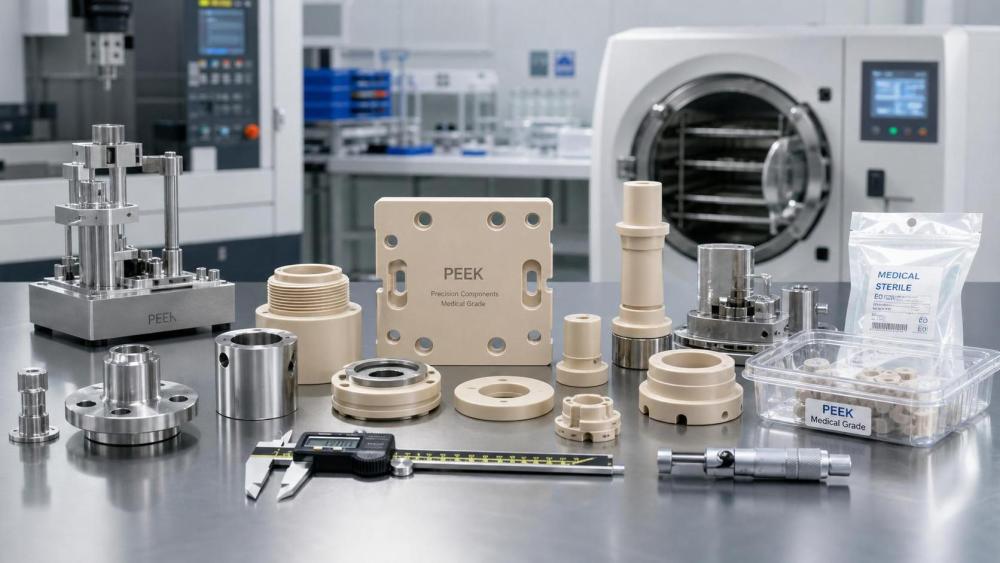
For medical and precision parts, PEEK often triggers immediate cost concerns. That reaction is understandable. Its resin price is far above many engineering plastics.
Still, procurement decisions rarely succeed when they focus only on price per kilogram. In regulated and high-accuracy applications, failure costs more than material cost.
That is why the better question is not simply, “Why is PEEK expensive?” It is, “What does PEEK help avoid, improve, or simplify?”
In many medical and precision programs, PEEK supports sterilization stability, biocompatibility pathways, tight tolerances, chemical resistance, and long service life.
When those factors affect approval timelines, scrap rates, maintenance cycles, or warranty exposure, PEEK may become a cost-control material, not just a premium one.
This review looks at PEEK through a value-based lens. The goal is practical: determine when PEEK earns its price and when alternatives make better business sense.
Why PEEK Commands a Premium
PEEK is a high-performance polymer designed for demanding environments. Its value comes from a rare combination of mechanical, thermal, chemical, and dimensional performance.
For medical parts, this can mean repeated sterilization without major property loss. For precision parts, it can mean stable geometry under heat, load, or chemical exposure.
PEEK also supports metal replacement in selected designs. That can reduce weight, improve imaging compatibility, simplify machining, or remove corrosion concerns.
The cost premium usually reflects three realities. Resin production is complex. Quality consistency is critical. End-use expectations are often much higher than standard plastics.
- High continuous-use temperature capability
- Strong chemical and hydrolysis resistance
- Low moisture uptake compared with many alternatives
- Good dimensional stability for precise components
- Potential compliance advantages in medical applications
These features do not automatically justify PEEK. They justify a serious comparison against total lifecycle cost, processing efficiency, and performance risk.
Where PEEK Creates Real Business Value
PEEK becomes attractive when part failure is expensive, validation is demanding, or service conditions are harsh. That is especially true in medical and precision manufacturing.
1. Lower compliance and validation risk
Medical programs often involve material traceability, documentation, lot consistency, and regulatory review. PEEK grades for healthcare can support cleaner qualification pathways.
That does not remove validation work. However, it may reduce uncertainty compared with less proven materials in surgical, diagnostic, or implant-adjacent designs.
2. Better performance across sterilization cycles
If a component sees steam, gamma, EtO, or aggressive cleaning chemistry, material degradation becomes a hidden cost driver. PEEK often performs well where others drift or crack.
Longer life can reduce replacement frequency, field failures, and quality complaints. In repeated-use devices, that advantage can materially offset the initial material premium.
3. Improved dimensional control
Precision parts fail when tolerances drift. PEEK’s dimensional stability can help maintain fit, movement, alignment, or sealing performance over time and temperature variation.
That matters in gears, valve components, analytical equipment, semiconductor fixtures, and high-accuracy housings where rework is expensive.
4. Higher system-level savings
Sometimes PEEK reduces cost outside the part itself. It may enable lighter designs, fewer assemblies, lower maintenance, or easier cleaning and sterilization workflows.
In actual purchasing decisions, these indirect savings are often the difference between rejecting PEEK and approving it.
When PEEK May Not Be Worth the Cost
PEEK is not a default answer. In many cases, it is over-specified. Paying for unused performance weakens margins and complicates sourcing without improving the final product.
If the part faces moderate temperatures, limited chemical exposure, and no repeated sterilization, lower-cost materials may deliver sufficient performance.
- PPS for heat and chemical resistance in stable geometries
- PEI for selected medical and electrical applications
- POM for precision movement in less aggressive environments
- PA or reinforced PA for structural parts with cost pressure
- PTFE blends or UHMWPE for certain wear-focused uses
The decision point is simple. If PEEK’s extra performance does not protect revenue, compliance, uptime, or product lifespan, the premium may not be justified.
This is especially relevant in high-volume components with tight cost targets. Even small resin savings can strongly affect annual spend at scale.
The Hidden Cost Factors Buyers Should Compare
A useful PEEK review goes beyond raw material price. Procurement teams should compare the full cost structure tied to manufacturing and end-use risk.
From a recent market perspective, buyers are also paying more attention to batch consistency, global availability, and technical support during qualification.
That shift matters. A lower-cost material with unstable supply can create more disruption than a premium material with dependable industrial support.
Medical Parts: Questions That Clarify the PEEK Business Case
For medical applications, the strongest PEEK cases usually appear when product reliability and regulatory confidence are closely linked.
- Will the part face repeated sterilization or aggressive disinfectants?
- Does the application require tight dimensional retention over time?
- Is biocompatibility documentation or medical-grade traceability important?
- Would failure affect patient safety, service continuity, or brand trust?
- Can PEEK reduce metal use, imaging issues, or corrosion concerns?
If several answers are yes, PEEK deserves serious consideration. If most are no, other engineering plastics may provide a better cost-performance balance.
In practice, medical buyers should also verify sterilization method, grade history, supplier change control, and documentation readiness before final approval.
Precision Parts: How PEEK Impacts Total Manufacturing Cost
Precision components are judged by repeatability. A cheap resin becomes expensive when it creates warpage, tolerance drift, assembly issues, or unstable wear behavior.
PEEK can help in applications where heat, friction, chemicals, or long duty cycles push common materials beyond their safe window.
This is often seen in semiconductor handling, analytical devices, aerospace interiors, industrial pumps, seals, and high-precision mechanical assemblies.
More importantly, PEEK may support lower total manufacturing cost through better process repeatability and less downstream correction.
- Fewer tolerance-related rejects
- Less rework after machining or molding
- Improved assembly fit consistency
- Lower risk of early field wear
- Better long-term part stability
That said, success depends on design discipline. PEEK cannot compensate for weak tolerance analysis, poor tooling strategy, or uncontrolled processing conditions.
A Practical PEEK Procurement Framework
A structured buying process helps prevent overbuying and underperforming. The goal is to compare PEEK against alternatives using business impact, not assumptions.
- Define the real performance threshold, not the ideal one.
- Map sterilization, temperature, chemical, and tolerance demands.
- Estimate scrap, validation, maintenance, and failure costs.
- Compare PEEK with at least two realistic alternative materials.
- Review supplier quality systems, documentation, and supply stability.
- Run prototype or pilot data before volume commitment.
This approach usually leads to clearer decisions. Either PEEK proves its value quickly, or the team identifies a lower-cost material with acceptable risk.
Final Take: Is PEEK Worth It?
PEEK is worth the cost when failure is expensive, compliance matters, and long-term stability directly affects product value. In those cases, unit price is only one line item.
PEEK is not worth the cost when its advanced performance is unnecessary or poorly matched to real operating conditions. Then it becomes avoidable overspecification.
For medical and precision parts, the smartest decision is usually a total-cost decision. Compare risk, lifespan, processing stability, and qualification effort alongside resin price.
When buyers treat PEEK as a strategic material rather than a commodity, the answer becomes clearer. Sometimes the premium is hard to justify. Sometimes it is the cheaper choice in disguise.
A disciplined review of application demands, supplier capability, and lifecycle cost will show whether PEEK is the right investment for the part in front of you.
Have questions about this sector analysis, or seeking best practices specific to your niche? Drop us a line below and let the senior consultants at APIM assist you.
We respect your privacy. Your information is strictly confidential.
Related News
- 00
0000-00
How does washing affect contamination in post-consumer recycled PP resins? - 00
0000-00
How does feedstock affect depolymerization equipment selection? - 00
0000-00
US Sets 213.44% Preliminary Antidumping Deposit on Chinese PTMEG - 00
0000-00
When should epoxy be used as a thermal interface material for semiconductors? - 00
0000-00
US Midterm Results Unlikely to Quickly Shift Recycled Plastics Market or Legislation