




Is PEEK Suitable for 3D-Printed Medical Implants in 2026?
When a spinal, cranial, or orthopedic implant concept moves from a CAD model to a printed part, material selection quickly becomes more complicated than choosing the strongest polymer. The implant may need to match a patient-specific anatomy, remain stable under repeated loading, permit imaging after surgery, survive sterilization, and fit into a documented manufacturing and validation process. A part that looks accurate on the build plate can still be unsuitable if its internal fusion, surface condition, or dimensional repeatability is not controlled.
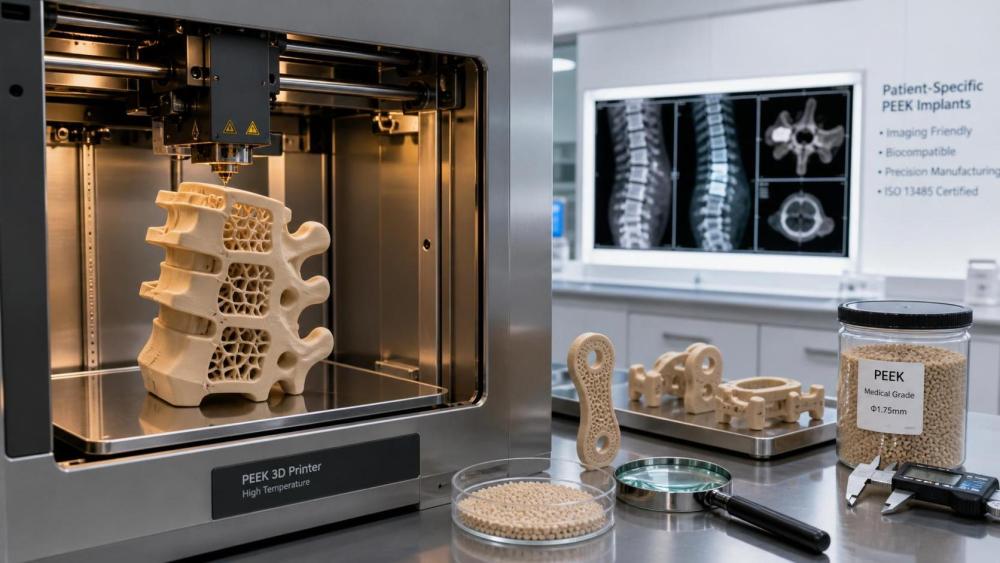
Is PEEK suitable for 3D-printed medical implants in 2026? It can be suitable for selected applications, but it is not an automatic replacement for machined PEEK or metal implants. PEEK has properties that make it highly relevant to implant development, including biocompatibility when an appropriate grade and process are used, radiolucency, chemical resistance, and an elastic modulus closer to bone than many metals. The real decision depends on the implant’s load case, geometry, printing method, post-processing route, cleanliness controls, and the evidence required to support its intended use.
Why PEEK remains attractive for implant design
Polyether ether ketone is a high-performance thermoplastic with a long history of interest in medical devices. Its radiolucency is especially useful where clinicians need to assess bone healing or adjacent structures without the imaging artifacts associated with many metallic implants. In implant concepts involving fixation, fusion, reconstruction, or personalized geometry, that characteristic can affect both treatment planning and follow-up assessment.
Its mechanical behavior also deserves attention. PEEK is often considered when designers want a less rigid alternative to titanium or cobalt-chromium alloys. A material with stiffness closer to bone may help reduce extreme stiffness mismatch in certain designs, although this does not by itself prove better clinical performance. Implant behavior is determined by geometry, wall thickness, lattice architecture, fixation method, load direction, surgical placement, and surrounding anatomy—not resin modulus alone.
PEEK also resists many chemicals and can tolerate elevated temperatures, which supports practical cleaning and sterilization planning. Yet “PEEK” is not one uniform material category. Medical suitability may vary between virgin resin grades, compounded grades, recycled-content materials, pigmented formulations, and reinforced grades. A formulation that performs well in an industrial component may not be appropriate for an implant. Material traceability, additive disclosure, and the intended biological contact profile matter from the first design review.
The key distinction: printable PEEK is not automatically implant-ready PEEK
A frequent early mistake is to treat successful printing as proof of implant suitability. High-temperature additive manufacturing can produce detailed PEEK shapes, but the process window is narrow compared with lower-temperature polymers. Thermal history strongly influences crystallinity, residual stress, interlayer bonding, warpage, and final mechanical properties. These variables can change across the build platform, between machines, and even between different part orientations.
For a medical implant, the question is not simply whether a printer reaches the polymer’s processing temperature. The relevant question is whether the system can repeatedly deliver a controlled thermal environment and whether the manufacturer can verify the resulting part condition. Poorly controlled cooling can create distortion or stress. Insufficient fusion between deposited roads can reduce strength in a direction that is critical in service. Excessive thermal exposure can also affect material condition.
Layer-based fabrication creates another design concern: anisotropy. A printed part may not behave the same way in every direction. Tensile, compressive, fatigue, and fracture behavior can differ depending on how layers are arranged relative to the expected load. For a non-load-bearing surgical guide, this may be manageable through normal design controls. For a load-bearing implant, it becomes a central engineering issue.
Which implant situations are more realistic candidates?
3D-printed PEEK is most compelling where patient-specific geometry provides a clear clinical or surgical value that conventional machining cannot efficiently deliver. Complex contours, customized interfaces, and structures designed around an unusual anatomical defect may justify the additional manufacturing effort. It may also be considered where radiolucency is a priority and the device design can accommodate the mechanical limits of the printed material.
The suitability threshold rises sharply as the consequence of mechanical failure increases. Implants subject to high cyclic loading, thin load paths, sharp internal transitions, or demanding fixation forces require more extensive design verification. A simple statement that PEEK has “bone-like stiffness” is not enough for these cases. The design team needs to examine the actual stress distribution, notch sensitivity, fatigue exposure, and the directionality introduced by printing.
Porosity is useful only when it is intentional and controllable
Porous implant structures are often discussed as an advantage of additive manufacturing. They can be designed to create surface complexity or open architecture intended to support bone interaction. However, designed porosity and process defects are not the same thing. A controlled lattice or porous region is part of the engineered geometry. Voids caused by inadequate interlayer bonding, inconsistent extrusion, moisture-related processing problems, or poor thermal management are manufacturing defects.
This distinction matters because unintended voids may weaken a part, complicate cleaning, and make mechanical behavior less predictable. In a medical setting, internal channels and porous structures also raise practical questions: Can powder, debris, processing residues, or cleaning agents be fully removed? Can sterilization reach all relevant areas? Does the final surface contain loose particles or partially fused features? These questions should be addressed during design and process development rather than after the geometry has been finalized.
Surface behavior may decide whether the concept progresses
PEEK has valuable bulk properties, but its surface is relatively chemically inert. That can be beneficial for chemical resistance, yet it may not produce the desired bone response without additional surface engineering in some applications. Surface roughening, texturing, coating approaches, or other modifications may be evaluated depending on the intended implant interface. Each added treatment introduces another manufacturing variable that must remain stable and compatible with the base material.
A rougher surface is not automatically better. It can alter cleanability, particulate risk, local stress concentration, and the consistency of the post-processing route. Similarly, a coating can change the interface behavior but may require separate assessment of adhesion, durability, sterilization effects, and potential wear. The right question is not “How can PEEK be made more bioactive?” but “What surface condition is necessary for this specific implant function, and can it be manufactured repeatedly?”
A practical decision path before committing to production
Teams evaluating 3D-printed PEEK can reduce avoidable rework by resolving the intended use before selecting a printer or optimizing a build file. The following sequence helps separate a promising concept from a material-led assumption.
- Define the clinical function and load environment. Identify whether the device is structural, patient-matched, temporary, permanent, bone-contacting, articulating, or used with metal hardware. Map static and cyclic loads rather than relying on a general material description.
- Select a traceable material route. Confirm that the feedstock grade, batch records, storage conditions, and material handling process are appropriate for the planned device development pathway. Do not assume industrial PEEK filament has suitable documentation for implant use.
- Design for the additive process. Account for minimum feature size, support removal, enclosed volumes, build orientation, shrinkage, and post-machining allowances. Features that are easy to model may be difficult to print and inspect consistently.
- Establish the critical process parameters. These may include chamber temperature, nozzle temperature, bed temperature, deposition rate, layer thickness, drying conditions, cooling profile, and build orientation. Their relevance must be demonstrated for the specific machine-material-part combination.
- Plan post-processing as part of manufacturing. Annealing, machining, surface finishing, cleaning, inspection, packaging, and sterilization are not secondary steps. They can alter dimensions, crystallinity, surface condition, and particulate cleanliness.
- Verify the finished device, not just test coupons. Coupons are useful, but complex implants may have local thermal histories and geometry-driven weaknesses that coupons do not represent. Verification should address the final configuration and its intended worst-case conditions.
What should be checked during print development?
The first printed samples often reveal issues that a CAD review cannot predict. Warpage may indicate uneven cooling or poor thermal support. A visibly rough or under-fused layer pattern may signal inadequate bonding. Dimensional drift can arise from shrinkage, calibration, or changes in material condition. These are not merely cosmetic concerns when the part must mate with anatomy, fixation hardware, or surgical instrumentation.
Process development should include a way to monitor build consistency across time, not only at initial setup. This generally involves documented feedstock control, equipment maintenance, parameter control, inspection criteria, and an approach for handling deviations. A printer capable of producing one acceptable demonstrator is not necessarily capable of producing a repeatable implant manufacturing process.
Inspection methods should match the risk profile of the design. External dimensions and surface appearance are important, but they may not reveal internal discontinuities or incomplete fusion. Where internal integrity is critical, non-destructive evaluation may be needed as part of development or production control. The inspection strategy should be established alongside the design, since certain internal geometries can be difficult to assess after printing.
Regulatory and quality boundaries cannot be added at the end
Medical implant development requires evidence that the final device is safe and performs as intended. Additive manufacturing changes the evidence burden because the device outcome depends on a linked system: feedstock, printer, software, parameters, build orientation, post-processing, cleaning, packaging, and sterilization. A change in one element may require an assessment of whether the established evidence still applies.
Biocompatibility evaluation is also tied to the finished device, including its surface condition and any residues introduced during manufacturing. Mechanical testing needs to reflect intended use and plausible worst-case configurations. Sterilization compatibility must be demonstrated for the final material condition and packaging approach. Where the implant is patient-specific, the workflow for imaging data, design review, manufacturing release, and traceability becomes part of the overall control system.
For this reason, PEEK is better viewed as a potential material platform than as a complete implant solution. Its well-known polymer properties can support a strong rationale, but the printed device must stand on its own technical and quality evidence.
Questions that often arise during PEEK implant evaluation
Is printed PEEK stronger than machined PEEK?
Not necessarily. Machined components begin with consolidated stock, while printed parts develop their structure layer by layer. Print orientation, fusion quality, thermal control, and post-processing can all influence strength and fatigue behavior. A direct comparison requires testing of equivalent geometries and relevant loading conditions.
Can carbon-fiber-reinforced PEEK be used instead?
Carbon-fiber reinforcement can increase stiffness and strength for industrial applications, but it also changes anisotropy, surface characteristics, imaging behavior, processing demands, and the biological evaluation path. It should not be treated as a simple upgrade for an implant concept. The appropriateness of a reinforced grade depends on the intended device and available supporting evidence.
Does radiolucency eliminate the need for metal markers?
No. Radiolucency can improve visualization around an implant, but whether markers or other radiographic features are needed depends on the clinical purpose, imaging requirements, device design, and applicable documentation expectations. This should be determined at the device-design stage.
Can a standard high-temperature FFF printer produce implantable PEEK parts?
A high-temperature printer may be capable of processing PEEK, but implantable use requires much more than temperature capability. The complete material, machine, process, post-processing, cleaning, validation, and quality-control route must be appropriate for the intended medical application.
When is machined PEEK the safer development choice?
Machined PEEK may be preferable when the geometry is relatively simple, established stock shapes are suitable, tight tolerances are critical, or the project does not gain meaningful value from additive design freedom. Additive manufacturing is most defensible when customization or complex geometry solves a real functional problem rather than merely offering a different production method.
Have questions about this sector analysis, or seeking best practices specific to your niche? Drop us a line below and let the senior consultants at APIM assist you.
We respect your privacy. Your information is strictly confidential.
Related News
- 00
0000-00
Do polyolefin hot melt adhesives bond well to polyethylene? - 00
0000-00
Korean Study Finds PLA Barely Degrades in Landfill After 320 Days - 00
0000-00
How to assess batch consistency from a thermal potting compounds supplier - 00
0000-00
How much weight can carbon fiber reinforced plastics save in cars? - 00
0000-00
Switching from PS to ABS Sheet Extrusion: Equipment Checks
Tag