




How to verify that flame retardants are REACH compliant
How to Verify That Flame Retardants Are REACH Compliant
For quality control and safety managers, confirming that flame retardants are REACH compliant is essential before a resin, compound, coating, adhesive, cable formulation, or finished component enters production or the supply chain. The difficulty is that “REACH compliant” is often used as a broad commercial statement, while REACH compliance depends on the exact chemical identity, material form, supplier role, intended use, and current regulatory status.
A flame-retardant polyamide for an electrical connector, a halogen-free polyolefin cable compound, and a reactive flame-retardant additive used in a coating system may all have very different compliance pathways. A supplier declaration can be useful, but it is not enough when the declaration does not identify what has actually been checked. Strong verification means building a traceable evidence file rather than accepting a single phrase on a datasheet.
For teams working with modified polymers, engineering plastics, specialty films, industrial adhesives, and recycled materials, this distinction matters. Flame retardancy is usually achieved through formulation design: additive chemistry, loading level, dispersion, synergists, fillers, polymer type, and processing history can all affect both fire performance and regulatory exposure.
Start by defining what is being assessed
Before requesting documents, determine whether the purchased item is a substance, a mixture, or an article under REACH. This is not just terminology. It affects which obligations may apply and what information should be requested from the supplier.
A neat flame-retardant additive is usually supplied as a substance. A masterbatch, flame-retardant compound, coating, adhesive, or resin blend is normally a mixture. A molded housing, cable, laminate, film, or assembled electrical product is generally an article. The same flame-retardant chemistry can move through all three forms during a value chain, but the documentation expected at each stage is different.
Also identify the legal entity placing the material on the European Economic Area market. Is your direct supplier an EU or EEA manufacturer, an importer, a distributor, or a non-EU producer represented by an Only Representative? A non-EU manufacturer may understand the formulation well, but it does not itself carry REACH registration obligations unless an appropriate EU-based Only Representative has been appointed. This point is frequently missed in global sourcing reviews.
What “REACH compliant” should and should not mean
REACH is not a single certificate awarded to a flame-retardant grade. Compliance is a continuing assessment against several regulatory mechanisms, including registration, restrictions, authorization, safety communication, and duties related to substances of very high concern (SVHCs). A material that was acceptable when initially qualified may require a new review after a Candidate List update, a formulation change, or a change in supplier role.
A sound supplier statement therefore uses a defined scope. It should make clear whether it covers the supplied material only, all intentionally added substances, Candidate List SVHC content, Annex XIV authorization status, Annex XVII restrictions, and any conditions of safe use communicated through the supply chain. A generic phrase such as “all products comply with REACH” leaves too much open to interpretation.
It is also important not to confuse REACH with product fire-performance standards. A UL 94 classification, glow-wire result, limiting oxygen index result, or cable flame test may demonstrate fire behavior under defined test conditions. It does not confirm the regulatory status of the flame-retardant package. Conversely, a material can have a clear REACH documentation trail but still be unsuitable for the required flame test, wall thickness, colour, processing route, or end-use environment.
Build an evidence package, not a document collection
The practical goal is to connect the commercial grade being purchased with the substances that drive regulatory risk. Documents should be current, revision-controlled, and linked to a specific manufacturer, grade name, formulation version where available, and production site or supply route where relevant.
The following records are commonly useful in a quality review:
- Supplier REACH declaration: ideally dated, signed or otherwise formally issued, and explicit about its scope and the relevant material grade.
- Safety Data Sheet (SDS): particularly Sections 1, 2, 3, 8, 11, 12, 15, and 16. For mixtures, Section 3 may identify hazardous constituents, but it may not disclose every ingredient or every non-hazardous additive.
- Substance identity information: chemical name, EC number, CAS number where applicable, and function of the relevant flame-retardant substance or additive package.
- Registration confirmation: where registration is relevant, ask for confirmation that the relevant substance has been registered by the appropriate actor for the intended supply. A full registration number may be partially masked in an SDS, so a controlled confirmation route may be necessary.
- SVHC declaration: stating whether Candidate List substances are present and, if present in an article, whether any are above the applicable 0.1% weight-by-weight threshold.
- Restriction and authorization review: confirmation of screening against Annex XVII restrictions and Annex XIV entries relevant to the material and intended use.
- Change-control commitment: notification requirements for formulation changes, raw-material substitutions, regulatory-list changes, or altered manufacturing locations.
The SDS is central, but it is not a complete compliance certificate. It is primarily a hazard communication document. Its absence of a named flame retardant may reflect legitimate confidentiality rules or concentration thresholds for disclosure; it should not automatically be treated as evidence that a substance is absent. When the formulation is confidential, ask the supplier to provide a formal regulatory assessment, or use a confidentiality agreement and a more detailed technical disclosure process.
Check registration status in the right context
REACH registration applies to substances manufactured in or imported into the EEA at one tonne or more per year per legal entity, subject to the regulation’s scope and exemptions. Polymers themselves are generally exempt from registration, but this does not mean that all substances associated with a polymer formulation are outside REACH. Monomers, additives, processing aids, and intentionally used flame retardants need to be assessed according to their own status and the supplier’s role.
For an imported flame-retardant compound, do not assume that the compound’s polymer base makes the whole product automatically compliant. Ask who has covered the flame-retardant substance under REACH: the EU importer, an EU manufacturer, or an Only Representative acting for the non-EU producer. The supplier should also confirm that the intended use is supported. Registration alone does not necessarily settle every use-specific question, especially where exposure controls or risk-management measures are communicated through an extended SDS.
A public substance database can help verify that a substance is known in the REACH system, but it should not be treated as proof that a particular supplier’s tonnage, legal entity, grade, or use is covered. Use external databases as a cross-check, not as a substitute for supplier accountability.
Screen SVHC, Annex XIV, and Annex XVII separately
These checks are often compressed into one line in a declaration, yet they answer different questions. The Candidate List identifies SVHCs. If an article contains an SVHC above 0.1% weight by weight, Article 33 communication duties apply in the supply chain. The Candidate List is updated periodically, so a declaration should state the list date or version used in the assessment.
Annex XIV is the authorization list. A substance appearing there may require authorization for specified uses after the relevant sunset date unless an exemption applies. Annex XVII contains restrictions that can limit manufacture, placing on the market, or use under stated conditions. A “not on the Candidate List” statement does not prove that a substance is unrestricted, and an Annex XVII screen does not replace an SVHC check.
For articles, especially complex products, evaluation may need to consider the relevant component level rather than relying only on the total weight of the assembled product. This can be important for cable assemblies, electronic housings, laminated constructions, bonded components, and multi-material automotive parts. Where SVHC duties apply, separate obligations such as SCIP notifications may also need to be assessed by the responsible EEA actor.
When analytical testing adds value—and when it does not
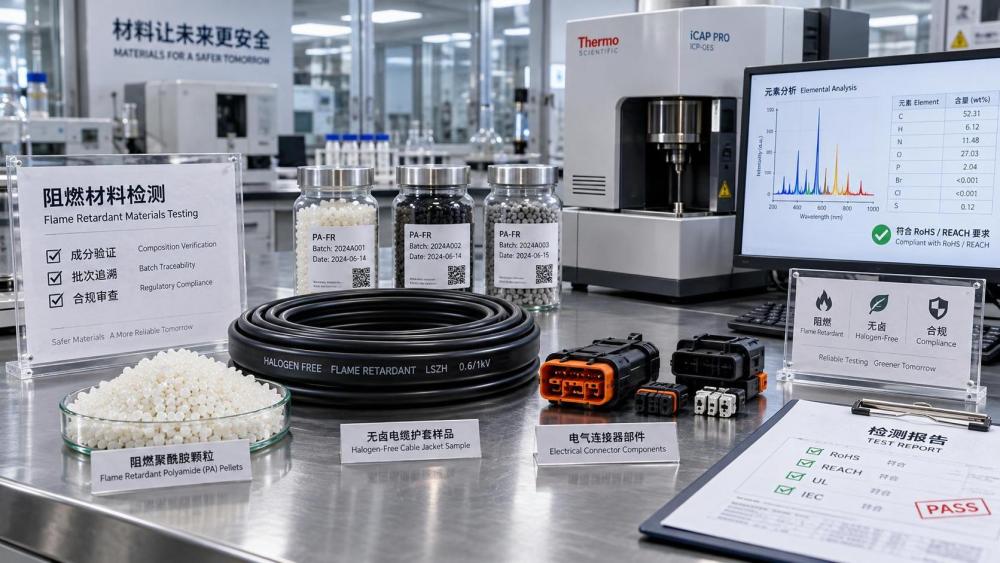
Laboratory testing can be a useful control, particularly for high-risk sourcing, recycled-content materials, unexplained formulation changes, or products supplied through long distribution chains. It is not, however, a universal shortcut to REACH compliance. Testing must be designed around a specific question: which substance, at what reporting limit, in which matrix, and for what compliance decision?
For example, screening may detect certain elemental signatures or classes of organic flame retardants, but it may not identify every proprietary additive, reaction product, polymer-bound substance, or trace impurity. A negative result only supports the method’s defined scope and detection capability. It cannot prove the absence of all regulated substances. Likewise, a detected substance does not on its own establish a breach; concentration, legal status, material category, intended use, and current regulatory conditions still need review.
A stronger approach is to use testing to challenge or confirm documented claims. If an incoming batch is tested, retain the sample identification, chain of custody, laboratory method, result, uncertainty information where provided, and the link to the batch certificate and supplier declaration. This makes the result useful in an audit rather than merely informative.
Watch the points where compliance can drift
Flame-retardant systems are vulnerable to quiet changes. A compounder may replace one synergist, pigment, carrier resin, mineral filler, recycled feedstock, or additive source while keeping the same commercial grade name. The finished part may still pass a routine flame test, yet the regulatory profile may no longer match the original declaration.
This is why quality agreements should define notification triggers. At minimum, request advance notice for any change to intentionally added flame retardants, changes that alter SVHC status, manufacturing-site transfers, changes in non-EEA supply routes, and changes affecting SDS classification or regulatory statements. For critical electrical, transport, construction, medical, or industrial applications, periodic document renewal is usually more reliable than treating the initial approval package as permanent.
Recycled polymers require extra care. The recycled content may be valuable from a circular-material perspective, but historical additives can be harder to characterize than a virgin resin formulation. Traceability, incoming-material controls, supplier screening strategy, and batch consistency become part of the REACH verification conversation. The same caution applies to imported regrind, reprocessed cable compounds, and mixed-source feedstock.
A practical approval decision
A material can generally move toward approval when the supplier identity and role are clear, the grade and formulation scope are traceable, the regulatory declaration is current, relevant registration responsibilities have been addressed, SVHC and restriction reviews are specific, and the documentation aligns with the actual use. Any mismatch deserves escalation: an SDS naming a substance absent from the declaration, a declaration with no list date, an unexplained change in hazard classification, or a supplier unwilling to state who holds the REACH responsibility.
For safety managers, the key question is not simply, “Does this material have a REACH statement?” It is, “Can we demonstrate why this exact flame-retardant material is suitable for this supply route and use, based on current evidence?” That standard produces better decisions and fewer surprises during customer audits, regulatory reviews, or formulation changes.
APIM’s coverage of flame-retardant compounds, polymer processing, recycled materials, and industrial applications is built around this kind of practical linkage between formulation, processing control, safety documentation, and supply-chain evidence. In a final review, compare the compliance file with the actual purchase specification, processing conditions, and finished-product requirements. The most reliable conclusion comes from those records agreeing—not from a broad compliance claim alone.
Have questions about this sector analysis, or seeking best practices specific to your niche? Drop us a line below and let the senior consultants at APIM assist you.
We respect your privacy. Your information is strictly confidential.
Related News
- 00
0000-00
How does feedstock affect depolymerization equipment selection? - 00
0000-00
US Sets 213.44% Preliminary Antidumping Deposit on Chinese PTMEG - 00
0000-00
When should epoxy be used as a thermal interface material for semiconductors? - 00
0000-00
US Midterm Results Unlikely to Quickly Shift Recycled Plastics Market or Legislation - 00
0000-00
When should you choose carbon fiber over glass fiber composites for lightweight parts?