




How to verify compliance before choosing a modified polymers supplier
How to verify compliance before choosing a modified polymers supplier
When a team starts screening a modified polymers supplier, the conversation often begins with datasheets, price, lead time, and sample availability. Compliance usually shows up a bit later, sometimes only after the RFQ gets serious. That is backwards. In modified plastics, compliance is not a paperwork layer added after material selection. It sits inside the formulation, the compounding process, the traceability system, and the supplier’s ability to keep all of that stable over time.
This matters whether the compound is a glass-fiber reinforced PA for an under-the-hood bracket, a flame-retardant PC blend for electrical housings, a conductive polymer for electronics handling trays, or a recycled-content formulation for packaging and industrial products. A material can pass an initial lab check and still become a sourcing problem later if the supplier cannot prove consistent regulatory control, change management, or batch-level traceability.
Technical evaluation teams usually need a more disciplined approach: verify what standards apply, check what the supplier is actually certifying, and separate marketing claims from controlled documentation.
Start with the compliance scope, not the certificate list
A common mistake is asking every supplier for the same set of documents. That sounds efficient, but it often produces the wrong result. Compliance requirements for a modified polymer depend on where the part will be sold, what it touches, how it is processed, and what failure mode matters most. Automotive, electrical, medical, consumer electronics, and food-contact packaging do not ask the same questions.
Before evaluating supplier documents, define the project boundary in plain engineering terms:
- End-use market and country of sale
- Application environment: heat, chemicals, UV, wear, electrical exposure
- Whether the part is structural, cosmetic, insulating, conductive, or flame-retardant
- Any customer-mandated restricted substance or recyclability requirements
- Whether the material will be extruded, injection molded, thermoformed, bonded, or co-processed with other layers or components
Once this scope is clear, it becomes easier to judge what evidence is relevant. A supplier may proudly present general ISO certifications, but those alone do not confirm that a halogen-free flame-retardant grade meets the exact electrical or substance-control expectations of your program.
Look beyond quality management certificates
Most established compounders can provide quality management certificates. They matter, but they are only the outer shell. A certified management system does not automatically prove that a specific modified polymer grade is compliant for your application.
The useful question is narrower: what controlled evidence exists for the exact grade, formulation family, and production site you may approve?
Ask for grade-specific compliance declarations where relevant, and check whether they are current, signed, and tied to a revision-controlled product identity. If a supplier sends a broad corporate statement without a material code, issue date, or scope notes, treat that as a starting point, not proof.
In practice, strong suppliers tend to distinguish clearly between:
- Site or company certifications
- Material regulatory declarations
- Third-party test reports
- Internal lot release data
- Application-specific approvals or listings, where applicable
That separation is healthy. It shows they understand the difference between system compliance and product compliance.
Check traceability all the way back to formulation control
For modified compounds, compliance can drift when formulation control is weak. This is especially true in flame-retardant systems, recycled-content materials, filled compounds, impact-modified blends, and any resin using multiple additive packages. A good-looking TDS does not tell you how tightly the supplier controls incoming raw materials, feeder accuracy, dispersion, contamination risk, or lot genealogy.
Ask how the supplier tracks the following:
- Base resin source and grade changes
- Additive and masterbatch batch numbers
- Regrind or recycled content rules, if any
- Production line, date, and shift records
- Retention sample practices and lot release criteria
This is where compounding know-how meets compliance. Platforms such as APIM often frame the issue correctly: screw design, feeding precision, melt filtration, residence time, degassing, and cooling are not just process details. They affect consistency, and consistency is what keeps a compliant formulation compliant when it moves from pilot sample to regular production.
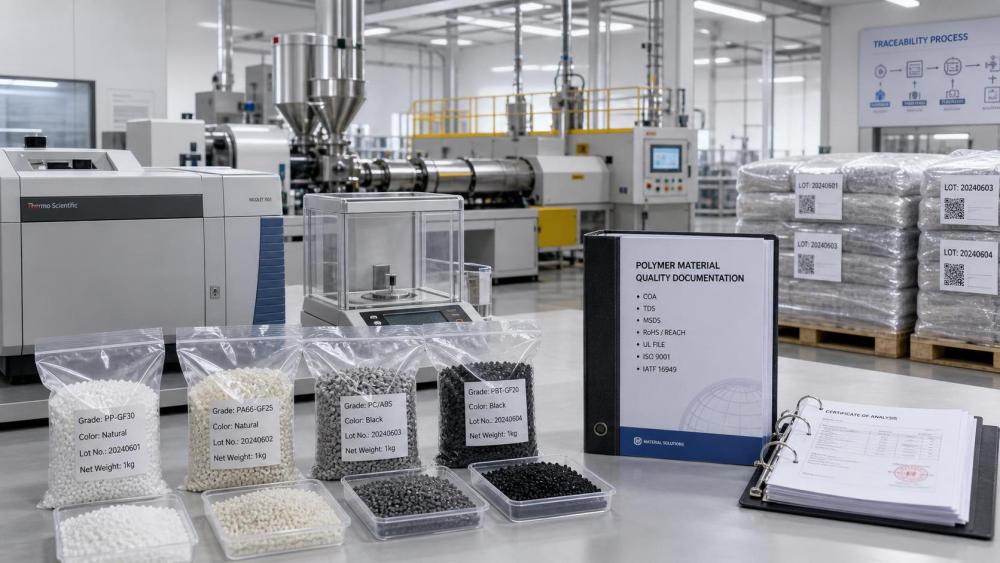
If a supplier cannot explain its change-control logic for raw materials or cannot trace finished pellets back to constituent inputs, that is a bigger warning sign than a slightly longer lead time.
Match test evidence to the actual risk in use
Technical teams sometimes over-focus on nominal values and under-focus on the wrong test method. A modified polymer may have acceptable tensile strength or MFI on paper, yet fail in the field because the tested condition does not reflect your application. Compliance verification should include a review of how the supplier validates the properties that matter in service.
For example:
The point is not to collect every report ever generated. It is to verify that the testing logic reflects the part’s actual risk profile. If the material will see hot glycol, cyclic loading, or soldering-adjacent temperatures, ask for evidence aligned to that reality.
Be careful with restricted substance declarations
This is one area where teams get caught by vague wording. A declaration that a material is “RoHS compliant” or “REACH compliant” may not be enough unless the supplier states what exactly is being declared, at what threshold, and for which product version. These regulations and substance lists are not all the same, and they evolve.
For modified polymers, this gets more complicated because additives drive performance. Flame retardants, stabilizers, pigments, antistats, impact modifiers, and processing aids all need scrutiny. If the supplier uses outsourced masterbatch or additive packages, ask whether those suppliers are also covered by incoming compliance verification.
A practical review usually includes:
- The exact regulation or customer standard referenced
- The material code and revision status
- Date of declaration and update policy
- Whether the statement is based on testing, supplier chain declarations, or both
- Any exclusions, use limitations, or country-specific notes
If the answer is “we have never had an issue,” keep asking. That is not a control system.
Audit the supplier’s change management before approving the grade
In long-life industrial programs, change management is often more important than the first approval package. A material that meets requirements today can become non-equivalent later if the supplier changes resin source, additive supplier, filler loading window, stabilizer package, or manufacturing site without a robust notification process.
Ask directly:
- What changes trigger customer notification?
- How much notice is provided?
- Which changes require requalification?
- Can the supplier issue PCNs or equivalent controlled notices?
- How are old and new lots segregated during transition?
This is where experienced buyers and R&D teams tend to separate capable suppliers from merely responsive ones. A supplier may ship samples quickly and answer emails fast, but if they cannot manage formulation change discipline, the downstream cost lands on your side.
Process capability still matters to compliance
Compliance is not purely regulatory. It also includes whether the compound can be processed in a stable, repeatable way without creating out-of-spec parts. In modified polymers, poor dispersion, moisture sensitivity, gel contamination, inconsistent pellet size, or unstable viscosity can turn an otherwise approved material into a production headache.
That is why technical teams should ask about processing windows and not rely only on nominal property sheets. For extrusion and compounding-related materials, details such as degassing capability, filtration practice, and temperature profile control are worth discussing. APIM’s industry coverage is useful here because it treats material performance and process control as one system rather than separate topics. That is the right mindset when evaluating suppliers.
If possible, compare supplier claims against trial behavior: drying sensitivity, color drift, flow stability, screw deposit, warpage, and scrap rate. Those observations often reveal weaknesses before a formal audit does.
Do not treat sustainability claims as self-proving
Recycled polymers, bio-based content, and low-impact formulations are becoming more common in sourcing discussions, but their compliance burden is not lighter. In some cases, it is heavier. If a supplier offers recycled-content modified compounds, verify how they support traceability, feedstock classification, and composition stability. If the material is proposed for demanding applications, ask what technical compromises, if any, are expected in impact, odor, color, or thermal stability.
This does not mean sustainable materials are risky by default. It means they need the same level of evidence as virgin-based compounds, sometimes more.
A workable verification sequence
In real projects, the most efficient approach is usually staged. Define application-specific compliance needs first. Then request grade-level declarations and key test evidence. After that, review traceability and change-control practices. If the supplier remains a candidate, move into processing trials, deeper documentation review, or an audit depending on project criticality.
That sequence saves time because it prevents teams from over-auditing suppliers that never had the right regulatory fit in the first place, while also preventing late-stage surprises from suppliers that looked acceptable on paper.
Choosing a modified polymers supplier is rarely just about who can make the compound. The harder question is who can keep the compound compliant, traceable, and consistent after commercialization. If a supplier can answer that with controlled documents, process discipline, and application-aware testing, you are looking at a much safer starting point.
Have questions about this sector analysis, or seeking best practices specific to your niche? Drop us a line below and let the senior consultants at APIM assist you.
We respect your privacy. Your information is strictly confidential.
Related News
- 00
0000-00
How does washing affect contamination in post-consumer recycled PP resins? - 00
0000-00
How does feedstock affect depolymerization equipment selection? - 00
0000-00
US Sets 213.44% Preliminary Antidumping Deposit on Chinese PTMEG - 00
0000-00
When should epoxy be used as a thermal interface material for semiconductors? - 00
0000-00
US Midterm Results Unlikely to Quickly Shift Recycled Plastics Market or Legislation