




How to verify UV curable adhesives for medical device biocompatibility
A UV adhesive can produce an exceptionally clean, rapid bond on a catheter hub, sensor housing, diagnostic cartridge, or wearable component. Yet for a medical device, a successful bond is only the beginning of the verification story. The cured adhesive may sit close to a patient-contacting pathway, be exposed to sterilization, or release trace substances that were never visible during routine production inspection.
For quality and safety teams, verifying UV curable adhesives for medical devices means building evidence that the adhesive, its cured state, its manufacturing process, and its intended use are all suitable for the device’s biocompatibility profile. The question is not simply, “Is this adhesive medical grade?” A more useful question is: “Can we demonstrate, under our actual conditions of use, that this adhesive does not create an unacceptable biological safety risk?”
That distinction matters. Supplier statements can be valuable, but they do not replace a device-specific biological evaluation. A formulation may be appropriate for one external-contact wearable device and inappropriate for a long-term implant, even if both applications use the same adhesive chemistry.
Start with the finished-device exposure, not the adhesive label
The most reliable verification process begins by defining how the adhesive exists in the final medical device. Is it fully enclosed behind a rigid housing? Could it contact intact skin through a thin film? Is it adjacent to a fluid path, drug reservoir, or gas channel? Could an uncured residue migrate to a patient-contacting component during assembly?
These details determine the scope of the assessment. Under the ISO 10993 biological evaluation framework, device categorization typically considers both the nature of body contact and the duration of exposure. A limited-contact external device, a mucosal-contact device, and an implantable device demand very different levels of evidence.
For example, an adhesive used to secure an optical component inside a sealed diagnostic instrument may require a focused rationale showing that patient exposure is not reasonably expected. By contrast, an adhesive bonding a wound-care sensor patch, a blood-contacting assembly, or a component used in an invasive procedure requires far more careful evaluation of leachables, residual monomers, and biological endpoints.
Quality teams should document the intended use in language that can be traced into the risk management file:
- Where is the cured adhesive located within the device?
- Can the patient, user, or administered fluid contact it directly or indirectly?
- What is the maximum foreseeable contact duration?
- Is the bond exposed to heat, moisture, disinfectants, lipids, drugs, or sterilization?
- Could wear, cracking, incomplete cure, or assembly variation increase exposure?
This early mapping avoids a common and costly mistake: commissioning biocompatibility testing for a neat adhesive coupon while the real device contains different substrates, a different cure depth, and a different surface-area-to-volume ratio.
A “medical-grade” claim is a starting point, not approval evidence
In the medical adhesive market, terms such as “medical grade,” “biocompatible,” or “ISO 10993 tested” are often used in good faith, but they must be interpreted precisely. They may refer to a cured sample tested by the adhesive manufacturer under a particular extraction condition. They may apply only to selected biological endpoints. They may also be based on a prior formulation revision rather than the exact product lot and process now being considered.
Before placing confidence in a supplier declaration, request the context behind it. A meaningful review normally includes the adhesive’s product designation and formulation status, test reports or summaries, curing conditions used for test specimens, test laboratory information, extraction conditions, the biological endpoints assessed, and any stated limitations on use.
A quality reviewer should be able to answer: Was the adhesive tested after full cure at the recommended energy dose? Was it tested as a free-standing cured material, or as part of a representative assembly? Were the tested conditions relevant to our patient-contact classification? If the answer is unclear, the statement should be treated as supportive information rather than final justification.
Formulation control also deserves attention. UV-curable systems can contain oligomers, reactive diluents, photoinitiators, stabilizers, pigments, adhesion promoters, and other additives. A change in any of these constituents, even when performance specifications appear unchanged, may affect extractables and toxicological assessment. Supplier change-notification agreements are therefore not merely procurement formalities; they are part of the device’s continuing biological safety control.
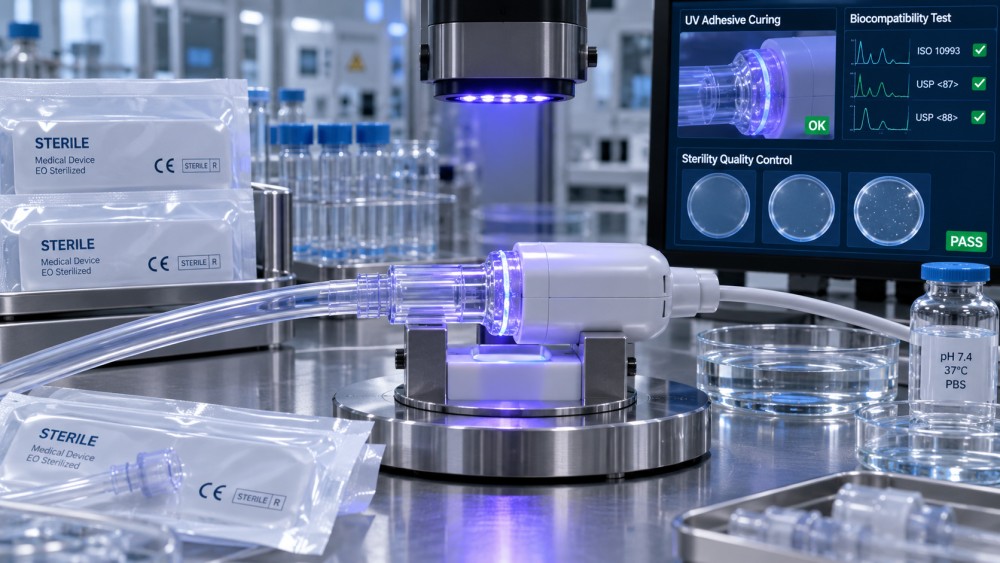
Understand what UV curing adds to the biocompatibility question
UV-curable adhesives are attractive because they offer short cure cycles, targeted application, low-temperature processing, and compatibility with many plastics, glass, and metals. Those same advantages introduce process-sensitive variables. Unlike a simple material purchase decision, the biological profile of a UV adhesive is closely tied to how completely and consistently it cures in the actual assembly.
Insufficient exposure can leave residual reactive species. Excessive exposure may generate heat, stress sensitive substrates, or affect nearby materials. Shadowed areas, opaque components, pigment loading, bond-line thickness, lamp aging, distance from the source, and fixture geometry can all change cure performance.
For this reason, biocompatibility verification should not be separated from process validation. The production method used to manufacture test articles must represent the validated manufacturing window. If a laboratory receives perfectly cured coupons made under ideal conditions but production uses a complex multi-part geometry with partially shadowed bond lines, the test program may miss the actual risk.
Useful controls commonly include measured irradiance and dose, defined lamp maintenance intervals, fixture verification, adhesive dispense-volume limits, maximum bond-line thickness, substrate cleanliness requirements, and cure confirmation methods. Depending on the system, cure confirmation may involve tack-free inspection, hardness, spectroscopy, thermal analysis, extraction screening, or destructive bond testing. No single method proves biocompatibility, but together they help show that the tested cure state is maintained in routine manufacturing.
Build the evidence package around ISO 10993 and risk management
ISO 10993-1 provides the overall principles for evaluating the biological safety of medical devices within a risk management process. It does not mandate that every device undergo every possible test. Instead, it calls for a science-based evaluation of available data, material characterization, exposure, toxicology, and residual uncertainty.
For UV curable adhesives medical devices, a practical evidence package often has several connected layers.
1. Chemical and material characterization
The review begins with what is known about the adhesive and what may be released from the finished device. ISO 10993-18 is widely used as a reference for chemical characterization of medical device materials. It supports identification and estimation of chemical constituents and extractables under conditions relevant to intended use.
Analytical work may include screening for volatile, semi-volatile, and non-volatile organic compounds, as well as inorganic constituents where relevant. The goal is not simply to generate a long chromatogram. The goal is to identify substances that may be released at levels requiring toxicological assessment, while recognizing that the whole device assembly can contribute compounds from substrates, inks, mold-release agents, packaging residues, or cleaning steps.
2. Toxicological risk assessment
Where chemical characterization identifies potential leachables, a qualified toxicologist evaluates them in relation to patient exposure. ISO 10993-17 provides a framework for toxicological risk assessment of device constituents. This work considers the identity of the chemical, dose, route and duration of exposure, available toxicological data, and the uncertainty in the assessment.
A detected compound is not automatically a device failure. Equally, a “not detected” result is not automatically reassuring unless the analytical method is suitable for the expected compounds and exposure scenario. The important outcome is a documented conclusion that residual chemical risk is adequately controlled or that additional action is required.
3. Biological endpoint testing, where justified
Depending on device categorization and the evidence already available, biological testing may include cytotoxicity evaluation under ISO 10993-5 and other endpoints identified through the ISO 10993-1 evaluation plan. Sensitization, irritation or intracutaneous reactivity, acute systemic toxicity, implantation, hemocompatibility, genotoxicity, and longer-term endpoints may be relevant in particular applications.
Testing should be selected because it addresses a specific residual risk, not because it creates a familiar checklist. For a device with prolonged or invasive contact, a narrow cytotoxicity result alone is rarely enough. For a non-contacting internal bond in a sealed device, extensive testing may be less informative than a strong exposure rationale supported by manufacturing controls and chemical data.
Sterilization can change the answer after the adhesive has passed initial testing
A bond that appears stable immediately after UV cure may behave differently after ethylene oxide sterilization, gamma irradiation, electron beam exposure, steam sterilization, or repeated high-level disinfection. Sterilization can alter polymer networks, affect adhesion at interfaces, increase discoloration, generate degradation products, or change extractable profiles.
Verification should therefore consider the adhesive in its final sterilized state whenever the finished device is supplied sterile. If the device is reprocessed, assess the maximum validated number of cleaning and sterilization cycles. Mechanical bond strength is important, but it is not enough: a bond can retain strength while its chemical release profile changes, or it can crack in a way that creates a new exposure pathway.
Stability planning should also account for shelf life and packaging. UV adhesive systems may be sensitive to moisture, oxygen exposure, temperature history, and light before curing. After assembly, aging can influence the adhesive-substrate interface. Accelerated aging data can support a shelf-life rationale when designed appropriately, but it should be linked to real-time data and a realistic understanding of the device’s storage conditions.
Use representative test articles—or clearly justify why you cannot
One of the strongest principles in medical device verification is representativeness. A cured adhesive disk may be useful for early supplier screening, but it may not represent the final article. In the device, the adhesive may be present in a thin annular bond line, in contact with polycarbonate or stainless steel, partially covered by another material, and subjected to a sterilization cycle.
Whenever possible, prepare test samples using production-equivalent materials, equipment, cure parameters, cleaning steps, and post-cure handling. Include worst-case features such as the maximum adhesive volume, minimum UV dose within the validated range, maximum bond-line thickness, and the relevant surface area exposed to extraction media. If using a surrogate is necessary, document why it is conservative and scientifically appropriate.
This is particularly important when a device has fluid-contacting pathways. A cured adhesive may not be intentionally exposed to fluid, but a small assembly defect, capillary pathway, or incomplete seal can make indirect contact plausible. Design verification, leak testing, and biological evaluation should speak to one another rather than exist as isolated files.
A practical review checklist for quality and safety teams
Before approving a UV adhesive for a medical device program, confirm that the following questions have documented answers:
- Is the exact adhesive formulation identified, controlled, and covered by supplier change notification?
- Has the device contact category and exposure duration been defined under the biological evaluation plan?
- Does the assessment address the adhesive as cured in the final or representative device configuration?
- Are UV dose, cure geometry, lamp condition, and bond-line limits controlled through process validation?
- Have incomplete cure and shadow-area risks been considered in the design and manufacturing FMEA?
- Are chemical characterization and toxicological assessment adequate for the expected patient exposure?
- Does the evidence reflect the final sterilization method, packaging, aging condition, and intended reprocessing cycle?
- Are relevant test reports, supplier documents, deviation records, and rationale documents traceable within the quality system?
Common shortcuts that create avoidable regulatory risk
The most frequent shortcut is relying on a supplier’s cytotoxicity statement as proof that the finished device is biocompatible. Another is treating bond strength validation as evidence of complete cure. A third is testing a pre-sterilization sample and assuming the result remains valid after sterilization or aging.
There is also a procurement-driven risk: replacing an adhesive with a “technically equivalent” alternative during a supply disruption. Equivalent viscosity, cure speed, or tensile strength does not establish equivalent chemical composition or biological safety. Any supplier, formulation, pigment, photoinitiator, or process change should pass through documented change control and an impact assessment.
The defensible outcome is a connected rationale
Verifying UV curable adhesives for medical devices is not about collecting the largest possible stack of reports. It is about connecting material chemistry, device design, patient exposure, curing controls, sterilization, and toxicological evidence into one defensible conclusion.
For quality and safety professionals, that connected view brings confidence at the point where it matters most: when an auditor asks why this adhesive is suitable for this device, under these manufacturing conditions, for this intended patient use. A well-built answer protects more than a submission timeline. It protects the consistency and safety of every device that leaves the production line.
Have questions about this sector analysis, or seeking best practices specific to your niche? Drop us a line below and let the senior consultants at APIM assist you.
We respect your privacy. Your information is strictly confidential.
Related News
- 00
0000-00
How does washing affect contamination in post-consumer recycled PP resins? - 00
0000-00
How does feedstock affect depolymerization equipment selection? - 00
0000-00
US Sets 213.44% Preliminary Antidumping Deposit on Chinese PTMEG - 00
0000-00
When should epoxy be used as a thermal interface material for semiconductors? - 00
0000-00
US Midterm Results Unlikely to Quickly Shift Recycled Plastics Market or Legislation