




How to Verify REACH Compliance Materials Before Supplier Approval
What should quality and safety teams check before approving a supplier for REACH compliance materials?
Before a new supplier is cleared, the real job is not collecting a single REACH statement and filing it away. The job is proving that the material, the document set, and the supplier’s own control process actually match. For quality and safety teams, that usually means checking three things together: the material identity, the substance information behind it, and the date and scope of the declaration.
A supplier can send a polished declaration that says a resin, film, adhesive, or compound is compliant, but if the grade code, revision, manufacturing site, or intended market is unclear, the statement has limited value. In practice, weak verification creates trouble later in incoming inspection, customer audits, export documentation, and product stewardship reviews. A tighter approval workflow is much easier than trying to rebuild traceability after production has started.
Is a supplier’s REACH declaration alone enough?
Usually, no. A declaration is a starting point, not a complete approval basis. It tells you what the supplier is claiming, but not always how that claim is supported.
For REACH compliance materials, the declaration should be tied to a specific product name or grade, issue date, supplier legal entity, and document owner. If the statement is broad, such as “all our products comply,” that is a warning sign. Quality teams need product-level evidence, especially when the material contains additives, colorants, fillers, flame retardants, stabilizers, recycled content, or adhesive chemistry that may affect substance status.
The useful question is not “Do you have a declaration?” but “What data supports this declaration for this exact material?”
Which documents matter most in the first review?
A practical first-pass review usually includes the documents below. If one of them is missing, you do not necessarily reject the supplier immediately, but you should stop short of full approval until the gap is resolved.
- REACH compliance declaration linked to the exact product grade
- Safety Data Sheet, where applicable, with current revision date
- SVHC communication statement for articles or materials supplied into article production
- Substance information or composition disclosure at a level sufficient for regulatory screening
- Any relevant test reports or third-party analytical data, if the material carries higher concern
- Change control or material revision procedure showing how the supplier updates compliance status
In polymer supply chains, this matters because the base resin may be stable while the additive package changes. That is where many approval mistakes start.
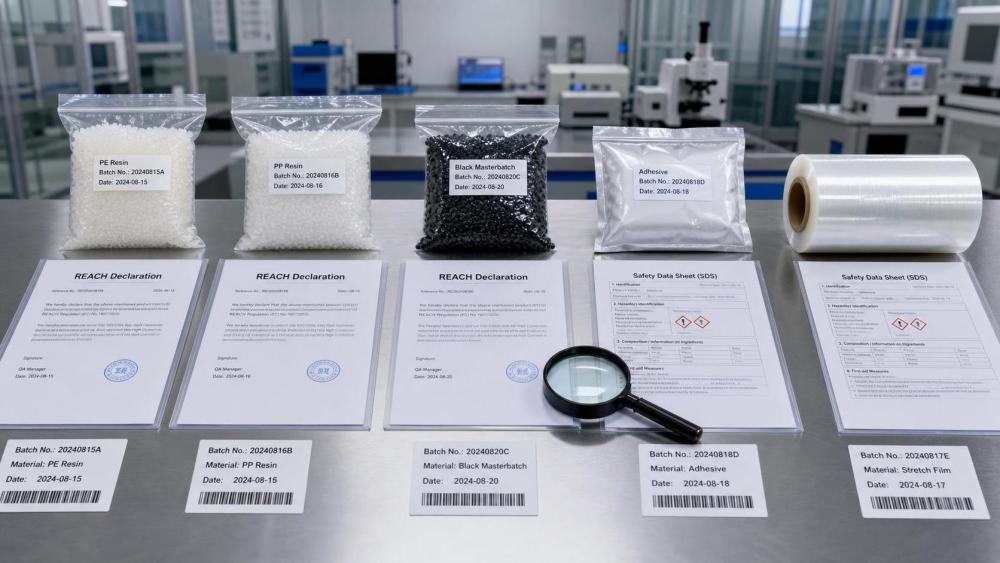
What exactly should be verified on the declaration itself?
Read the declaration like a control document, not a marketing attachment. The most important fields are basic, but they are often where problems hide.
If any of those points are vague, the declaration is too weak to carry supplier approval on its own.
How do you confirm the material identity is traceable?
This is where many teams are less strict than they should be. A compliant document set is not very useful if it cannot be tied to the material arriving at your dock.
Match the declared product against the quotation, technical data sheet, purchase specification, label format, and sample identification. For compounds, masterbatches, adhesives, and multilayer materials, check whether customer-specific versions exist. A generic name like “FR PC compound” is not enough if the approved product is actually a custom flame-retardant formulation with color and filler modifications.
The simplest control is to require that every compliance document references the exact commercial grade and, where relevant, internal formulation code or revision.
Do all materials need the same level of REACH review?
Not really. Risk should drive depth. A natural-color virgin polymer from an established producer may need a lighter review than a recycled compound, pigmented adhesive, conductive formulation, or imported specialty film with several functional layers.
Materials that usually deserve closer review include products with recycled content, unknown additive packages, brominated or phosphorus-based flame retardants, plasticizers, curing agents, solvents, biocides, surface treatments, and imported formulations supplied through traders rather than original manufacturers. In those cases, ask for deeper composition support and stronger change notification commitments.
What is the practical role of the SDS in REACH verification?
The Safety Data Sheet does not replace a REACH declaration, but it often reveals whether the supplier’s regulatory file is being maintained properly. Review the issue date, section consistency, composition information where disclosure is required, and the identity of the legal manufacturer or importer.
If the SDS and the declaration contradict each other on product identity, hazard status, or supplier details, stop there and resolve that conflict first. It usually means the documents were generated from different systems or different formula versions.
How should teams review SVHC information without overcomplicating the process?
Keep it specific. Ask whether any Substance of Very High Concern on the Candidate List is present above the communication threshold in the supplied item or material, and require the answer to be tied to the exact product grade. Do not accept a broad sentence with no product reference and no date.
For materials used to make articles, this step is especially important because downstream communication duties can affect labeling, customer disclosure, and internal risk review. Quality and safety teams should also check whether the supplier has a routine for updating SVHC status when the Candidate List changes. A document from years ago is not a live control.
When should you ask for analytical testing or third-party evidence?
Not for every material. Testing is most useful when the formulation risk is high, the source is new or opaque, or the supplier documentation is too generic. It can also be justified when customer contracts require additional confidence for restricted substances.
That said, laboratory testing has limits. It does not automatically prove full REACH compliance, and it may not detect every relevant substance in every matrix. Use it as supporting evidence where the supply chain data is weak, not as a substitute for supplier accountability.
What are the most common red flags during supplier approval?
A few patterns come up again and again:
- The declaration covers an entire product range with no grade-level identification.
- The document has no issue date or the date is clearly outdated.
- The supplier is a distributor, but there is no traceability back to the original manufacturer.
- A recycled or modified material is supported by the same generic statement used for virgin grades.
- The SDS, TDS, and declaration do not align on product code or manufacturer identity.
- There is no clear process for notifying customers about formula or regulatory changes.
Any one of these may justify a clarification request. Several together usually mean the approval package is not mature enough.
How can procurement, quality, and EHS divide the work without missing critical checks?
The cleanest approach is to separate ownership by decision type. Procurement confirms who the legal supplier is and what exact grade is being sourced. Quality confirms document traceability, revision control, and match to the purchase specification. EHS or product stewardship reviews the substance-related claims and communication obligations. That division sounds obvious, but many gaps happen because everyone assumes another team checked the same point.
A short approval checklist works better than a long policy document. If the checklist forces each function to sign off on a defined question, weak declarations are less likely to slip through.
What should happen after the supplier is approved?
Approval is not the finish line. REACH compliance materials need ongoing control because formulations, substance lists, and supply sources can change. Set a refresh rule for critical documents, require notification for composition or site changes, and link supplier updates to your material master or approved vendor list.
For higher-risk materials, build a trigger-based review: new grade revision, manufacturing site transfer, additive change, recycled content adjustment, or customer market expansion. That is more reliable than waiting for the next audit to discover the file is stale.
What is a sound approval standard when time is tight?
A practical rule is this: do not approve on document presence alone; approve on document consistency and traceability. If the supplier can show a current grade-specific REACH statement, aligned SDS or equivalent technical documentation, clear source identity, and a defined change-control path, you have a workable compliance basis. If those pieces do not line up, speeding the approval only shifts the problem downstream.
For quality and safety teams, the strongest habit is simple: every compliance claim must be tied to a named material, a dated record, and a responsible supplier entity. That one rule eliminates a surprising number of approval mistakes.
Have questions about this sector analysis, or seeking best practices specific to your niche? Drop us a line below and let the senior consultants at APIM assist you.
We respect your privacy. Your information is strictly confidential.
Related News
- 00
0000-00
Do polyolefin hot melt adhesives bond well to polyethylene? - 00
0000-00
Korean Study Finds PLA Barely Degrades in Landfill After 320 Days - 00
0000-00
How to assess batch consistency from a thermal potting compounds supplier - 00
0000-00
How much weight can carbon fiber reinforced plastics save in cars? - 00
0000-00
Switching from PS to ABS Sheet Extrusion: Equipment Checks