




How to Select Low Outgassing Polymers for Aerospace Assemblies
How to Select Low Outgassing Polymers for Aerospace Assemblies
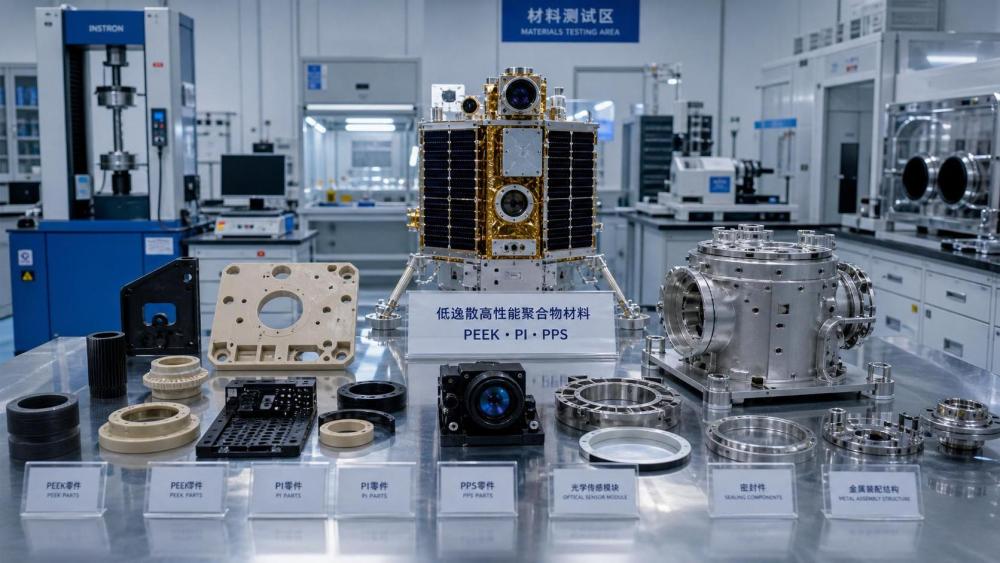
Selecting low outgassing polymers for aerospace assemblies is not just a materials choice.
It shapes contamination control, thermal stability, mechanical reliability, and long-term mission performance.
That is why material selection often becomes a system-level decision, not a simple resin comparison.
In aerospace, even trace volatile release can fog optics, affect sensors, or contaminate sensitive surfaces.
This also means a polymer that works on Earth may fail under vacuum and thermal cycling.
For teams evaluating low outgassing polymers for aerospace, the challenge is balancing cleanliness with structural and process needs.
A good decision usually starts with understanding what “low outgassing” actually means in practical assembly terms.
What Low Outgassing Really Means in Aerospace
Low outgassing polymers for aerospace are materials that release very limited volatile compounds under vacuum and heat.
The concern is not only total mass loss.
Condensable residue matters just as much because it can deposit onto critical components.
Most aerospace programs reference ASTM E595 for baseline screening.
Two numbers usually get the most attention: TML and CVCM.
TML measures total mass loss during testing.
CVCM tracks collected volatile condensable materials that may foul nearby surfaces.
A low number is helpful, but it is not the whole story.
A polymer may pass outgassing limits yet still struggle with radiation, atomic oxygen, or extreme thermal movement.
So the selection process should always connect test data with the actual assembly environment.
Start with the Assembly Environment
The best low outgassing polymers for aerospace depend on where the part will operate.
Interior cabin use, satellite electronics, optical payloads, and propulsion-adjacent structures do not create the same demands.
Begin by mapping four conditions before comparing resin grades.
- Vacuum exposure level and duration.
- Maximum and minimum operating temperatures.
- Distance from optics, sensors, connectors, or coated surfaces.
- Mechanical loads, vibration, and dimensional tolerance needs.
This step sounds basic, but it prevents many wrong turns.
In actual sourcing decisions, contamination sensitivity often matters more than nominal strength.
A polymer near optical equipment may need far stricter screening than a bracket in a less sensitive zone.
Key Material Families to Evaluate
Several engineering polymers are commonly reviewed as low outgassing polymers for aerospace assemblies.
Each offers a different balance of processability, cost, thermal resistance, and cleanliness.
PEEK
PEEK is often shortlisted for high-performance aerospace parts.
It offers strong thermal stability, chemical resistance, and good mechanical retention at elevated temperatures.
Its main tradeoffs are cost and demanding processing conditions.
PI and PAI
Polyimide and polyamide-imide grades are valuable for very high temperature applications.
They are often considered where thermal endurance and dimensional stability dominate the decision.
Qualification time can be longer because formulation differences matter.
PPS
PPS is attractive when chemical resistance, dimensional control, and easier processing are needed.
For some components, it can be a practical alternative to more expensive ultra-high-performance materials.
PTFE and Fluoropolymers
Fluoropolymers are often reviewed for wire insulation, seals, and chemically aggressive environments.
Their friction and chemical performance are excellent, though mechanical rigidity may be limited.
LCP and Specialty Thermoplastics
Liquid crystal polymers can fit compact electronic assemblies needing precision and thin-wall molding.
However, shortlisting should still be tied to verified outgassing and end-use testing.
Do Not Evaluate Resin Alone
One common mistake is selecting low outgassing polymers for aerospace by base resin name only.
In practice, additives, fillers, colorants, lubricants, and residual processing aids can change outgassing behavior.
Glass fiber reinforcement may improve stiffness but affect surface quality and contamination risk during machining.
Carbon-filled grades may solve conductivity needs while introducing new qualification questions.
That is why a tested compound grade is more useful than a generic material family description.
Supplier process discipline also matters.
Moisture control, pellet cleanliness, packaging, lot consistency, and post-processing all influence final results.
Questions That Strengthen Material Screening
A stronger evaluation framework usually comes from better technical questions, not just bigger data sheets.
When screening low outgassing polymers for aerospace, ask suppliers for evidence tied to your actual use case.
- Which exact grade was tested under ASTM E595?
- Was the tested sample molded, machined, annealed, or post-cured?
- Are TML and CVCM results lot-specific or historical averages?
- What additives or reinforcements are included in the formulation?
- Is there data for thermal cycling, radiation exposure, or vacuum aging?
- What cleaning agents and assembly adhesives are chemically compatible?
- Can the supplier support traceability and change notification requirements?
These questions reduce the gap between brochure performance and assembly reality.
A Practical Comparison Framework
For decision-making, a comparison table keeps evaluation grounded.
It also helps separate must-have requirements from preferences.
This approach is especially useful when several low outgassing polymers for aerospace appear technically acceptable at first glance.
Common Risks During Qualification
Recent project reviews show a few recurring problems.
The first is assuming lab data automatically reflects assembled hardware behavior.
Machining fluids, handling contamination, and bonding agents can change cleanliness outcomes.
The second is underestimating geometry effects.
Thin sections, trapped volatiles, and enclosed spaces may create unexpected release patterns.
The third is overlooking supplier formulation drift.
A small additive change can trigger requalification work later.
For that reason, low outgassing polymers for aerospace should be managed through configuration control, not one-time approval.
How to Make the Final Selection
A practical final decision usually follows a staged filter.
- Remove materials without verified outgassing data.
- Screen remaining grades against thermal and mechanical limits.
- Review additives, post-processing, and assembly compatibility.
- Compare supplier traceability, lot consistency, and change control.
- Run application-level testing on the shortlisted grades.
This sequence keeps the decision tied to risk reduction.
It also prevents overpaying for premium polymers that add little functional value.
In many programs, the best low outgassing polymers for aerospace are not the most exotic ones.
They are the grades with the clearest data, stable supply, and best fit for the assembly environment.
Closing Perspective
Choosing low outgassing polymers for aerospace is ultimately about disciplined matching.
Match the polymer grade to the contamination risk, thermal profile, structural duty, and qualification path.
Then verify the compound, process history, and supplier controls with the same level of care.
That is where better material decisions usually become better mission outcomes.
For teams comparing candidate grades, the most useful next move is a structured shortlist built around application-specific evidence, not generic resin claims.
Have questions about this sector analysis, or seeking best practices specific to your niche? Drop us a line below and let the senior consultants at APIM assist you.
We respect your privacy. Your information is strictly confidential.
Related News
- 00
0000-00
How does washing affect contamination in post-consumer recycled PP resins? - 00
0000-00
How does feedstock affect depolymerization equipment selection? - 00
0000-00
US Sets 213.44% Preliminary Antidumping Deposit on Chinese PTMEG - 00
0000-00
When should epoxy be used as a thermal interface material for semiconductors? - 00
0000-00
US Midterm Results Unlikely to Quickly Shift Recycled Plastics Market or Legislation