




How to Qualify Polymer Material Suppliers for Risk Assessment and Compliance
How to Qualify Polymer Material Suppliers for Risk Assessment and Compliance
Effective supplier qualification for polymer materials risk assessment starts in the place many teams underestimate: not with commercial approval, but with technical doubt. A polymer supplier may present ISO certificates, a polished data sheet, and acceptable pricing, yet still create compliance exposure if the material formulation changes without notice, the traceability chain is weak, or the production process cannot hold batch consistency. For quality and safety teams, supplier qualification is less about proving that a company exists and more about proving that the delivered material will remain controlled, documented, and legally usable in the intended application.
That distinction matters because polymer materials are rarely simple commodities in regulated or performance-sensitive environments. A PA compound used in an automotive connector, a flame-retardant PC in an electrical housing, a TPU in a wearable device, or a multilayer film in food packaging may all look interchangeable at purchasing level. They are not interchangeable once migration limits, halogen declarations, UL recognition status, biocompatibility expectations, REACH communication duties, or processing stability enter the discussion. This is why supplier qualification for polymer materials risk assessment should be treated as a structured compliance exercise tied to actual end use, not a general vendor onboarding form.
One common mistake is to treat material compliance as a document collection task. Teams ask for RoHS, REACH, SDS, maybe a CoA template, and consider the supplier screened. Those documents are necessary, but they do not answer the harder questions. Who controls raw material changes in the supplier’s formulation? Is there a formal change notification process? Are restricted substances assessed only against intentionally added content, or also against reasonably expected impurities? Does the declaration apply to one grade, one production site, or an entire product family? If the supplier uses recycled content, can they explain source control and contamination management? A certificate without scope is often less useful than it appears.
What “qualified” really means in polymer sourcing
In practice, a qualified polymer supplier is one that can demonstrate repeatable control over four things at the same time: material identity, process stability, compliance evidence, and change management. If one of these is missing, the qualification is incomplete.
Material identity is more than a grade name. For compounds and modified resins, it includes base polymer type, reinforcement or filler system, additive package category, color system where relevant, and the manufacturing location that actually produces the grade. Process stability covers whether compounding, drying, filtration, pelletizing, contamination control, and testing are managed in a way that supports consistent downstream performance. Compliance evidence means the supplier can provide declarations and supporting records appropriate to the market and application. Change management is the discipline that prevents a “same grade” material from quietly becoming a different risk profile six months later.
This is where quality teams should push past generic supplier questionnaires. A polymer producer and a trader are not qualified in the same way. A producer may control formulation and manufacturing directly. A distributor may add value through regional inventory, technical support, and documentation handling, but often depends on the original manufacturer for deep formulation knowledge. For compliance-sensitive applications, that distinction should be explicit in the approval record.
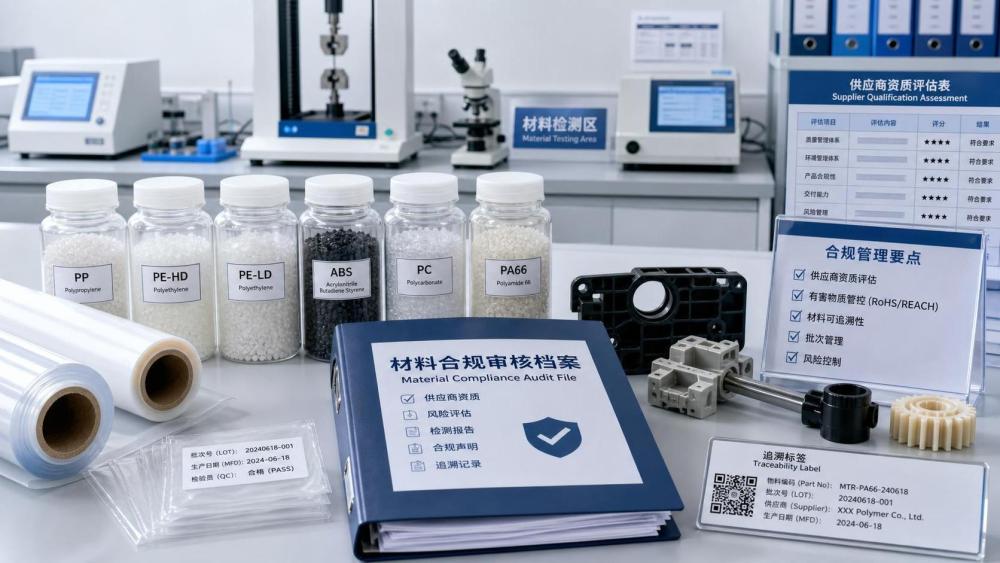
Risk assessment should follow the application, not the resin family
A useful qualification process begins by ranking material risk in context. The same PBT supplier may be low risk for a non-visible industrial bracket and high risk for an electrical connector exposed to heat, creepage requirements, and regional substance restrictions. The same PET film may be routine for protective lamination and much more sensitive for pharmaceutical packaging. Resin family alone tells you very little about compliance burden.
A practical screening model usually looks at three layers together:
- Application risk: electrical safety, food contact, medical contact, transportation, consumer exposure, flame performance, or long-term structural duty.
- Material complexity: virgin resin versus modified compound, reinforced grade, flame-retardant system, color concentrate, adhesive-backed film, recycled-content formulation, or multilayer structure.
- Supply chain opacity: direct manufacturer versus brokered source, single site versus multiple sites, stable formulation versus customer-specific modifications.
When those three factors stack up, qualification should go deeper. That may include a process audit, a formulation disclosure protocol under confidentiality, test plan alignment, or tighter lot-release documentation. Without this risk filter, teams often spend too much time screening low-risk items and too little time challenging materials that can trigger recalls, nonconformities, or regulatory reporting issues.
Documents matter, but only when they are tied to scope and control
For polymer suppliers, the usual compliance file may include an SDS, technical data sheet, certificate of analysis format, declaration for RoHS, communication relevant to REACH SVHC obligations, and quality management certification such as ISO 9001. Depending on sector, teams may also ask about IATF 16949, ISO 14001, food contact statements, USP Class VI or ISO 10993 related support, UL file references, conflict minerals reporting where relevant to assemblies, or specific customer restricted substance lists. None of these should be requested blindly. The point is to confirm that the supplier understands which statements are regulatory, which are customer declarations, and which depend on final article design rather than raw material alone.
For example, polymer suppliers can often support food contact compliance with statements about constituent substances and intended regulatory frameworks, but final compliance of a package depends on article design, processing conditions, and migration behavior. In electrical applications, a supplier may provide a UL-recognized resin grade, but that does not automatically validate every molded part geometry. Qualification fails when these boundaries are blurred and commercial teams treat upstream declarations as complete downstream approval.
This is also why revision control deserves more attention. A declaration dated two years ago, with no revision history and no site reference, is weak evidence. A stronger file links each declaration to a specific material code, manufacturing site, revision date, responsible issuer, and change notification policy. Experienced compliance teams look for control systems, not just paperwork volume.
Process capability often predicts compliance reliability
Many polymer compliance problems are not caused by dramatic violations. They start with ordinary process drift. In compounding, poor feeder calibration can shift additive ratios. In recycled polymer streams, sorting variation can alter contamination risk. In flame-retardant grades, substitution within an additive package may affect declaration accuracy. In film and sheet production, inconsistent thickness or surface treatment can turn a formally compliant material into a functional failure at converting stage.
That is why supplier qualification should include a basic view of manufacturing discipline. You do not always need a full audit, but you do need evidence of how the supplier manages incoming raw material approval, batch coding, retained samples, off-spec segregation, equipment cleaning, rework rules, and complaint feedback. For a twin-screw compounded engineering plastic, it is reasonable to ask how formulation integrity is protected across lot changes. For adhesive systems and specialty films, storage conditions and shelf-life control may be just as important as chemistry.
The strongest suppliers are usually able to explain their process in operational terms. They can describe where contamination risk is highest, what is tested in routine release, what is verified periodically, and how customer notifications are triggered when raw materials or process parameters change. That kind of answer is more valuable than a polished statement claiming “strict quality control.”
A practical qualification framework
This framework is deliberately narrow. It avoids turning qualification into a paperwork warehouse and keeps attention on the points most likely to affect product safety, legal conformity, and field performance.
Where teams often misjudge polymer supplier risk
Several misunderstandings come up repeatedly. One is assuming that a virgin polymer producer is automatically lower risk than a compounder. In reality, a disciplined compounder with strong formulation control and transparent compliance support may be easier to qualify for a specific application than a large resin producer offering only generic declarations. Another is assuming that recycled-content materials are unmanageable from a compliance standpoint. They are not inherently unmanageable, but they usually require tighter source qualification, contaminant screening logic, and clearer communication about variability boundaries.
A third mistake is separating technical approval from supplier approval. Procurement may onboard a supplier based on commercial capability while engineering validates material performance separately. That split works until a formulation change, regional regulation update, or second-site transfer occurs and nobody owns the combined risk picture. In polymer supply chains, quality, regulatory, sourcing, and product engineering need one shared qualification record or the control system develops gaps.
The more demanding the application, the more important it is to qualify the supplier’s behavior under change, not just the current material state. Many nonconformities appear after approval, during cost optimization, reformulation, raw material substitution, or capacity expansion. A supplier that communicates early, documents clearly, and understands application-specific restrictions is usually safer than one with attractive paperwork but weak escalation habits.
What good qualification looks like in day-to-day use
Good supplier qualification for polymer materials risk assessment does not produce a perfect guarantee. It produces a defendable decision trail. A quality manager should be able to show why a supplier was approved, what evidence supported the decision, what use conditions were assumed, what documents are under revision control, and what events would trigger requalification. That is what stands up during customer audits, internal investigations, and regulatory scrutiny.
For teams working across engineering plastics, films, adhesives, and recycled polymers, the method should stay consistent even when the technical details change. Define the application risk. Confirm the exact material identity. Test the strength of traceability and change control. Read compliance documents for scope, not just presence. Ask enough about process discipline to understand whether the supplier can keep the material inside its declared boundary. That is usually the difference between a supplier that is approved on paper and one that is genuinely qualified for compliance-critical supply.
In other words, supplier qualification is not a gate at the start of sourcing. In polymer materials, it is an ongoing control point between formulation complexity, regulatory exposure, and real manufacturing variation. Teams that treat it that way tend to make fewer assumptions, ask better technical questions, and catch risk before it becomes a product problem.
Have questions about this sector analysis, or seeking best practices specific to your niche? Drop us a line below and let the senior consultants at APIM assist you.
We respect your privacy. Your information is strictly confidential.
Related News
- 00
0000-00
NAPCOR Report: US PET Bottle Recycling Rate Fell to 29% in 2025 - 00
0000-00
How does washing affect contamination in post-consumer recycled PP resins? - 00
0000-00
How does feedstock affect depolymerization equipment selection? - 00
0000-00
US Sets 213.44% Preliminary Antidumping Deposit on Chinese PTMEG - 00
0000-00
When should epoxy be used as a thermal interface material for semiconductors?