




How to Evaluate a Medical Grade Polymers Supplier for FDA Compliance and Material Traceability
How to Evaluate a Medical Grade Polymers Supplier for FDA Compliance and Material Traceability
Choosing a reliable medical grade polymers supplier requires more than checking product availability or price. For technical evaluation teams, FDA compliance, material traceability, lot consistency, and supporting documentation are the parts that determine whether a material can move through design control, validation, and audit without creating avoidable risk. In practice, the supplier is not just selling resin. The supplier is becoming part of the quality chain behind a medical device, diagnostic component, pharmaceutical packaging system, or healthcare assembly.
One of the most common misunderstandings is that “medical grade” is a universal regulatory category. It is not. In supplier conversations, the term usually refers to a polymer grade positioned for medical or healthcare use, often supported by biocompatibility data, controlled manufacturing, and a more formal documentation package than an industrial grade. That still does not mean the material is automatically approved for every medical application, nor does it mean the supplier itself is operating at the level your device program requires. A technical evaluation has to separate marketing language from actual evidence.
For FDA-related projects, the practical question is narrower and more useful: can this supplier provide a polymer with the quality controls, change management discipline, traceability, and regulatory support needed for the intended use? That framing usually leads to better decisions than asking whether a resin is simply “FDA compliant.”
What FDA compliance really means in polymer sourcing
A medical device manufacturer evaluating polymers will often encounter several overlapping but different ideas: FDA food contact status, Device Master File support, biocompatibility test data, quality system certifications, and declarations about raw material composition. These are not interchangeable. A supplier may offer a polymer based on constituents that appear in U.S. food contact regulations, but that does not by itself establish suitability for implantable, prolonged-contact, sterilized, or drug-contact applications. In the same way, a resin can be sold into healthcare markets without the supplier operating the kind of documented change control that a regulated customer expects.
Technical teams usually need to verify several layers at once. The first is composition-related support: statements on intentionally added substances, restricted materials, and where relevant, compliance references tied to applicable FDA frameworks. The second is application support: whether the supplier has data or declarations relevant to skin contact, fluid contact, limited-duration use, repeated sterilization, or specific processing conditions. The third is system support: whether documentation is version-controlled, regularly updated, and tied to actual production lots rather than generic product sheets.
This is where weak suppliers tend to show their limits. They may provide a polished technical data sheet, but when asked for a declaration of compliance, statement of composition control, sterilization compatibility information, or notice policy for formulation changes, the response becomes vague. For a technical evaluation team, that vagueness is already data.
Traceability is not a paperwork exercise
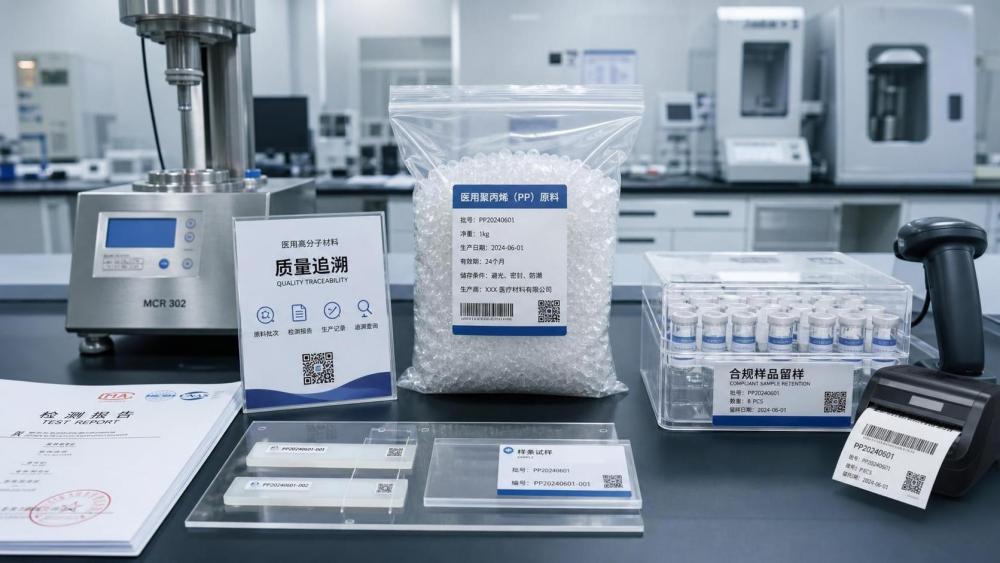
Material traceability matters because polymer performance problems often do not originate in the final molding step. They can come from resin lot variation, additive dispersion differences, contamination, drying history, packaging integrity, or undocumented upstream substitutions. In medical applications, the ability to trace a molded component back to a specific polymer batch, and from there to a controlled manufacturing record, is often what allows a deviation to be investigated without freezing an entire product line.
A capable medical grade polymers supplier should be able to explain traceability in operational terms. How is each lot identified? Can the lot be linked to production date, plant, line, and raw material inputs? How are retained samples managed? What happens if a customer asks for historical batch records during a complaint investigation? These are more revealing questions than asking whether the supplier “has traceability,” because most suppliers will say yes. The real distinction is depth and retrieval speed.
Traceability also needs to survive the realities of global supply. If a supplier uses multiple production sites, toll compounders, regional warehouses, or re-packaging partners, the chain must remain intact. Otherwise, the lot number on the shipped bag may not tell you enough to support root-cause analysis or audit review.
The supplier documents that actually matter
In early-stage sourcing, teams often collect too many documents and still miss the important ones. A broad folder of PDFs is not the same as a usable compliance package. What matters is whether the documents support technical review, regulatory review, and future change control.
A good sign is internal consistency across these records. If the regulatory declaration references one product code, the CoA shows another, and the technical sheet uses a broader family name, that creates unnecessary ambiguity. Small naming mismatches become large audit problems once material is incorporated into controlled design history and purchasing records.
Lot consistency is where supplier quality becomes visible
Medical polymer selection is often discussed in terms of nominal properties: tensile strength, melt flow, impact resistance, clarity, chemical resistance, sterilization tolerance. Those values matter, but for regulated production, consistency can matter more than the headline number. A material with slightly lower performance but stable lot-to-lot behavior is often easier to validate and keep in production than a higher-performing grade with wider variation.
This is especially relevant for modified compounds, filled systems, color-controlled materials, and polymers used in precision molding or extrusion. Additive content, moisture sensitivity, pellet geometry, contamination control, and thermal history can all influence downstream yield. If the supplier cannot discuss control methods for compounding, sampling, testing frequency, and nonconformance handling, there is a gap between the brochure and the manufacturing reality.
Technical evaluation teams should pay attention to how the supplier answers process questions. Serious suppliers can usually explain which properties are release-tested, which are type-tested, and which data points are informative rather than lot-certified. That distinction matters because many published material properties are not measured on every production batch.
Questions that reveal supplier maturity
A strong supplier review is rarely built on one decisive question. It comes from asking several practical questions that expose how the system works under pressure:
- Is the medical grade produced on a dedicated line, campaign basis, or shared line with purge and cleaning controls?
- How are formulation changes, raw material substitutions, and manufacturing site transfers governed?
- What is the formal notice period for changes that could affect form, fit, function, processing, or regulatory status?
- Can the supplier provide lot-specific documents with each shipment, and are these records easily retrievable later?
- What quality certifications are in place, and how do they relate to the actual plant making the resin or compound?
- Has the supplier defined what sterilization methods the material has been evaluated against, if any?
- How does the supplier handle complaints, investigations, and retained sample review?
None of these questions guarantee approval on their own. Together, they help determine whether the supplier can support a regulated lifecycle rather than just an initial sample order.
Where teams often make avoidable mistakes
One recurring mistake is treating biocompatibility data from the polymer supplier as a complete substitute for device-level assessment. Material data can be useful, and in some programs it is an important input, but the final device still depends on geometry, additives, pigments, processing residues, sterilization effects, and patient contact conditions. Another mistake is accepting generic compliance letters with no product revision, no scope statement, and no responsible issuer. Those letters may help with early screening, but they are weak support for qualification files.
A third issue is underestimating the impact of commercial supply structure. A technically sound resin can become risky if regional distribution changes lot labeling practices, if repackaging breaks chain-of-custody clarity, or if second-source manufacturing is introduced without disciplined customer notification. Material risk is not only chemistry. It is also governance.
A practical decision standard
When evaluating a medical grade polymers supplier, the most useful standard is not whether the supplier says the right things. It is whether the supplier can produce consistent material, controlled records, clear declarations, and traceable lot history in a form that fits your quality system. Technical teams should expect evidence of documented change control, lot-specific release documentation, traceability beyond warehouse labeling, and enough regulatory support to understand where the material fits and where its limits begin.
That usually leads to a more durable sourcing decision. In medical manufacturing, the better supplier is often the one whose documentation is precise, whose process boundaries are explicit, and whose traceability system still works six months after the first qualification run, when an auditor, customer, or internal investigation asks questions that the original data sheet never answered.
Have questions about this sector analysis, or seeking best practices specific to your niche? Drop us a line below and let the senior consultants at APIM assist you.
We respect your privacy. Your information is strictly confidential.
Related News
- 00
0000-00
How does washing affect contamination in post-consumer recycled PP resins? - 00
0000-00
How does feedstock affect depolymerization equipment selection? - 00
0000-00
US Sets 213.44% Preliminary Antidumping Deposit on Chinese PTMEG - 00
0000-00
When should epoxy be used as a thermal interface material for semiconductors? - 00
0000-00
US Midterm Results Unlikely to Quickly Shift Recycled Plastics Market or Legislation