




How to Compare Flame Safety Materials Suppliers
How should you start comparing a flame safety materials supplier?
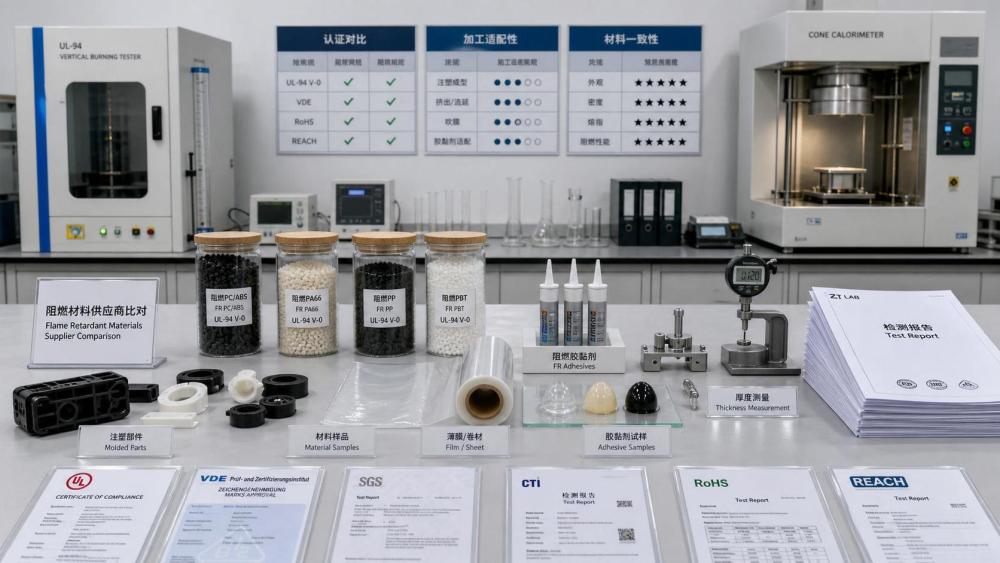
A useful comparison starts with the application, not the supplier list.
Flame safety materials are selected for electrical parts, transport interiors, housings, films, insulation layers, adhesives, and engineered plastic components.
That means one flame safety materials supplier may perform well in one segment and poorly in another.
In practice, the first screen should answer three questions.
- Which regulation or customer standard must the material meet?
- What base polymer, compound, film, or adhesive system is required?
- What processing method will be used after purchase?
This matters because flame performance alone rarely decides suitability.
A flame-retardant PA, PC, PBT, TPU, film, or bonded assembly must still process cleanly and stay stable in end use.
A stronger comparison also looks at how the supplier explains formulation logic, additive systems, test conditions, and batch consistency.
That is where structured technical platforms such as APIM become useful.
They help separate marketing claims from real material behavior across polymers, compounds, films, adhesives, and processing routes.
What makes one flame safety materials supplier stronger than another?
The short answer is repeatable performance with usable support.
A reliable flame safety materials supplier should provide more than a datasheet and a price quote.
Look for evidence in five areas.
Certification and test transparency
Check whether ratings are linked to recognized standards such as UL 94, IEC, automotive tests, rail requirements, or customer-specific protocols.
Ask for thickness-specific results, test reports, and update dates.
Formulation consistency
A capable flame safety materials supplier controls compounding quality, filler dispersion, moisture handling, pellet uniformity, and color stability.
These details affect molding, extrusion, warpage, and long-term safety behavior.
Processing fit
Some flame-retardant systems process easily.
Others increase viscosity, plate-out, brittleness, corrosion risk, or drying sensitivity.
The better supplier will discuss machine settings, residence time, screw design, and downstream stability.
Application knowledge
A strong flame safety materials supplier understands whether the material goes into connectors, battery parts, film laminates, insulation, or bonded structures.
That usually leads to fewer trial rounds.
Commercial stability
Lead time, minimum order quantity, regional inventory, change control, and raw material exposure are critical.
A low-cost source can become expensive if availability is unstable.
Which comparison points matter most before shortlisting?
Before moving into samples or audits, it helps to compare suppliers on one page.
The table below works as a practical first filter.
This kind of matrix is especially useful when comparing compounds, films, and adhesive-related flame systems across several regions.
It also creates a more disciplined conversation with each flame safety materials supplier.
Are certifications enough to judge a flame safety materials supplier?
Usually, no.
Certification is essential, but it is only one layer of evidence.
A flame safety materials supplier can hold valid test records and still create problems during scale-up.
More common issues appear in formulation drift, inconsistent pellet quality, thickness sensitivity, or poor secondary processing behavior.
For example, a flame-retardant compound may pass a lab test but crack after molding, lose toughness after humidity exposure, or affect bonding in multilayer structures.
Films may meet a fire requirement yet struggle with haze, curl, coating adhesion, or thermoforming.
Adhesive systems can also change flame behavior at assembly level.
That is why technical interpretation matters.
APIM’s value in this context is its structured view across polymers, modified compounds, films, adhesives, and processing technologies.
It helps connect certificate language with real manufacturing conditions.
Where do flame safety materials supplier comparisons often go wrong?
The biggest mistake is comparing only price and nominal rating.
That approach looks efficient, but it hides downstream costs.
Several warning signs deserve attention.
- The flame safety materials supplier cannot explain test conditions clearly.
- Data is available only for one thickness or one limited processing route.
- There is no discussion of chemical exposure, heat aging, or mechanical retention.
- Lead times look acceptable, but raw material sourcing is concentrated in one region.
- Technical support ends after sample approval.
- Color, reinforcement, or recycled content changes are handled informally.
Another common error is evaluating the material outside the assembly context.
In real projects, flame performance may depend on wall thickness, insert design, venting, coatings, adhesives, or neighboring components.
A good flame safety materials supplier will ask those questions early.
How do cost, lead time, and technical support change the final choice?
When two suppliers look similar on paper, the decision often shifts to execution risk.
A lower-priced flame safety materials supplier may still lose if the material causes extra scrap, tooling adjustments, approval delays, or repeated fire testing.
A better way to compare is total adoption cost.
Include these practical items in the calculation.
- Sample and trial quantity requirements
- Processing adjustments and machine downtime
- Retest cost after color or formulation changes
- Inventory buffer needed for long lead times
- Engineering time spent resolving startup issues
Technical support deserves extra weight in cross-functional projects.
This is especially true for modified compounds, specialty films, and adhesive-linked assemblies where processing windows are narrow.
The more complex the application, the more valuable responsive support becomes.
What is a practical next step after the first comparison?
Move from broad screening to a controlled shortlist.
Three to five candidates are usually enough for a serious review.
For each flame safety materials supplier, request a matched information set.
- Current technical data and compliance documents
- Application references close to the intended use
- Recommended processing window and known limitations
- Lot traceability and change notification policy
- Commercial terms tied to realistic annual volume
Then compare sample behavior, not just paperwork.
Check molding, extrusion, lamination, coating, or bonding performance under expected production conditions.
If the program spans several materials categories, structured reference sources such as APIM can help align technical, commercial, and supply-chain questions before final approval.
A sound decision usually comes from this sequence: define the use case, compare evidence, test the fit, and confirm supply reliability.
That creates a clearer basis for selecting the right flame safety materials supplier with fewer surprises later.
Have questions about this sector analysis, or seeking best practices specific to your niche? Drop us a line below and let the senior consultants at APIM assist you.
We respect your privacy. Your information is strictly confidential.
Related News
- 00
0000-00
How does washing affect contamination in post-consumer recycled PP resins? - 00
0000-00
How does feedstock affect depolymerization equipment selection? - 00
0000-00
US Sets 213.44% Preliminary Antidumping Deposit on Chinese PTMEG - 00
0000-00
When should epoxy be used as a thermal interface material for semiconductors? - 00
0000-00
US Midterm Results Unlikely to Quickly Shift Recycled Plastics Market or Legislation