




How to Choose Radiation Resistant Medical Grade Polymers
How to Choose Radiation Resistant Medical Grade Polymers
Choosing radiation resistant medical grade polymers requires more than checking sterilization compatibility.
Technical evaluators must balance radiation stability, mechanical retention, biocompatibility, processing behavior, and regulatory expectations.
That is the only reliable way to avoid degradation, discoloration, embrittlement, or hidden performance loss.
This guide explains how to assess radiation resistant medical grade polymers for demanding healthcare applications with better confidence.
It also helps connect material data with real sourcing, validation, and long-term product decisions.
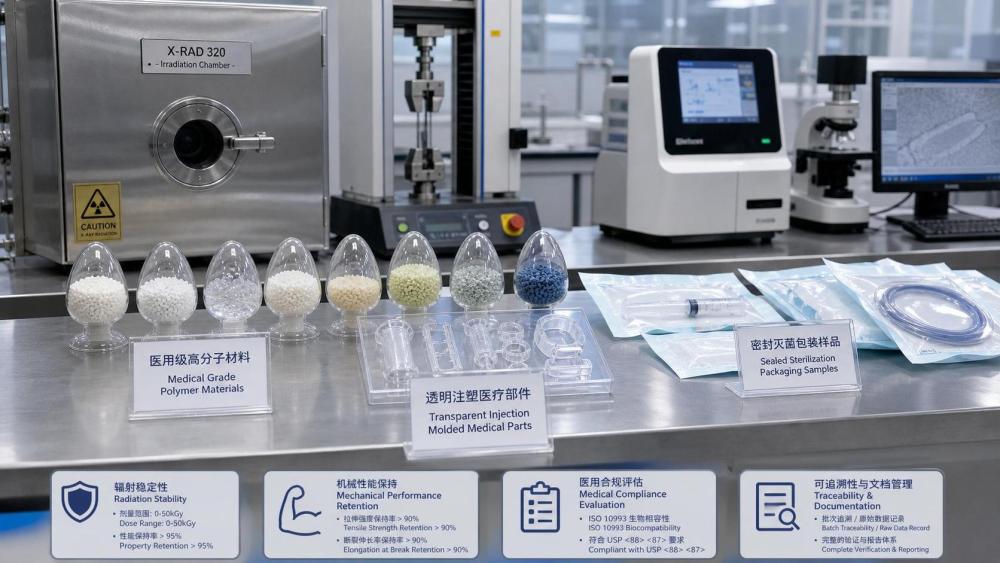
Start with the Radiation Exposure Profile
The first step is defining the actual radiation environment, not the assumed one.
Radiation resistant medical grade polymers behave differently under gamma, e-beam, and X-ray exposure.
Dose level matters, but cumulative dose matters just as much.
A single sterilization cycle may be acceptable.
Repeated cycles can change the decision completely.
In practical evaluation, clarify these points early:
- Radiation type: gamma, electron beam, or X-ray
- Target sterilization dose and allowable range
- Number of exposure cycles during service life
- Dose rate and storage condition after irradiation
- Need for shelf-life retention after sterilization
This baseline prevents overselecting expensive materials or underestimating degradation risk.
It also makes supplier discussions far more precise.
Know What Radiation Actually Does to Polymers
Radiation can trigger chain scission, crosslinking, oxidation, or additive breakdown.
The balance between these effects depends on polymer chemistry and formulation details.
That is why two medical grades with similar datasheets may perform very differently after irradiation.
Common failure signals include yellowing, reduced impact strength, cracking, dimensional shift, and lower elongation.
For transparent components, appearance changes may be a rejection point by themselves.
For load-bearing parts, retained toughness is often more critical than color.
So the question is not whether a resin survives radiation, but whether it still meets the application after radiation.
Focus on Property Retention, Not Just Material Names
Many teams start with familiar families such as PEEK, PPSU, PSU, PEI, PP, PC, or certain polyamides.
That is useful, but it is not enough for selecting radiation resistant medical grade polymers.
Property retention after irradiation should drive the shortlist.
Check performance before and after the required dose.
Then compare the gap, not only the starting value.
Priority metrics usually include:
- Tensile strength retention
- Elongation and impact retention
- Dimensional stability
- Color and transparency retention
- Stress cracking resistance
- Chemical resistance after sterilization
This approach gives a more defensible material decision than relying on generic family reputation.
Compare Shortlisted Radiation Resistant Medical Grade Polymers by Application Fit
A good material for a syringe component may be wrong for an implant tool handle.
Application fit keeps the evaluation practical.
The better question is always application-specific.
Which radiation resistant medical grade polymers still meet the design window after sterilization, assembly, shipping, and storage?
Review Formulation, Additives, and Supplier Control
Radiation performance is rarely about base resin alone.
Stabilizers, pigments, release agents, glass fiber, and regrind policy can all change results.
This is where supplier discipline becomes a major decision factor.
Ask for formulation consistency, change notification practice, lot traceability, and irradiation test history.
A technically strong resin is less useful if supply variation changes validation outcomes later.
In actual procurement work, this point often separates lower-risk options from merely promising ones.
For APIM-style material intelligence, structured supplier comparison is as important as lab data.
Check Biocompatibility and Regulatory Alignment Early
Radiation resistant medical grade polymers must still satisfy medical compliance expectations.
Radiation stability does not replace biocompatibility, extractables review, or documentation support.
Relevant checkpoints may include USP Class VI, ISO 10993, sterilization validation support, and master file availability.
More importantly, ask whether those claims remain valid for the exact grade and the exact irradiation condition.
Some teams discover late that a compliant polymer grade lacks enough post-radiation data for their submission path.
That delay is expensive and avoidable.
Do Not Ignore Processing and Part Design Effects
A radiation resistant polymer can still fail because of molding stress or poor geometry.
Sharp corners, weld lines, residual stress, and thin sections often amplify radiation damage.
This is especially relevant for injection molded medical components.
Review the full conversion route:
- Drying requirements and melt sensitivity
- Molding temperature and residence time
- Residual stress tendency
- Joining, bonding, or overmolding effects
- Packaging interaction before sterilization
When radiation resistant medical grade polymers are evaluated together with processing risk, the final choice is usually more robust.
Build a Simple Decision Matrix
Selection decisions improve when teams score candidates against the same criteria.
A basic matrix can reduce subjective debate and speed up technical alignment.
- Define pass-fail requirements first.
- Weight radiation retention, compliance, processing, and cost.
- Score each grade using supplier data and internal trials.
- Flag evidence gaps that still need testing.
- Review total risk, not unit price alone.
This method is especially useful when comparing premium materials with lower-cost alternatives.
In many cases, the cheapest resin becomes the costliest option once validation failures are included.
A Practical Way to Choose with More Confidence
The strongest decisions on radiation resistant medical grade polymers come from layered evaluation.
Start with the real radiation profile.
Then test property retention, compliance fit, processing risk, and supplier consistency together.
That sequence keeps material selection grounded in performance, not assumption.
For technical evaluation work, the goal is not finding the most advanced polymer on paper.
The goal is choosing radiation resistant medical grade polymers that still deliver stable function after real-world sterilization and use.
A disciplined shortlist, targeted test plan, and structured supplier review will usually get you there faster.
Have questions about this sector analysis, or seeking best practices specific to your niche? Drop us a line below and let the senior consultants at APIM assist you.
We respect your privacy. Your information is strictly confidential.
Related News
- 00
0000-00
Do polyolefin hot melt adhesives bond well to polyethylene? - 00
0000-00
Korean Study Finds PLA Barely Degrades in Landfill After 320 Days - 00
0000-00
How to assess batch consistency from a thermal potting compounds supplier - 00
0000-00
How much weight can carbon fiber reinforced plastics save in cars? - 00
0000-00
Switching from PS to ABS Sheet Extrusion: Equipment Checks