




How to Choose Food Contact Packaging Materials for Containers Under FDA and EU Rules
Where do technical evaluators usually get food contact material selection wrong?
Most mistakes happen before anyone looks at a test report. A resin may be widely used in packaging, but that does not automatically make a specific grade suitable for food contact packaging materials for containers. FDA and EU compliance depends on the actual composition, intended food type, contact time, temperature, and whether the material is used alone or inside a multilayer structure.
A common error is selecting by polymer family only: “PET is used for food,” “PP is common for containers,” or “PE works for closures.” That is too broad. Additives, colorants, impact modifiers, recycled content, adhesive tie layers, inks, and processing aids can change the compliance picture. Another frequent problem is assuming a supplier declaration covers every use case. Many declarations are limited to specific food simulants, temperature ranges, or single-use conditions.
If you are evaluating materials for a container, start with the use conditions, not the resin name. That one shift saves a lot of rework.
What is the practical difference between FDA and EU food contact rules?
Both systems are built around safety, but they work differently in day-to-day material evaluation.
In the United States, food contact materials are commonly assessed against FDA regulations in 21 CFR. The question is whether each component is permitted for the intended use, either through a relevant regulation, an effective Food Contact Notification, a prior-sanctioned substance, or another recognized authorization route. The review is substance-based and use-specific.
In the EU, the framework starts with Regulation (EC) No 1935/2004 and good manufacturing practice under Regulation (EC) No 2023/2006. For plastic materials, Regulation (EU) No 10/2011 is usually the key working document. It brings in the Union list, specific migration limits for some substances, overall migration requirements, and declaration of compliance expectations.
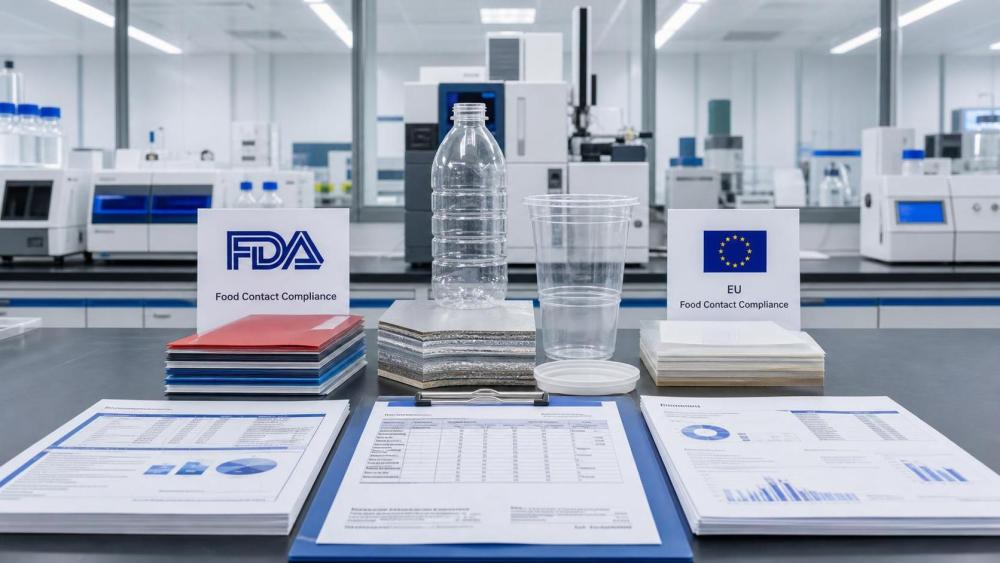
The practical takeaway is simple: FDA compliance is not the same as EU compliance, and an EU declaration does not replace a U.S. regulatory review. For global container programs, technical teams should build the material file against both systems from the start.
Which product-use details must be fixed before you compare materials?
Before you shortlist materials, lock down the exposure profile. Without that, “compliant” is too vague to be useful.
- Food type: aqueous, acidic, alcoholic, fatty, dry, or mixed-contact applications
- Contact conditions: refrigerated, ambient fill, hot fill, microwave reheating, retort, or freezer use
- Time and temperature: short contact, long-term storage, repeated use, or single use
- Container format: rigid tub, bottle, tray, cup, lid system, multilayer structure, or lined component
- Functional need: oxygen barrier, moisture barrier, grease resistance, transparency, impact strength, sealability
- Processing route: injection molding, thermoforming, blow molding, extrusion, coextrusion, lamination
This matters because migration testing and regulatory coverage are tied to actual conditions. A material acceptable for room-temperature dry food may not be acceptable for hot fatty food. The same resin may also behave differently after retort, especially if additives or tie layers are involved.
How do you screen candidate materials without overrelying on generic supplier claims?
Ask for the right documents early, then read them against the end use rather than treating them as pass/fail labels. For food contact packaging materials for containers, the document pack should usually include a food contact declaration, composition-related compliance statement, intended-use limitations, and where relevant, migration support data.
One sentence in a supplier sheet saying “suitable for food contact” is not enough for technical approval. You need the condition boundaries.
Do migration limits matter if the base resin is already approved?
Yes. Very often, that is where the real decision sits.
Approval of a base polymer or monomer route does not automatically clear the finished article. In EU plastics work, specific migration limits may apply to certain monomers, additives, or breakdown products. Overall migration can also become an issue when the full formulation and processing history are considered. Under FDA review logic, permitted substances still have use limitations tied to conditions of contact, food type, or functional role.
This is especially relevant for modified compounds, barrier layers, and colored packaging. Heat stabilizers, slip agents, antioxidants, plasticizers, adhesives, and printing-related components are often what trigger deeper review, not the main polymer itself.
How should you evaluate multilayer containers and barrier structures?
Treat every layer as part of the compliance file, even when one layer does not directly contact food. Technical teams sometimes focus only on the inner seal layer and ignore tie resins, adhesives, oxygen barriers, or recycled outer layers. That shortcut creates risk.
For multilayer containers, review:
- The full layer structure and thickness of each layer
- Which layers are intended as functional barriers, if any
- Whether each component has relevant food contact support for the intended market
- Whether migration assessment was performed on the finished structure or only on individual raw materials
That last point matters more than people expect. A coextruded or laminated structure can behave differently from a single resin tested on its own. Processing temperature, layer interaction, and residuals from adhesives or inks can change the final migration profile.
Can recycled or bio-based materials be used for food contact containers?
They can be, but the evaluation standard becomes tighter, not looser. Sustainability claims do not replace food contact review.
With recycled materials, the key technical questions are traceability of input stream, decontamination or recycling process control, intended contact conditions, and the regulatory route used to support food contact use in the target market. For bio-based materials, the same rule applies as for conventional materials: composition, additives, and actual use conditions determine suitability.
This is one area where teams often confuse sustainability status with compliance status. Keep those files separate, then connect them only after both are strong enough on their own.
What testing should be requested when the paperwork looks incomplete?
Request testing only after you know what question the test needs to answer. Blind testing wastes time because migration conditions must reflect intended use.
In practice, the gap usually falls into one of three categories: no coverage for the target food type, no coverage for the target temperature/time condition, or no finished-article evidence for a converted structure. That tells you whether to ask for supporting migration data, finished-pack testing, or a reformulation review.
Also check whether the sample tested is materially equivalent to production. Color changes, recycled content shifts, additive package changes, and different curing or sealing conditions can make an earlier report much less useful than it first appears.
Who carries responsibility: resin supplier, converter, or brand owner?
Responsibility is shared across the chain, but not equally for every decision.
The raw material supplier is usually responsible for accurate information on the supplied material and its known use limitations. The converter is responsible for what processing does to the material, what additional substances enter the article, and whether the finished container still fits the intended use profile. The packer or brand owner typically owns the market placement decision and must ensure the final packaging matches the food, fill process, storage, and distribution conditions actually used.
Technical evaluators should not let these roles blur. When accountability is vague, document quality usually is too.
What are the most useful red flags during supplier review?
A few warning signs come up repeatedly:
- The declaration names regulations but does not define use conditions.
- The supplier cannot confirm whether the statement applies to the exact grade being quoted.
- Migration data are based on a different structure, different thickness, or different additive package.
- Colorants, masterbatches, labels, inks, or closure liners are excluded from the compliance statement.
- There is no change notification process for formulation or manufacturing site changes.
Any one of these does not automatically disqualify a material, but it does mean the approval file is not ready yet.
If two materials are both compliant, how do you choose between them?
Then the decision becomes an engineering trade-off, not a legal one. Compare them on the factors that affect the actual container: process window, seal performance, drop resistance, stress cracking risk, barrier retention after forming, clarity, weight, and supply stability. The lower-cost option is not automatically lower risk if it needs tighter processing control or has weaker documentation support.
For technical evaluators, a strong choice usually has three qualities at the same time: the regulatory path is clear, the finished container can be manufactured consistently, and the supporting documents will survive customer or auditor review without too much interpretation.
What is a workable approval sequence for food contact packaging materials for containers?
Keep it disciplined:
- Define food type, contact conditions, container design, and target markets.
- Collect grade-specific regulatory documents for every relevant material and auxiliary component.
- Map document coverage against FDA and EU requirements separately.
- Identify gaps tied to migration, structure, additives, or processing.
- Request targeted testing or technical clarification where the gaps actually are.
- Approve the finished structure, not just the raw resin list.
- Put change control in place before commercial launch.
That sequence is less glamorous than debating resin families, but it is what keeps a packaging project from failing late. When FDA and EU rules are both in scope, the best material is usually the one that fits the product, survives processing, and comes with evidence that is precise enough to defend under real scrutiny.
Have questions about this sector analysis, or seeking best practices specific to your niche? Drop us a line below and let the senior consultants at APIM assist you.
We respect your privacy. Your information is strictly confidential.
Related News
- 00
0000-00
How does washing affect contamination in post-consumer recycled PP resins? - 00
0000-00
How does feedstock affect depolymerization equipment selection? - 00
0000-00
US Sets 213.44% Preliminary Antidumping Deposit on Chinese PTMEG - 00
0000-00
When should epoxy be used as a thermal interface material for semiconductors? - 00
0000-00
US Midterm Results Unlikely to Quickly Shift Recycled Plastics Market or Legislation