




How do compliant plasticizers affect formulation approval?
How Do Compliant Plasticizers Affect Formulation Approval?
Regulatory compliant plasticizers can significantly influence formulation approval by shaping safety documentation, migration performance, processing consistency, and market access. For technical evaluators, selecting the right plasticizer is not simply a compliance exercise; it requires balancing polymer compatibility, end-use requirements, regional regulations, and long-term product reliability.
This is especially true in flexible PVC, coatings, adhesives, sealants, films, wire and cable compounds, synthetic leather, flooring, medical components, and packaging structures. In these applications, a plasticizer is rarely a minor adjustment. It can alter hardness, low-temperature flexibility, fusion behavior, volatility, fogging, odor, extraction resistance, electrical properties, and the way a finished article performs after months or years in service. A formulation may look acceptable during laboratory mixing yet fail approval because the selected additive creates an unresolved documentation gap, exceeds a migration limit in a relevant use condition, or changes process behavior enough to compromise batch consistency.
The practical question is therefore not simply, “Is this plasticizer compliant?” A more useful question is: “Compliant with which requirements, for which end use, in which market, at what concentration, and with what supporting evidence?” That distinction often determines whether approval is straightforward or becomes a repeated cycle of reformulation and retesting.
Compliance changes the approval path, not just the ingredient list
A compliant plasticizer can reduce uncertainty only when its regulatory status is relevant to the finished product. A supplier statement that an additive is suitable for one region or application should not automatically be treated as proof for another. Requirements can differ between general industrial articles, electrical and electronic equipment, toys, food-contact materials, medical devices, consumer products, automotive interiors, and construction products. The applicable framework may also depend on whether the substance is intentionally used, whether it can migrate from the final article, and whether the product is sold as a material, component, or finished consumer good.
For example, an evaluator may need to consider substance restrictions under regional chemical regulations, customer restricted-substance lists, and sector-specific rules at the same time. A plasticizer that is acceptable in an industrial hose may require a different review when used in a cable jacket exposed to heat, a film with food-contact potential, or a soft-touch automotive component where odor, fogging, and emissions are also part of the approval discussion. The formulation cannot be approved on the basis of chemistry alone; it has to be approved within its exposure scenario.
This is why technical teams should begin with a market-and-use map before comparing plasticizer types. It should identify target countries, product category, foreseeable contact conditions, expected service temperature, whether the article is for consumer or industrial use, and any customer-specific material declaration format. That short exercise frequently exposes questions that a generic certificate cannot answer.
The strongest approval packages connect composition to use conditions
Formulation approval normally moves faster when the plasticizer supplier can provide a coherent technical and regulatory evidence package. The exact documents will vary, but evaluators commonly need a current safety data sheet, technical data sheet, substance identity information, a declaration against applicable restricted-substance requirements, and traceable confirmation of the material grade being supplied. For sensitive applications, the review may need more detail on impurities, residual monomers, composition ranges, toxicological support, migration-relevant data, or change-control practices.
A declaration is useful, but it should be read alongside the actual formulation. A compliant raw material can still create a final-product issue when its loading level, interaction with other additives, surface area, thickness, processing history, or contact medium changes the result. Plasticizer migration is a good example. It is influenced by molecular structure and molecular weight, but also by polymer affinity, formulation balance, temperature, contact time, surface treatments, fillers, stabilizers, and the material on the other side of a bonded or stacked assembly.
For that reason, approval teams should avoid a common shortcut: treating a supplier’s regulatory letter as a substitute for finished-article assessment. The letter supports the review. It does not eliminate the need to evaluate the final formulation under the use conditions that matter to the product owner.
Performance trade-offs can create compliance risk later
Replacing a restricted or commercially unacceptable plasticizer is often presented as a one-for-one substitution. In practice, it rarely is. Different plasticizer families can change the balance between primary plasticization efficiency, permanence, low-temperature behavior, viscosity reduction, heat stability, extraction resistance, and compatibility. A material that reaches the target Shore hardness at a lower dosage may not deliver the same resistance to oils, detergents, humidity, or repeated heat exposure. Another alternative may show strong permanence but require processing changes to achieve uniform fusion or dispersion.
These differences matter during approval because a regulatory compliant plasticizer is still expected to produce a stable manufacturable compound. If substitution leads to plate-out, inconsistent gelation, color variation, excessive volatility, altered adhesion, or higher scrap rates, the formulation may fail internal qualification even when its compliance profile is sound. In extrusion, minor shifts in melt viscosity or fusion rate can affect output stability, surface finish, gauge control, and downstream winding. In calendering, coating, and adhesive production, the same choice can influence rheology, cure response, open time, or substrate wetting.
Technical approval should therefore compare candidate plasticizers in the full compound, not only as neat liquids. Small-scale screening can be useful, but it should be followed by process-representative trials whenever the application is demanding. A formulation intended for a specialty film, flexible insulation layer, pressure-sensitive adhesive, or molded soft component needs evidence that reflects the actual conversion route and expected end-use stresses.
Parameters worth reviewing before a substitution is locked in
- Compatibility with the base polymer and other additives, including stabilizers, fillers, pigments, flame retardants, and processing aids.
- Required flexibility, hardness, tensile behavior, elongation, compression set, and low-temperature performance.
- Volatility, fogging, odor, extractability, staining potential, and migration behavior under realistic exposure conditions.
- Processing effects on fusion, melt viscosity, torque, coating rheology, extrusion stability, and surface quality.
- The regulatory scope of available declarations, including geographic market, intended application, and document validity.
- Supplier traceability, batch-to-batch control, notification of composition changes, and continuity of supply.
Migration and extraction testing should follow the real failure mode
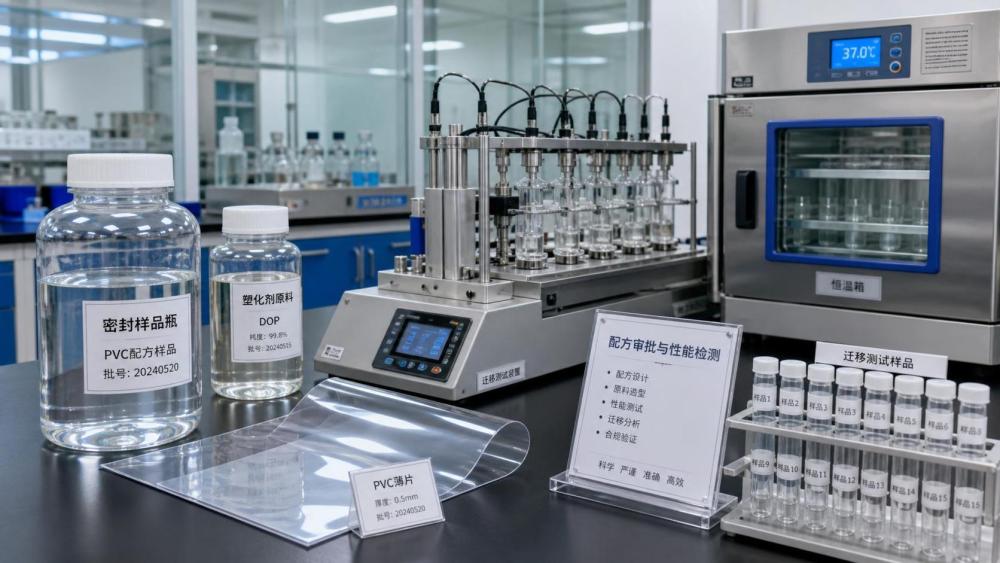
Migration is often discussed as if it were one universal test. It is not. The appropriate assessment depends on what the material may contact and how it will be used. A flexible polymer part in contact with another polymer, an oil-containing environment, a cleaning agent, skin, packaged goods, or a high-temperature electronic assembly can face very different transfer mechanisms. The test approach should reflect the relevant standard, customer specification, and end-use scenario rather than relying on a convenient internal method that does not represent actual exposure.
For technical evaluators, the crucial point is to define the concern before selecting the test. Is the risk surface bloom? Mass loss at elevated temperature? Plasticizer transfer to an adjacent material? Chemical extraction? Changes in electrical insulation? Odor or fogging in an enclosed interior? Each question may require a different specimen design, conditioning method, contact medium, duration, or analytical method. A result can be technically accurate and still be unhelpful if it answers the wrong question.
This is also where polymer architecture matters. Multilayer films, coated textiles, bonded assemblies, recycled-content compounds, and highly filled systems may not behave like a homogeneous sheet. Interface effects, barrier layers, adhesive tie layers, and local plasticizer concentration can change how substances move through the structure. Approval should account for the final construction, particularly where the flexible layer is thin or in direct contact with a sensitive substrate.
Supplier qualification is part of formulation qualification
A technically suitable grade can become a long-term approval problem if the supply chain is poorly controlled. Plasticizer sourcing may involve multiple production sites, intermediates, distributors, or relabeling arrangements. For a material under ongoing regulatory scrutiny, technical teams need confidence that the commercial material matches the material reviewed during validation. This does not necessarily require disclosure of proprietary process details, but it does require clarity about grade identity, specification limits, manufacturing consistency, and how changes will be communicated.
Change control is particularly important when a formulation has been approved by a downstream customer or linked to a specific compliance declaration. A change in feedstock source, impurity profile, manufacturing route, stabilizer package, or additive concentration may affect documentation and performance even if the product name remains unchanged. Procurement teams often focus understandably on price and availability, while R&D focuses on physical properties. The approval process works better when both groups agree in advance on which changes require technical notification and whether requalification will be necessary.
Global Advanced Polymers & Industrial Materials Intelligence Network (APIM) approaches material selection from this broader perspective. Across polymers, modified compounds, specialty films, industrial adhesives, recycling systems, and extrusion technologies, the recurring lesson is that material performance and documentation cannot be separated. A compound may pass a short-term mechanical test yet remain unsuitable for commercial release if traceability, process stability, or market-specific compliance support is incomplete.
A practical way to make the decision
An efficient approval process usually starts by ranking requirements rather than trying to optimize everything at once. Identify the non-negotiables: target market access, relevant restricted-substance requirements, end-use exposure, mandatory customer documents, and critical performance thresholds. Then identify the variables that can be tuned, such as dosage, hardness, process temperature, stabilizer balance, filler level, or layer thickness. This prevents teams from spending weeks optimizing a formulation built around a plasticizer that cannot meet the required documentation or intended-use conditions.
Where several alternatives appear viable, a decision matrix can help, but it should not reduce the review to a simple cost-per-kilogram comparison. Include effective dosage, expected processing adjustments, testing burden, document completeness, supply risk, and the consequences of a future regulatory or customer-specification change. The lowest-cost additive may produce a more expensive approval route if it requires extensive retesting, creates an uncertain declaration position, or narrows the markets where the finished product can be sold.
It is also sensible to separate “approved for development” from “approved for release.” A development approval allows trials and data generation. A release approval should be tied to a defined grade, supplier, formulation range, process window, final application, and document revision. That distinction gives teams room to learn without accidentally treating preliminary information as permanent qualification.
Approval is a formulation decision with a market consequence
Compliant plasticizers affect formulation approval because they influence both sides of the decision: whether the material can enter the intended market and whether it can reliably do its job once converted into a finished product. The best choice is not automatically the additive with the broadest compliance statement, the highest permanence, or the lowest purchase price. It is the candidate whose regulatory evidence, polymer interaction, processing behavior, long-term performance, and supplier controls align with the actual product scenario.
Before finalizing a formulation, technical evaluators should confirm the target geography, intended contact conditions, finished-article construction, relevant customer requirements, and available supplier documentation. They should then test the risks that are specific to the application rather than relying on generic substitution logic. That disciplined sequence is usually more valuable than rushing to label a plasticizer as simply compliant or non-compliant.
Have questions about this sector analysis, or seeking best practices specific to your niche? Drop us a line below and let the senior consultants at APIM assist you.
We respect your privacy. Your information is strictly confidential.
Related News
- 00
0000-00
How does washing affect contamination in post-consumer recycled PP resins? - 00
0000-00
How does feedstock affect depolymerization equipment selection? - 00
0000-00
US Sets 213.44% Preliminary Antidumping Deposit on Chinese PTMEG - 00
0000-00
When should epoxy be used as a thermal interface material for semiconductors? - 00
0000-00
US Midterm Results Unlikely to Quickly Shift Recycled Plastics Market or Legislation