




How do aircraft OEMs evaluate heat-resistant polymer suppliers?
Aircraft OEMs evaluate heat-resistant polymer suppliers as a qualification risk decision, not as a comparison of resin data sheets. A polymer may show an attractive continuous-use temperature or a high melting point, yet still be unsuitable for an aircraft system if its properties shift after thermal ageing, its flame behavior is poorly documented in the final part geometry, or the supplier cannot preserve lot-to-lot consistency through a long production program.
For procurement teams, the practical question is whether a supplier can support a defined aerospace application from development through serial production, configuration changes, and aftermarket demand. The answer depends on the relationship between the material, the intended part, the processing route, the qualification evidence, and the supplier's operational controls. Heat resistance is necessary, but it is only one element of that assessment.
Start with the operating envelope, not the polymer family
Terms such as PEEK, PEI, PPS, high-temperature polyamide, and fluoropolymer can quickly narrow an initial supplier list. They do not establish suitability by themselves. OEM buyers should first translate the system requirement into a realistic operating envelope for the specific component.
A bracket near an engine bay, an electrical connector behind an avionics panel, a duct in a conditioned cabin zone, and an insulation component in a power-distribution assembly may all be described as heat-resistant polymer applications. Their thermal loads, exposure duration, vibration profile, chemical contact, flame requirements, and consequences of failure can be materially different.
The procurement brief should distinguish between peak temperature and sustained temperature, as well as between ambient air temperature and actual part temperature. A component can be exposed to short excursions above its normal duty condition without failing, while prolonged exposure at a lower temperature can lead to creep, oxidation, embrittlement, loss of dielectric performance, or dimensional movement. That distinction affects which supplier test evidence is useful.
- What temperature does the part see in normal operation, during abnormal events, and during ground servicing?
- How long does the material remain at each temperature level?
- Will the part be under mechanical load, clamping force, pressure, electrical stress, or vibration during heat exposure?
- Which fluids, lubricants, hydraulic media, cleaning agents, fuels, or de-icing chemicals may contact it?
- Does the part sit in a fire-sensitive, smoke-sensitive, or electrically critical location?
- What changes after moulding, machining, welding, bonding, or assembly could alter performance?
A supplier that asks these questions early is usually more useful than one that responds with a generic grade recommendation. Procurement should treat technical interrogation as part of supplier capability, because an inappropriate material recommendation can create a costly qualification loop later.
Thermal performance must be demonstrated in the finished-use condition
Headline temperature ratings are often misunderstood. They may describe a short-term test, a thermal transition, a laboratory screening result, or a reference condition that does not reflect the aircraft part. They do not automatically predict retention of strength, stiffness, impact resistance, electrical insulation, or dimensional stability after long-term exposure.
OEMs therefore examine how a supplier characterizes performance after ageing. The useful evidence is tied to the relevant failure mode. For a load-bearing clip, retained tensile and fatigue-related properties may matter. For a connector body, dielectric behavior, tracking resistance, and dimensional control can be more important. For a duct or enclosure, distortion under temperature, pressure, and vibration may drive the decision.
Reinforcement and additives require particular attention. Glass fiber, carbon fiber, flame-retardant packages, pigments, lubricants, and impact modifiers can make a grade better suited to one requirement while complicating another. Reinforcement may improve stiffness and reduce thermal expansion, for example, but it can affect weld-line strength, anisotropy, surface quality, tool wear, and fracture behavior. A resin supplier should be able to explain which formulation variables are controlled and which part-level effects the OEM or tier supplier must validate independently.
Thermal ageing also cannot be separated from the service environment. A polymer exposed to dry heat can behave differently when moisture, oxygen, fuel vapor, cleaning chemicals, or electrical loading are present. Procurement teams should avoid accepting a statement of chemical compatibility without understanding the temperature, contact duration, stress state, and fluid concentration behind it.
Flame, smoke, and toxicity evidence needs the correct scope
For many aircraft interior and electrical-system applications, flame-related performance is a central qualification gate. Yet a material's generic flame classification is not the same as compliance for a specific aircraft component. Part thickness, color, reinforcement, processing history, assembly design, and adjacent materials can all affect the final outcome.
A strong supplier submission makes the boundary of its evidence explicit. It identifies the tested grade, color range, nominal thickness or wall section, processing assumptions, and test method. It also separates material-level results from component-level responsibility. This is important when a compound has been modified for flow, pigmentation, recycled content, or another production requirement after initial screening.
Buyers should ask whether the supplier has a disciplined change-notification process for formulation constituents that influence flame, smoke, or toxicity behavior. A seemingly minor change to a flame-retardant source, stabilizer, pigment, fiber treatment, or compounding process can trigger reassessment. The commercial risk is not limited to material performance; an undocumented change can disrupt approved production and generate a traceability investigation.
The right procurement position is not to demand that every raw-material supplier own final aircraft-part certification. The more defensible position is to define what documentation the supplier must provide, what remains with the moulding or component partner, and what evidence must be retained across the approved supply chain.
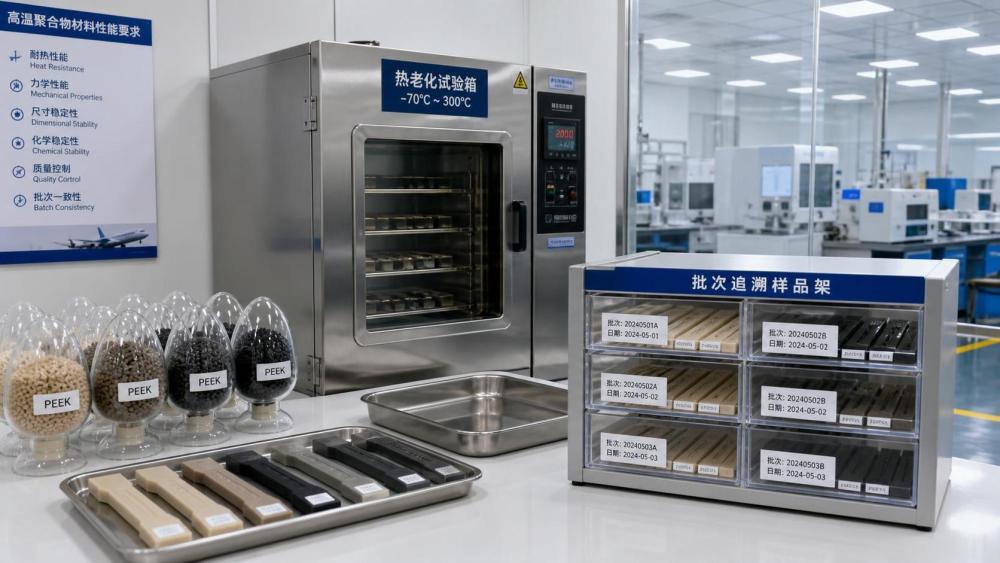
Traceability and batch consistency are part of the material specification
Aircraft programs are long-lived, and a qualified polymer is expected to remain identifiable over years of production. That makes traceability a technical requirement as well as a quality-system requirement. OEMs need to know which resin, reinforcement, additive package, and production site were used for each supplied batch, and whether the material can be linked to the certificate of analysis, inspection records, and applicable process controls.
For procurement, a certificate of analysis has value only when the reported parameters correspond to meaningful controls. Typical controls may include moisture, melt-flow behavior, filler or fiber content, density, color, ash level, particle contamination, and selected mechanical or thermal indicators. The exact list depends on the polymer and use case. What matters is whether the supplier can demonstrate that the characteristics affecting the part are monitored with an appropriate sampling plan and release discipline.
Batch consistency deserves more scrutiny than a supplier's nominal specification range. A broad published range may be technically acceptable for general industrial use but create moulding variation in a thin-wall aircraft part. Changes in viscosity, fiber distribution, moisture, pellet quality, or contamination level can alter filling behavior, warpage, weld lines, and final dimensions. If the conversion process is sensitive, procurement should involve the moulder or component manufacturer before approving a source.
Evaluate the supplier's ability to support qualification, not just to ship resin
A supplier may produce a technically credible grade but still be a weak aerospace source if its documentation is fragmented, its technical staff cannot support processing questions, or its response to deviations is slow. OEMs commonly assess the supplier's quality management maturity, manufacturing controls, document retention, corrective-action practices, and willingness to support audits within the appropriate commercial and confidentiality framework.
This review should extend beyond the sales organization. Procurement needs visibility into where the polymer is compounded, how sites are qualified, whether the same grade is made at more than one location, and what happens if a line, reactor, extruder, feeder, or key upstream source changes. A multi-site footprint can improve continuity, but only if material equivalence and change control are managed rather than assumed.
Technical support matters most when the component enters development or encounters a production issue. High-temperature polymers may have narrow processing windows, stringent drying requirements, high melt temperatures, sensitivity to residence time, or demanding tooling needs. An experienced supplier should provide meaningful processing guidance while recognizing that final settings depend on the part geometry and converter equipment.
Questions that expose the difference between a brochure-level supplier and a qualification-ready supplier include:
- Can the supplier provide retained samples and historical lot records for the required period?
- Who owns technical response when material behavior changes at the moulder?
- Can it support root-cause analysis involving raw material, compounding, and downstream processing?
- What formal process governs plant transfers, raw-material changes, capacity expansions, and discontinuation?
- Are application data and test reports clearly linked to the exact grade and revision under consideration?
- Does packaging protect the material from moisture, contamination, and damage through the actual logistics route?
Supply continuity must be examined at the formulation level
For aircraft programs, a low purchase price can be outweighed by the cost of a supply interruption or forced requalification. Procurement teams should assess capacity, lead-time behavior, inventory strategy, geographic exposure, logistics routes, and dependency on single-source additives or reinforcements. This is particularly relevant for specialty compounds where a small-volume additive, pigment, fiber treatment, or stabilizer may be the true bottleneck.
Supplier financial health may be reviewed as part of a broader sourcing assessment, but it should not replace operational due diligence. The more useful question is whether the supplier has a credible continuity plan for a disruption and whether that plan has practical limits. Backup manufacturing is only valuable if the backup site can manufacture the approved material under equivalent controls and supply the required documentation.
Buyers should also clarify demand patterns. Aerospace demand can be uneven, especially during ramp-up, retrofit activity, or service-part ordering. A supplier that is comfortable with large annual forecasts may still struggle with low-volume, high-urgency releases. Agreements should address minimum order quantities, shelf-life management, forecast visibility, allocation priorities, and the handling of obsolete or slow-moving grades.
Use total qualification cost to compare supplier options
A lower resin quotation may conceal a higher program cost if it creates extra testing, moulding trials, scrap, inventory exposure, or change-management work. Conversely, a premium supplier may be justified when its data package, process control, application support, and supply assurance reduce qualification uncertainty.
This does not mean the most established source should automatically win. A newer or alternative supplier can be a strong candidate when it can map its evidence to the application requirement, submit representative lots for evaluation, disclose formulation and manufacturing boundaries appropriately, and accept disciplined change-control obligations. The decision should be based on evidence quality and residual risk, not reputation alone.
A practical sourcing process often starts with a short technical gate before commercial negotiation. Suppliers that cannot establish traceability, relevant thermal and flame evidence, processing support, and change control should not advance merely because their grade appears comparable on a data sheet. For those that pass, procurement can compare price, capacity, service, and commercial terms on a more reliable basis.
Build the approval around a controlled material definition
The final approval should identify more than a trade name. It should define the grade, reinforcement or additive condition, permitted color and site configuration, applicable documentation, packaging expectations, and supplier change obligations. Where the converter's process has a meaningful effect on part performance, the approved material definition should connect to the relevant moulding or fabrication conditions rather than treating resin and component as separate decisions.
That is the core answer to how aircraft OEMs evaluate suppliers of heat-resistant polymers: they assess whether the supplier can repeatedly deliver a controlled material whose behavior is supported in the intended aircraft system. Temperature capability opens the discussion. Qualification evidence, traceability, processing discipline, and continuity determine whether the source can remain approved.
Have questions about this sector analysis, or seeking best practices specific to your niche? Drop us a line below and let the senior consultants at APIM assist you.
We respect your privacy. Your information is strictly confidential.
Related News
- 00
0000-00
How does washing affect contamination in post-consumer recycled PP resins? - 00
0000-00
How does feedstock affect depolymerization equipment selection? - 00
0000-00
US Sets 213.44% Preliminary Antidumping Deposit on Chinese PTMEG - 00
0000-00
When should epoxy be used as a thermal interface material for semiconductors? - 00
0000-00
US Midterm Results Unlikely to Quickly Shift Recycled Plastics Market or Legislation