




How REACH Polymer Compliance Standards Affect Material Approval in 2026
Material approval in 2026 will depend on more than performance data and cost targets. REACH polymer compliance standards are moving closer to the center of supplier qualification, formulation review, and documentation control across industrial markets.
That shift matters because polymers are rarely simple materials. A resin, compound, film, or adhesive may contain additives, stabilizers, pigments, processing aids, recycled inputs, or residual substances that affect regulatory status.
In practice, REACH polymer compliance standards influence whether a material can be approved smoothly, delayed for clarification, or rejected until evidence is complete. The real issue is not only compliance on paper, but confidence in what is inside the material and how that information is maintained.
Why 2026 is becoming a decision point
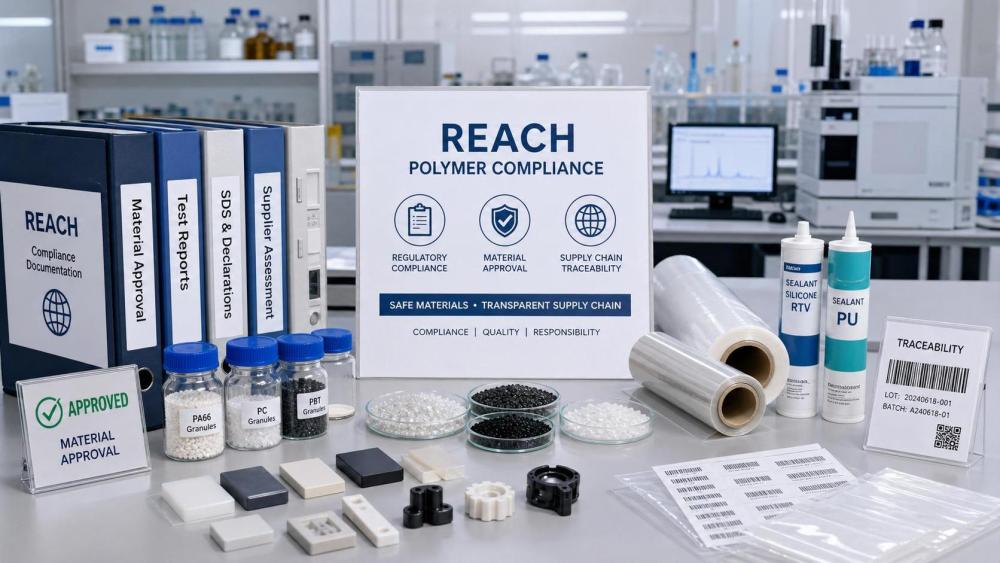
European chemical regulation has already shaped global material sourcing. By 2026, many companies expect tighter attention on substance transparency, supply chain traceability, and the treatment of polymers used in complex industrial products.
This does not mean every polymer suddenly becomes prohibited. It means material approval teams are expected to ask better questions, verify declarations faster, and identify compliance gaps earlier in the release cycle.
The pressure is especially visible in advanced materials. Engineering plastics, modified compounds, specialty films, and industrial adhesives often combine multiple chemistries in one commercial grade.
As APIM frequently highlights across performance-driven materials, the business risk usually appears where formulation complexity meets inconsistent supplier data. That is why REACH polymer compliance standards now affect approval timing as much as technical testing does.
What REACH polymer compliance standards really cover
A common misunderstanding is that polymers are automatically outside regulatory concern. Under REACH, the polymer itself may have a distinct treatment, but the compliance review still extends to monomers, additives, impurities, and substances of very high concern.
So when companies discuss REACH polymer compliance standards, they are usually addressing a wider control framework. That framework includes substance registration relevance, SVHC screening, restricted substance checks, safe use information, and reliable supporting declarations.
For material approval, the important point is simple. A polymer grade may perform well in heat resistance, impact strength, barrier performance, or electrical insulation, yet still face approval friction if its compliance evidence is incomplete.
This is particularly relevant for compounded materials. Glass-fiber reinforced PA, flame-retardant PC, conductive compounds, UV-stabilized films, and structural adhesives often rely on additive packages that require deeper regulatory visibility.
The approval file is broader than a data sheet
A technical data sheet explains performance. A compliance file explains regulatory acceptability. In 2026, both are needed before a material can move through controlled approval systems with low risk.
That file often includes supplier declarations, SDS content, SVHC statements, compositional information at agreed disclosure levels, update dates, and evidence that changes in formulation will be communicated.
Where approval delays usually begin
Most delays do not start with an obvious legal violation. They start with uncertainty. One supplier provides a broad statement, another uses old language, and a third cannot clearly explain the origin of additives in a recycled or modified formulation.
That uncertainty creates review loops. Technical teams ask for clarification. Safety teams request updated documents. Sourcing teams pause release decisions because the compliance position is not fully defensible.
The pattern appears across industries using polymer-based components:
- Automotive parts using reinforced or flame-retardant engineering plastics
- Electronics housings and insulation systems with additive-heavy compounds
- Packaging films built from multilayer structures, coatings, or recycled content
- Industrial adhesives and sealants with complex reactive chemistry
- Medical and precision components requiring stable documentation over long approval cycles
In each case, REACH polymer compliance standards affect not just market access, but internal release confidence. A material cannot be treated as approved if the compliance logic remains unclear after technical validation.
How different material categories are affected
Not every polymer family carries the same review burden. The compliance workload often rises with formulation complexity, supplier depth, and the number of substances involved in final performance.
This is where structured materials intelligence becomes useful. Platforms such as APIM help connect formulation logic, processing behavior, and compliance context instead of treating them as separate decisions.
What a stronger approval process looks like
The most effective response is not to add paperwork at the end. It is to build REACH review into the earliest stages of material selection, supplier comparison, and product change control.
A stronger process usually includes several practical checks:
- Request current REACH declarations before lab trials move too far
- Separate performance approval from compliance approval in internal records
- Review additive-sensitive grades more closely than standard unmodified resins
- Confirm how suppliers manage formulation changes and SVHC updates
- Check whether recycled or bio-based content introduces new traceability gaps
- Align compliance documents with the exact commercial grade and revision level
These steps reduce the chance of approving a material based on outdated or generic statements. They also make later audits easier, especially when one product uses multiple polymer systems from different regions.
Documentation must match the real material path
A compliant declaration loses value if the approved material later changes through compounding, coloring, co-extrusion, lamination, or adhesive bonding. Each conversion step can alter the substance picture that approval teams rely on.
That is why REACH polymer compliance standards should be reviewed across the finished material path, not only at the base resin level.
Key judgment points for 2026 sourcing and change control
When a new material enters evaluation, several questions now matter as much as tensile strength, melt flow, or heat distortion temperature.
Useful judgment points include:
- Is the supplier declaration current enough for a 2026 release decision?
- Does the material rely on additives that commonly trigger deeper REACH review?
- Is the formulation stable across plants, regions, and production lots?
- Can the supplier explain substance transparency beyond a high-level statement?
- Will downstream processing introduce coatings, inks, tie layers, or bonding agents that change the compliance picture?
In broader terms, REACH polymer compliance standards are now part of material risk management. They shape approval speed, escalation frequency, and long-term confidence in the selected grade.
The next sensible step is to review current approval files against the materials that carry the highest formulation complexity. That baseline makes it easier to compare suppliers, update control rules, and prepare for 2026 with fewer surprises.
Have questions about this sector analysis, or seeking best practices specific to your niche? Drop us a line below and let the senior consultants at APIM assist you.
We respect your privacy. Your information is strictly confidential.
Related News
- 00
0000-00
How does washing affect contamination in post-consumer recycled PP resins? - 00
0000-00
How does feedstock affect depolymerization equipment selection? - 00
0000-00
US Sets 213.44% Preliminary Antidumping Deposit on Chinese PTMEG - 00
0000-00
When should epoxy be used as a thermal interface material for semiconductors? - 00
0000-00
US Midterm Results Unlikely to Quickly Shift Recycled Plastics Market or Legislation