




How Plastic Additives Improve UV Stability in Outdoor Products
Why UV Stability Has Become a Core Material Question
Outdoor plastics rarely fail from one factor alone. Sunlight, heat, oxygen, humidity, and stress usually work together over time.
That is why plastic additives for UV stability matter well beyond appearance. They influence service life, safety margin, maintenance frequency, and replacement cost.
In outdoor housings, films, profiles, automotive parts, electrical components, and protective surfaces, early aging can quickly turn into a business problem.
Discoloration is often the first visible warning. Soon after, gloss loss, chalking, cracking, embrittlement, and property drift may follow.
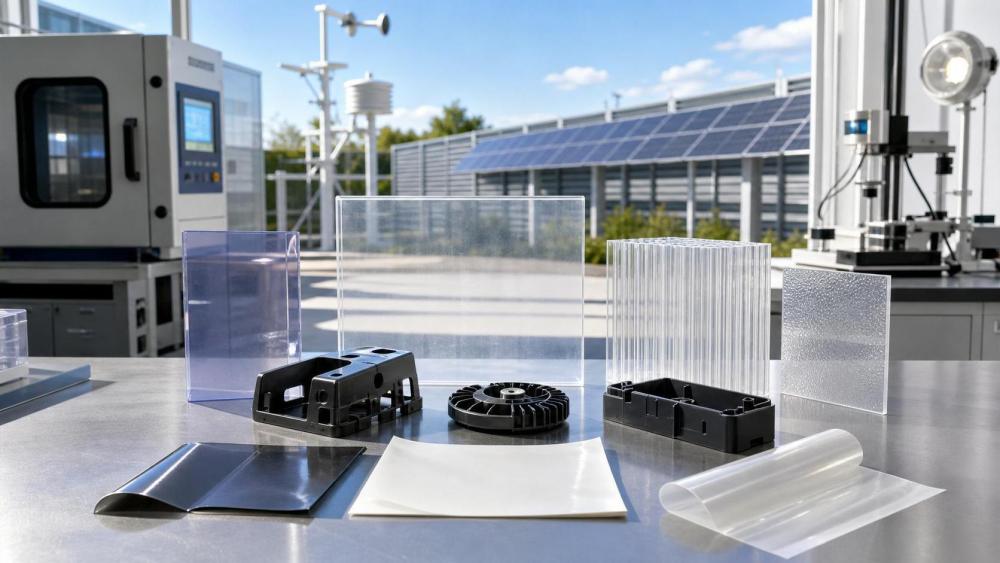
For companies comparing engineering plastics, modified compounds, and specialty films, UV resistance is no longer a secondary line item.
It sits alongside strength, heat resistance, dimensional stability, processability, and sustainability when outdoor performance is under review.
What Plastic Additives for UV Stability Actually Do
Plastic additives for UV stability are formulation tools that slow the damage caused by ultraviolet radiation.
UV energy can break polymer chains, trigger oxidation, and weaken pigments, surfaces, and mechanical performance.
Additives interrupt that cycle in different ways. Some absorb harmful radiation. Some deactivate free radicals. Some protect the polymer surface more broadly.
The main additive families
- UV absorbers: capture specific wavelengths before the polymer structure is damaged.
- HALS: hindered amine light stabilizers reduce long-term photo-oxidative degradation.
- Carbon black and selected pigments: screen light and improve weathering resistance in some systems.
- Antioxidants: support thermal and oxidative stability during both processing and service.
Simple selection by additive name is rarely enough. Performance depends on resin chemistry, dosage, dispersion, color, thickness, and expected exposure conditions.
Why the Industry Is Paying Closer Attention
Outdoor plastics are moving into more demanding roles across transport, electronics, energy, construction, packaging, and industrial equipment.
As advanced polymers replace metal, glass, and conventional plastics, durability expectations rise with them.
That shift is especially clear in engineering plastics such as PC, PMMA, ABS blends, PA, PET, PBT, and TPU.
These materials may offer weight reduction, design freedom, and processing efficiency, but outdoor exposure introduces a different set of risks.
Another reason is the broader use of recycled and bio-based content. Sustainability targets are expanding, yet weathering performance must still hold.
Plastic additives for UV stability therefore become part of a larger balancing act involving durability, compliance, aesthetics, and circular design.
This is where structured material intelligence matters. APIM’s coverage of modified polymers, compounding quality, processing control, and application logic aligns with these decisions.
Where UV-Stabilized Formulations Deliver Practical Value
The value of plastic additives for UV stability changes by application. In some products, color retention leads the discussion. In others, mechanical reliability is the real issue.
In business terms, the benefit is not only longer life. It can also mean fewer warranty issues, more predictable performance, and lower variation across regions.
Material and Processing Factors That Change the Result
A UV package cannot be evaluated in isolation. The base polymer sets the starting point.
For example, PMMA and ASA have stronger natural weatherability than many unmodified polyolefins or standard ABS grades.
Even then, additive design still matters because color, thickness, transparency, and service conditions can change the exposure profile.
Key variables to check
- Resin type and intrinsic weatherability
- Additive compatibility with the polymer matrix
- Dosage level and dispersion quality after compounding
- Pigment system, especially dark versus transparent formulations
- Part thickness and whether degradation begins mainly at the surface
- Processing temperature and residence time during extrusion or molding
- Expected outdoor geography, altitude, and combined heat-humidity load
Compounding quality is often underestimated. Poor dispersion can create local weak points even when the additive chemistry is technically correct.
That is why equipment settings also matter. Screw design, feeding accuracy, melt temperature, and degassing can all influence final stability.
APIM’s focus on extrusion and compounding technologies is relevant here because weathering performance starts long before field exposure begins.
How to Evaluate Plastic Additives for UV Stability in Practice
A useful evaluation begins with the end-use environment, not the additive brochure.
A part used under direct sun in a hot climate faces different risks than a shaded enclosure in mild conditions.
The next step is to define which properties must survive. Visual change is not always the most critical metric.
A practical evaluation sequence
- Map the service environment, exposure duration, and temperature range.
- List the properties that must remain stable after weathering.
- Compare candidate polymers before comparing additive packages.
- Review compound formulation, color system, and processing window together.
- Request accelerated weathering data and understand the test method used.
- Check whether field data exists for similar thickness, color, and geography.
- Consider recyclability, traceability, and long-term supply consistency.
Accelerated testing is helpful, but it should not be treated as a universal forecast. Different standards emphasize different stress combinations.
A material that performs well in one cycle may behave differently under moisture-heavy or heat-heavy outdoor conditions.
Common Misreads During Selection
One common mistake is assuming that more additive always means better outdoor life.
In reality, overloading can affect processing, transparency, color tone, surface quality, or cost without solving the root problem.
Another issue is focusing on initial mechanical data while ignoring retention after aging.
A material can look strong on day one and still lose too much impact resistance after exposure.
It is also risky to compare UV-stabilized grades without checking the full formulation context.
A glass-fiber reinforced compound, a transparent film, and a dark injection-molded housing may all require different stabilization strategies.
A Better Basis for the Next Decision
Plastic additives for UV stability should be viewed as part of system design, not as a small corrective ingredient.
They connect polymer choice, compounding discipline, processing control, outdoor environment, and product life expectations.
For companies reviewing outdoor materials, the most productive next step is to build a comparison framework around real exposure conditions and performance retention.
That framework should bring together resin type, additive package, weathering data, color system, process conditions, and supply consistency.
When those factors are evaluated together, plastic additives for UV stability become easier to judge in commercial and technical terms.
APIM’s structured coverage of advanced polymers, modified compounds, specialty films, and processing technologies offers a practical starting point for that review.
Have questions about this sector analysis, or seeking best practices specific to your niche? Drop us a line below and let the senior consultants at APIM assist you.
We respect your privacy. Your information is strictly confidential.
Related News
- 00
0000-00
Do polyolefin hot melt adhesives bond well to polyethylene? - 00
0000-00
Korean Study Finds PLA Barely Degrades in Landfill After 320 Days - 00
0000-00
How to assess batch consistency from a thermal potting compounds supplier - 00
0000-00
How much weight can carbon fiber reinforced plastics save in cars? - 00
0000-00
Switching from PS to ABS Sheet Extrusion: Equipment Checks