




How PPS Performs in High-Temperature Electrical Parts: Limits, Advantages, and Trade-Offs
PPS has become a familiar choice in high-temperature electrical parts because it combines heat resistance, insulation performance, and dimensional control in one engineering polymer. In practice, though, successful use of PPS depends less on a single datasheet line and more on how thermal load, part geometry, compliance targets, processing conditions, and long-term aging interact inside the finished component.
That is why PPS keeps attracting attention across electronics, automotive electrification, industrial controls, power systems, and compact consumer devices. As APIM often frames material decisions, the real question is not whether a resin looks strong on paper, but whether it stays reliable through molding, assembly, service life, and cost review.
Why PPS matters in electrical systems under heat
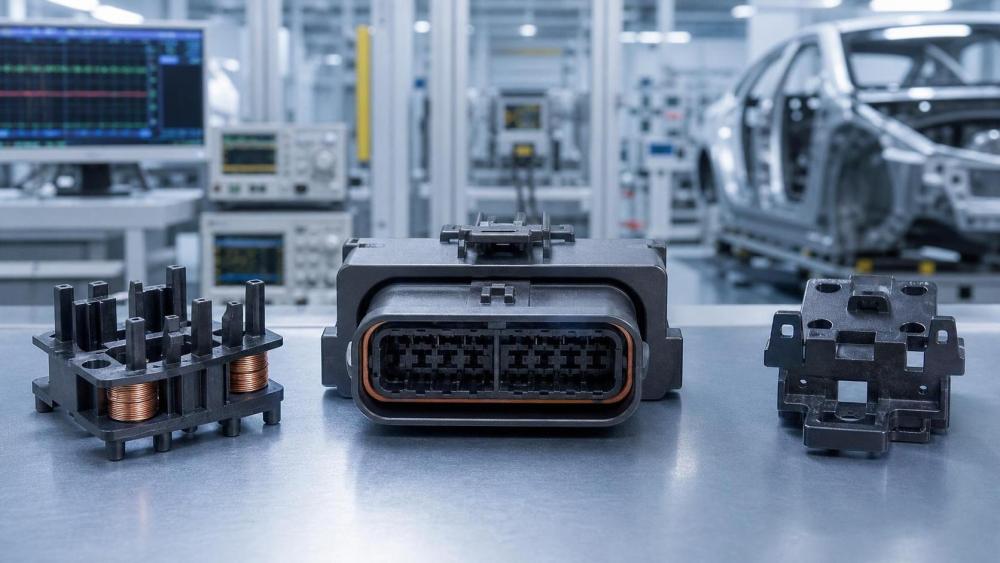
Electrical parts rarely face heat alone. They also see voltage stress, thermal cycling, mechanical loads, flame safety requirements, and tight dimensional tolerances. A connector body near a motor, relay housing, bobbin, sensor frame, or terminal support may operate in a small space where failure margins are narrow.
PPS, or polyphenylene sulfide, is valued because it keeps stiffness and shape better than many standard engineering plastics as temperature rises. It also offers low moisture absorption, strong chemical resistance, and good inherent flame behavior, which helps when parts must remain stable in humid, oily, or electrically active environments.
For modern manufacturing, this matters beyond performance alone. Smaller parts, higher power density, and longer warranty expectations mean thermal reliability now affects product safety, assembly yield, and supplier risk at the same time.
What PPS does well before its limits appear
The strongest case for PPS usually starts with heat. It performs well in continuous elevated temperatures where PA, PBT, or other common resins may soften, creep, or drift dimensionally. This is especially useful in coil formers, switchgear parts, charging components, and under-hood electrical assemblies.
Dimensional stability is another major advantage. Because PPS absorbs little moisture, molded dimensions remain comparatively predictable after storage and service exposure. In electrical parts with tight fit, pin alignment, or enclosure tolerances, that consistency can protect both function and assembly efficiency.
PPS also supports demanding electrical requirements. It is widely selected for insulation structures, precision housings, and flame-rated components where dielectric behavior and stable geometry must coexist. When reinforced correctly, PPS can also deliver high rigidity without moving immediately to metal.
Typical strengths seen in practice
- High thermal resistance for sustained service in hot electrical zones.
- Low moisture uptake, supporting stable dimensions and electrical consistency.
- Good chemical resistance to fuels, oils, flux residues, and cleaning media.
- Inherent flame resistance, often helpful for compliance planning.
- Compatibility with glass fiber and mineral reinforcement for stiffness control.
These benefits explain why PPS is often considered in electric vehicles, industrial automation, renewable energy hardware, and compact electronics. In each case, the material helps solve multiple design constraints at once rather than a single thermal problem.
Where PPS starts to show trade-offs
PPS is not a universal answer. One of its most common trade-offs is brittleness relative to tougher materials. In thin clips, snap fits, impact-prone housings, or parts exposed to rough handling, unmodified PPS may crack where a tougher resin would flex.
The second trade-off is processing sensitivity. PPS must be molded within a controlled temperature window. Resin dryness, residence time, tool design, and venting all influence surface quality, flash, weld line strength, and final performance. This links material choice directly to compounding quality and molding discipline.
Cost is another practical limit. PPS is usually more expensive than mainstream engineering plastics, so the justification must come from real service conditions, failure prevention, downsizing, or compliance value. If the application does not need high-temperature capability, the premium can be hard to defend.
There is also a design balance around fillers. Glass-fiber reinforced PPS improves stiffness and heat performance, but may reduce toughness, increase anisotropy, and affect tool wear. Conductive or thermal fillers can address special needs, yet they may change dielectric behavior or flow performance.
Common limits to evaluate early
How application context changes the PPS decision
The same PPS grade can look excellent in one electrical part and mediocre in another. Context matters. A coil bobbin near sustained heat may reward dimensional stability more than toughness. A battery-adjacent connector may demand heat and flame performance, but also require precise creepage design and long-term dielectric reliability.
In semiconductor equipment or precision sensors, low outgassing and dimensional accuracy may matter as much as thermal resistance. In automotive electrical systems, chemical exposure and thermal cycling become part of the material equation. In industrial controls, compliance, production repeatability, and field repair risk may carry more weight.
This is where a broader APIM-style view becomes useful. Material selection should connect resin properties with processing method, equipment capability, assembly route, certification burden, and expected service life. PPS should be judged as a system choice, not just a polymer family.
Applications where PPS is often a strong candidate
- Connector housings near hot circuits or motors.
- Relay, switch, and breaker components needing thermal stability.
- Coil formers, bobbins, and insulators exposed to electrical heat buildup.
- Sensor carriers and precision electrical supports.
- EV charging, inverter, and under-hood electrical structures.
Questions worth asking before approving PPS
A sound PPS decision usually starts with the real thermal profile, not the peak temperature alone. Continuous temperature, short spikes, thermal cycling frequency, and nearby heat sources all affect whether PPS offers necessary headroom or unnecessary cost.
Mechanical loading should be reviewed next. If the part includes weld lines, screw bosses, living features, or snap actions, toughness may become the deciding factor. In some cases, a modified PPS grade works. In others, another polymer family may offer a better balance.
Supply and production readiness also deserve attention. The best PPS compound on paper can still create delays if tooling is not optimized, if molders lack experience, or if batch consistency is weak. Compound design, twin-screw extrusion quality, filler dispersion, and drying control all shape downstream outcomes.
- Match the grade to real service temperature and exposure time.
- Check dielectric, flame, and dimensional requirements together.
- Review part geometry for brittleness-sensitive features.
- Confirm molding capability before locking the specification.
- Compare total system cost, not resin price alone.
A practical way to move from material interest to decision
PPS works best when the material is evaluated through a structured shortlist rather than a generic “high-temperature plastic” label. Start by mapping temperature, voltage, chemicals, tolerances, and compliance requirements. Then compare reinforced and unfilled options against actual part geometry and manufacturing capability.
Short validation loops often reveal more than broad comparisons. Prototype parts, thermal aging checks, electrical testing, and assembly trials can show whether PPS delivers practical reliability or only theoretical margin. This approach also helps separate resin selection issues from tooling or processing issues.
For teams using APIM as a technical reference, the next step is usually to build a decision frame that links material data with application risk. That means looking at PPS not just as a heat-resistant polymer, but as a business choice shaped by performance stability, production repeatability, qualification effort, and lifecycle cost.
When those factors align, PPS can be an efficient solution for high-temperature electrical parts. When they do not, its limits appear quickly. The most reliable outcome comes from testing the trade-offs early, while design freedom is still available.
Have questions about this sector analysis, or seeking best practices specific to your niche? Drop us a line below and let the senior consultants at APIM assist you.
We respect your privacy. Your information is strictly confidential.
Related News
- 00
0000-00
How does washing affect contamination in post-consumer recycled PP resins? - 00
0000-00
How does feedstock affect depolymerization equipment selection? - 00
0000-00
US Sets 213.44% Preliminary Antidumping Deposit on Chinese PTMEG - 00
0000-00
When should epoxy be used as a thermal interface material for semiconductors? - 00
0000-00
US Midterm Results Unlikely to Quickly Shift Recycled Plastics Market or Legislation