




How Often Should REACH Documentation Be Updated for Polymer Products?
There is no single annual or biennial rule that makes REACH documentation “valid” for polymer products. The practical answer is event-driven: documentation should be reviewed whenever the formulation, supply chain, substance status, intended use, or applicable REACH requirement changes. For many businesses, that means maintaining a scheduled control cycle as well, but the schedule is a management safeguard—not a substitute for reviewing regulatory triggers when they occur.
This distinction matters because a polymer grade can remain commercially unchanged while its compliance position changes. A newly listed Substance of Very High Concern (SVHC), a revised restriction, updated supplier data, or a changed article configuration can all affect what must be declared to customers. Conversely, repeatedly reissuing unchanged paperwork without reassessing the underlying material data does not create meaningful compliance assurance.
Start by identifying what is actually being supplied
“Polymer product” is not a sufficient compliance category on its own. The documentation required, the party responsible, and the update trigger differ depending on whether the company places a polymer resin, a formulated compound, a semi-finished material, or a finished article on the EU market.
Under REACH, polymers are generally exempt from registration under Article 2(9). That exemption does not mean that polymer producers and importers have no REACH responsibilities. Monomers and other substances used to manufacture the polymer may be subject to registration requirements. Additives, pigments, flame retardants, stabilizers, processing aids, fillers, residual monomers, and impurities can also create obligations depending on their role, concentration, hazard classification, and supply-chain position.
A bag of glass-fibre-reinforced polyamide pellets is normally supplied as a mixture containing a polymer and other constituents. Its documentation may include a Safety Data Sheet (SDS), exposure-related information where applicable, and declarations covering restricted substances or SVHC status. A molded connector, multilayer film, adhesive-bonded assembly, or finished automotive component may be an article. Article-specific obligations, including communication duties under REACH Article 33, then become central.
The update question should therefore be asked in a more precise form: Has anything changed that affects the REACH status or customer communication duties for this specific material or article?
Events that require an immediate documentation review
A disciplined compliance process treats several changes as automatic review triggers. Some lead to a revised declaration; others may confirm that the existing document remains correct. Both outcomes should be recorded.
- Changes to formulation or bill of materials. Any addition, removal, or concentration change involving additives, masterbatches, colorants, recycled feedstock, curing agents, plasticizers, fillers, or processing aids requires reassessment. A change below a commercial product-name level can still alter the chemical inventory behind the grade.
- A new raw-material supplier or a changed supplier manufacturing site. Equivalent performance does not prove equivalent chemical composition. Different suppliers may use different stabilizer packages, catalysts, pigments, or impurity profiles. Procurement changes should not be closed until current compliance evidence has been reviewed.
- Revised supplier declarations, SDSs, or analytical data. A supplier may update information because of a changed classification, newly available hazard information, a revised concentration range, or a regulatory finding. Such information can affect downstream declarations even where the formulation has not intentionally changed.
- Updates to the REACH Candidate List. When ECHA adds substances to the Candidate List, businesses must compare the new entries against their material and article data. This is one of the most important recurring triggers for SVHC declarations.
- New or amended restrictions under REACH Annex XVII. Restrictions can set conditions for manufacture, placing on the market, or use. Their relevance depends on the substance, product type, concentration, application, and intended customer market.
- Authorisation developments under Annex XIV. If a substance used in the supply chain is included in Annex XIV, the business must determine whether its use is covered by an authorisation, whether an exemption applies, and how this affects continuity of supply and customer communication.
- Changed intended use or market destination. A polymer compound used in general industrial molding may need different information when supplied for food-contact packaging, electrical equipment, medical applications, toys, or another regulated end use. REACH is not the only legal framework involved, but its documentation cannot be assessed in isolation from product use.
- Changes to article design. The concentration of an SVHC is assessed in the relevant article, not simply across the weight of a complex final product. Changes in layers, coatings, inserts, cables, adhesives, labels, or subcomponents can change the Article 33 analysis.
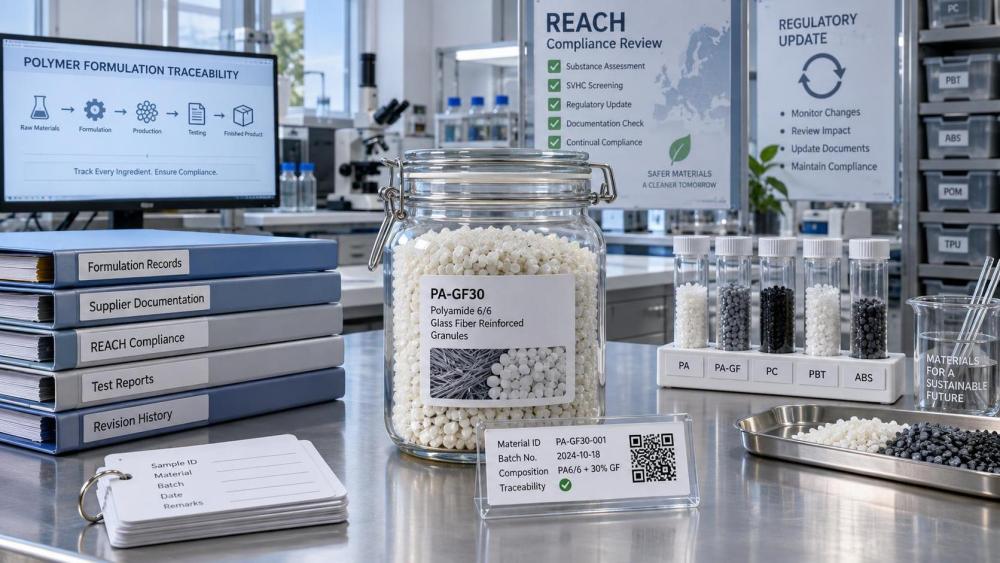
Candidate List updates need a defined response process
For polymer products supplied into European value chains, Candidate List monitoring should not be treated as a passive regulatory-news exercise. It should connect directly to the controlled material data used for declarations.
Where an SVHC on the Candidate List is present in an article above 0.1% weight by weight, Article 33 requires the supplier to provide sufficient information, available to the supplier, to allow safe use of the article. At a minimum, that information must identify the substance. This communication is required automatically for professional recipients. When a consumer requests the information, it must be provided free of charge within 45 days.
For articles placed on the EU market containing Candidate List substances above that threshold, SCIP database obligations may also apply. SCIP is administered under the Waste Framework Directive rather than REACH itself, but it relies on the same Candidate List and threshold logic. Businesses should avoid assuming that an Article 33 declaration alone resolves every reporting obligation.
A Candidate List addition does not automatically mean every polymer product needs a new “REACH compliant” certificate. It means the company needs a traceable assessment. If the newly listed substance is absent, documentation may remain substantively unchanged, but the review record should show which material families, suppliers, and articles were checked. If the substance is present above the relevant threshold in an article, customer communications and, where applicable, SCIP data need prompt attention.
The Candidate List has often been updated more than once in a year, but businesses should not rely on a fixed publication calendar. Monitoring should be continuous enough to capture ECHA updates and convert them into internal actions without waiting for the next annual supplier-review exercise.
SDS updates follow different rules from article declarations
For compounds, adhesive systems, masterbatches, and other mixtures, the SDS is often the most visible document in the supply chain. Its revision should be driven by the conditions in REACH Article 31 and the applicable SDS format requirements, including the provisions in Annex II. An updated SDS is required when new information becomes available that may affect risk-management measures or hazards; when an authorisation has been granted or refused; or when a restriction has been imposed.
This does not mean every administrative edit requires the same response. A revised telephone number, document layout, or company branding does not carry the same compliance significance as a revised classification, changed hazardous constituent disclosure, altered occupational exposure controls, or a new restriction. Nevertheless, document control should distinguish editorial changes from changes that require customer redistribution, technical review, or formulation investigation.
Article suppliers have a different challenge. Finished polymer articles may not require an SDS simply because they are articles. That does not eliminate the need for REACH evidence. A customer may require an SVHC declaration, Article 33 statement, SCIP reference where relevant, restricted-substance declaration, material composition statement, or a controlled declaration covering specified regulatory lists. The correct document depends on the item and transaction, not on the convenience of reusing an SDS template.
A practical review rhythm combines calendar controls with change controls
An effective answer to how often should REACH compliance documentation be updated for polymer products is: immediately after a relevant change, supported by a recurring verification cycle. The periodic cycle catches missing supplier updates, incomplete composition data, obsolete declarations in sales systems, and material substitutions that were not escalated through the formal change process.
Many organizations use a documented annual review for active material families and customer-facing declarations. This can be sensible, particularly where there are many grades, multiple production sites, recycled-content inputs, or frequent sourcing changes. However, an annual review must not delay action after a Candidate List change, a material reformulation, or a newly identified supply-chain issue.
Version dates alone do not prove a declaration is current
A common weakness in polymer supply chains is treating the date on a declaration as the main indicator of compliance. A recent date can conceal a weak assessment if the supplier only issued a generic statement without reviewing its formulation against the relevant regulatory list. An older document can also be misleading even if the material has not changed, because regulatory lists and customer requirements may have changed since it was issued.
Useful documentation identifies the exact product grade, legal entity, manufacturing site where relevant, document version, scope of the assessment, and regulatory reference. It should make clear whether the declaration covers the product as supplied, a finished article, or both. It should also distinguish “no intentionally added” language from a concentration-based compliance conclusion. The two statements are not equivalent: an unintentionally present impurity or recycled-content contaminant may still require assessment.
For recycled polymers, traceability deserves particular attention. Recycled content can introduce variability in legacy additives, pigments, plasticizers, or contaminants. A broad supplier assurance may be insufficient where the material is used in a sensitive application or where the downstream customer needs article-level SVHC confirmation. The appropriate response is not to presume non-compliance, but to establish whether the available compositional evidence is adequate for the claim being made.
Build the update process around controlled data, not email collection
Compliance documentation becomes unreliable when declarations are stored as disconnected PDFs in procurement inboxes. The operational objective is to maintain a controlled link between each sellable grade or article and the information needed to support its REACH position.
That record should connect the commercial product code to the approved formulation or bill of materials, raw-material supplier declarations, SDSs where applicable, SVHC screening status, restrictions review, customer-specific requirements, revision history, and responsible approver. A formulation change should automatically trigger a compliance review before commercial release. Similarly, a regulatory update should generate a defined list of affected materials rather than a company-wide request for indiscriminate document renewals.
Customer declarations should be issued with an internal validity logic. If the declaration depends on a specific Candidate List version, state that basis. If it is valid only for the identified grade and supplied configuration, avoid wording that implies coverage of all products, all applications, or all future reformulations. Precision is more defensible than a broad “REACH compliant” statement with no stated scope.
Do not confuse REACH review with a single-document exercise
REACH documentation for polymer products is not complete because an SDS or supplier certificate exists. The real control point is whether the document reflects the current product, applicable legal requirements, and the position of the company in the supply chain. Polymer registration exemption, Article 33 communication, SDS revision obligations, Annex XVII restrictions, and SCIP reporting can apply differently to different forms of the same material.
The most reliable policy is therefore simple: review compliance documentation at least on a defined recurring cycle, but update or reconfirm it immediately when a regulatory, formulation, supplier, use, or article-design change occurs. This approach reduces the risk of outdated SVHC statements, unsupported customer declarations, avoidable supply interruptions, and compliance claims that cannot be substantiated when a buyer asks for the underlying evidence.
Have questions about this sector analysis, or seeking best practices specific to your niche? Drop us a line below and let the senior consultants at APIM assist you.
We respect your privacy. Your information is strictly confidential.
Related News
- 00
0000-00
NAPCOR Report: US PET Bottle Recycling Rate Fell to 29% in 2025 - 00
0000-00
How does washing affect contamination in post-consumer recycled PP resins? - 00
0000-00
How does feedstock affect depolymerization equipment selection? - 00
0000-00
US Sets 213.44% Preliminary Antidumping Deposit on Chinese PTMEG - 00
0000-00
When should epoxy be used as a thermal interface material for semiconductors?