




How Flame Retardant Engineering Plastics Affect Heat Resistance and UL Ratings
How Flame Retardant Engineering Plastics Affect Heat Resistance and UL Ratings
For technical evaluators, selecting flame retardant engineering plastics is not only about meeting fire safety requirements but also about understanding how additives influence heat resistance, mechanical stability, and final UL ratings.
This article examines the relationship between formulation, thermal performance, and certification outcomes, helping you assess materials more accurately for demanding electrical, automotive, and industrial applications.
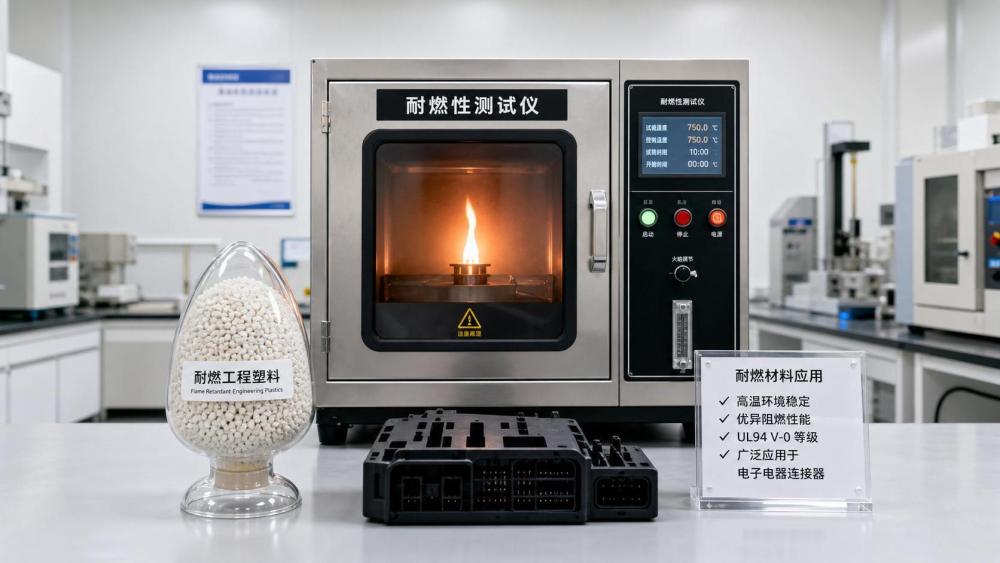
In practice, flame retardant engineering plastics sit at the intersection of safety, processing, and long-term reliability.
A grade may pass a flammability test, yet lose impact strength, warp under heat, or create molding issues.
That is why heat resistance and UL ratings must be evaluated together, not as separate checkboxes.
Why Flame Retardant Engineering Plastics Behave Differently Under Heat
Base resin matters first.
PBT, PA66, PC, PPS, and PEEK all respond differently to thermal stress before any flame retardant package is added.
Semi-crystalline resins often retain stiffness better at elevated temperatures.
Amorphous resins may offer dimensional precision, but their thermal response follows a different curve.
Once flame retardants enter the formulation, the picture changes again.
Some additives promote char formation.
Some release active species that interrupt combustion.
Others rely on synergists, fillers, or surface effects to reach target performance.
The additive package affects more than flammability
Flame retardant engineering plastics often include phosphorus-based, halogen-free, brominated, or mineral systems.
Each approach can shift thermal aging, melt viscosity, moisture sensitivity, and part appearance.
For example, some halogen-free systems need higher loading levels.
Higher loading can reduce toughness and lower heat distortion performance if the resin matrix is not optimized.
This also means a V-0 rating does not automatically indicate better overall heat resistance.
How Heat Resistance Should Be Interpreted
Heat resistance is not a single number.
Technical reviews usually involve several metrics, each answering a different question.
- HDT shows how the part behaves under load at rising temperature.
- RTI indicates expected long-term performance in real service conditions.
- Melting point or glass transition helps define process and use limits.
- Thermal aging data reveals property retention after prolonged exposure.
- Glow wire or electrical tests may matter in appliance and connector designs.
A common mistake is to compare flame retardant engineering plastics by UL 94 only.
UL 94 measures how a specimen burns in a defined setup.
It does not fully describe long-term thermal endurance.
That gap becomes important in enclosed electrical parts, under-hood components, and compact industrial housings.
Why formulation can lower heat performance
Some flame retardants act like plasticizers at certain levels.
Others interfere with crystallization or create stress concentration points.
Poor dispersion can make the result worse.
In actual business decisions, this is where compound quality starts to matter more than brochure claims.
A well-compounded flame retardant engineering plastic can preserve more stiffness and dimensional control at temperature.
Understanding UL Ratings Beyond the Headline Grade
When people discuss UL ratings, they often mean UL 94 classifications such as HB, V-2, V-1, and V-0.
These ratings are useful, but they are not the whole evaluation framework.
Thickness dependence is one of the biggest practical issues.
A flame retardant engineering plastic may achieve V-0 at 1.5 mm, but not at 0.8 mm.
For miniaturized electronics, that distinction directly affects part approval.
UL 94 and RTI answer different questions
UL 94 focuses on flame behavior during a short test event.
Relative Thermal Index, or RTI, focuses on property retention over time.
A material with a strong flammability rating may still carry a lower RTI than expected.
That is especially true when the flame retardant package accelerates aging or affects polymer stability.
This is one reason technical evaluators ask for yellow card data, not just marketing sheets.
A practical comparison view
What Changes in Real Applications
The effect of flame retardant engineering plastics becomes clearer in application-specific reviews.
In connectors and switch components, thin-wall performance often dominates the decision.
In automotive parts, thermal cycling and dimensional stability carry more weight.
In industrial enclosures, balance matters across flammability, impact strength, and process stability.
Typical tradeoffs to watch
- Higher flame retardant loading can reduce elongation and impact resistance.
- Glass fiber improves stiffness, but may complicate surface quality and weld line behavior.
- Moisture-sensitive systems need tighter drying control before molding.
- Processing windows may narrow as additive packages become more complex.
- Color stability can change under heat aging or reprocessing.
From recent market shifts, halogen-free flame retardant engineering plastics are seeing wider adoption.
Even so, substitution is rarely direct.
A compound that matches UL 94 still needs verification on heat resistance, warpage, and tool performance.
How to Evaluate Flame Retardant Engineering Plastics More Accurately
A solid review process starts with the end-use environment, not the data sheet headline.
This keeps flame retardant engineering plastics aligned with real operating risk.
- Define the actual temperature profile, including peaks, continuous exposure, and cycling.
- Check required UL ratings at the exact part thickness.
- Review RTI, HDT, and aging data together.
- Ask about additive system type, filler content, and reinforcement level.
- Confirm molding conditions, drying needs, and regrind limits.
- Request yellow card documentation and lot-to-lot consistency information.
- Validate final parts with end-use testing, not plaques alone.
This approach is especially useful when comparing PA, PBT, PC, and high-temperature flame retardant engineering plastics.
The data may look similar at first glance.
The practical differences usually appear in thin sections, long-term aging, and process repeatability.
Final Takeaway for Material Decisions
Flame retardant engineering plastics should be judged as engineered systems, not simple fire-safe grades.
The resin, additive package, reinforcement, and compounding quality all influence heat resistance and UL ratings.
A better UL 94 result does not always mean better thermal endurance.
Likewise, a high-heat polymer can still underperform if the flame retardant formulation is poorly matched.
The most reliable choice comes from reading flammability, RTI, HDT, aging, and processing data as one connected story.
For stronger decisions, compare flame retardant engineering plastics at real part thickness, under actual thermal loads, and with certification data that reflects the final application.
Have questions about this sector analysis, or seeking best practices specific to your niche? Drop us a line below and let the senior consultants at APIM assist you.
We respect your privacy. Your information is strictly confidential.
Related News
- 00
0000-00
Do polyolefin hot melt adhesives bond well to polyethylene? - 00
0000-00
Korean Study Finds PLA Barely Degrades in Landfill After 320 Days - 00
0000-00
How to assess batch consistency from a thermal potting compounds supplier - 00
0000-00
How much weight can carbon fiber reinforced plastics save in cars? - 00
0000-00
Switching from PS to ABS Sheet Extrusion: Equipment Checks