




How Can You Verify a Polyamide Supplier’s RoHS Certification?
A supplier's RoHS document is useful only when it can be tied to the exact polyamide grade, formulation, production source, and intended product use. A generic statement saying that a company or its "nylon materials" are RoHS compliant is not enough for a purchasing or compliance decision.
For PA6, PA66, PA12, bio-based polyamides, glass-fiber-reinforced compounds, flame-retardant grades, color-matched materials, and recycled-content compounds, compliance risk often sits in the additives rather than in the base polymer. Pigments, stabilizers, fillers, processing aids, flame-retardant packages, lubricants, and regrind can all change the restricted-substance profile. Verification therefore needs to go beyond checking whether a PDF carries a RoHS logo.
Start by asking what the document actually proves
RoHS is often described as a certification, but many polymer suppliers issue a declaration of compliance rather than a formal third-party certificate. That distinction matters. A supplier declaration can be entirely appropriate, provided it is specific, authorized, current, and supported by a defensible material-control process. A document called a “certificate” may still be weak if it contains no grade identification, no applicable legislation, and no basis for the claim.
For products placed on the EU market, the relevant framework is generally the EU RoHS Directive. The restriction applies to substances in homogeneous materials, meaning materials that can be mechanically separated, rather than to the finished assembly's total weight. For a molded electrical connector, for example, the polyamide housing, pigment system, metal inserts, labels, coatings, and any overmolded material may need separate consideration.
A credible document should identify the regulatory basis clearly. It should state whether the declaration addresses the standard RoHS restricted substances and whether it considers applicable exemptions. A broad phrase such as “meets environmental requirements” does not establish RoHS compliance.
Check the restricted-substance scope
For many sourcing decisions, the declaration should address the ten substances commonly associated with EU RoHS restrictions: lead, mercury, cadmium, hexavalent chromium, polybrominated biphenyls, polybrominated diphenyl ethers, bis(2-ethylhexyl) phthalate, butyl benzyl phthalate, dibutyl phthalate, and diisobutyl phthalate.
The usual maximum concentration values are expressed in each homogeneous material: 0.1% by weight for most restricted substances and 0.01% for cadmium, unless a valid exemption applies. Procurement teams should avoid treating those figures as a simple pass/fail screen for a whole molded part. The relevant question is whether the declared polyamide compound, in its supplied form and intended formulation, remains within the applicable limits.
Older declarations may cover only the original six RoHS substances. Such documents may still be useful as historical evidence, but they do not by themselves demonstrate coverage of the four phthalates added to the commonly expected substance set. Check the issue date, revision number, and substance list rather than assuming the word “RoHS” carries a uniform meaning.
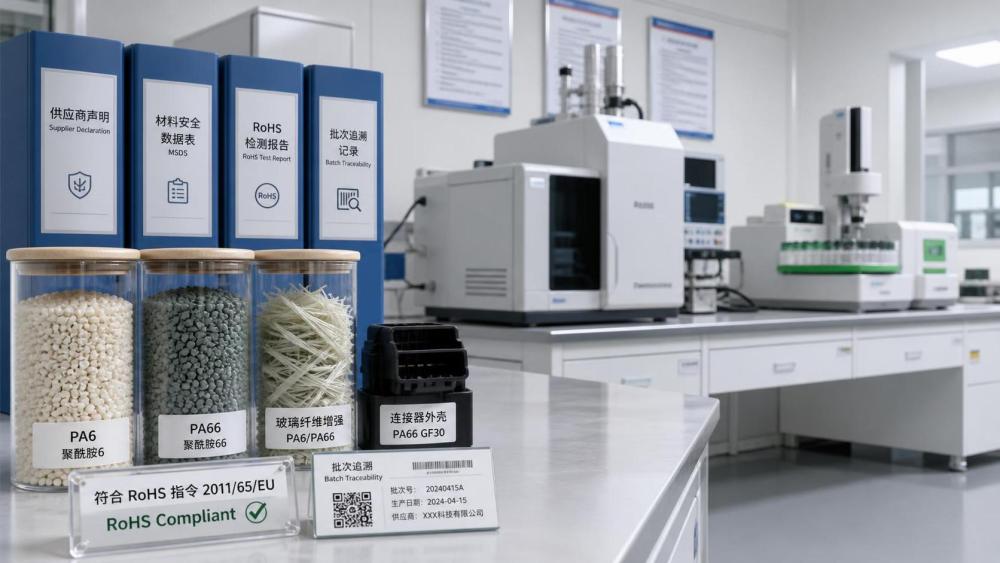
Match every document to the exact polyamide grade
The most important verification step is traceability. A RoHS declaration should name the exact commercial grade, not simply “polyamide,” “nylon,” or “PA66.” Grade identity should align with the supplier's technical data sheet, safety data sheet, quotation, purchase order, and packaging label.
This is especially important where multiple versions of a material exist under a common family name. A natural PA66 resin may have a different compliance profile from a black heat-stabilized grade. A 30% glass-fiber-reinforced compound can differ from an unfilled grade. A halogen-free flame-retardant formulation and a conventional flame-retardant version may use entirely different additive packages. Even color can matter where pigments or masterbatch additions are introduced during compounding.
- Confirm the full grade name, internal grade code, color designation, reinforcement level, and flame-retardant designation.
- Check that the manufacturing entity named on the document is the entity supplying the material, or that its relationship to the seller is clear.
- Compare the document issue date with the material's current technical data sheet revision.
- Ask whether the declaration applies to all production sites or only to a named plant.
- For distributor-supplied material, obtain the original producer's declaration where possible rather than relying only on a distributor-issued statement.
A declaration that covers “PA6 GF30” without identifying color, additive package, or grade code may be adequate only when the supplier can confirm that all variants are controlled under the same formulation and compliance system. That explanation should be documented, particularly for electronics programs with customer audit requirements.
Read the declaration as a controlled legal document
A strong RoHS declaration normally contains more than a logo and a signature image. It should include the supplier's legal entity name and address, an identifiable document title or reference number, the material or product scope, the applicable RoHS legislation, an issue date, and an authorized signatory or responsible function.
The language should also be precise. Statements such as “designed to comply,” “RoHS capable,” or “contains no intentionally added restricted substances” are not always equivalent to a compliance declaration. They may indicate that the supplier has not completed final verification, that analytical data are incomplete, or that the claim depends on a defined use condition.
Dates deserve closer attention than they often receive. A declaration does not necessarily expire on a fixed schedule, but an old document can become unreliable after a formulation change, supplier substitution, new color introduction, site transfer, or regulatory update. A current declaration should be requested at material approval and again when any controlled change occurs. High-risk applications may justify a periodic refresh as part of the supplier quality agreement.
Use test reports carefully, not as a substitute for traceability
Laboratory reports can strengthen a supplier's evidence package, but they should be interpreted in context. A report may show the composition of one sample, one production lot, or one finished article. It does not automatically prove that every batch of a polyamide grade remains compliant over time.
First, determine what was tested. Handheld X-ray fluorescence screening can identify some elemental concerns, such as lead, cadmium, mercury, or chromium, but it is not a complete method for organic flame retardants or phthalates. A report that covers only heavy metals cannot support a full ten-substance RoHS claim. Similarly, a report for a finished molded component cannot automatically be transferred to a differently colored resin pellet or another compounder’s formulation.
Second, compare the report to the declared material. The sample description should identify the grade, batch or lot where available, color, form, and testing date. Confirm that the reporting laboratory is identifiable and that the analytical methods are suitable for the substances being claimed. A polished report with no clear sample linkage is weaker evidence than a concise report tied directly to a lot and accompanied by a controlled declaration.
Third, understand why testing was performed. A supplier may use routine incoming-material controls, formulation reviews, supplier declarations, and periodic analytical verification. That can be more reliable than a one-time test report, provided the supplier can explain its change-control process. For critical material programs, ask how the company controls additives, pigments, recycled feedstock, and raw-material substitutions after initial qualification.
Investigate the areas where polyamide compounds carry more risk
Virgin, unfilled natural polyamide may be comparatively straightforward to document, but a buyer should not assume that all PA grades present the same verification burden. The following situations usually justify more detailed questions.
Flame-retardant grades
Flame-retardant polyamides are common in electrical and electronic parts, precisely where RoHS evidence is often required. The material may contain phosphorus-based, nitrogen-based, mineral, halogenated, or synergistic additive systems. The RoHS issue is not whether a material is marketed as flame retardant; it is whether its specific additives create restricted-substance concerns or whether documentation has kept pace with formulation changes.
Ask the supplier to confirm the formulation family and whether the grade's RoHS declaration covers the delivered flame-retardant version. If the supplier uses a general declaration for a family of grades, request a statement explaining the family scope and the controls used to keep the restricted-substance status consistent.
Black, colored, and custom-matched compounds
Pigments and color masterbatches are frequent weak points in document packages because they may be sourced separately or changed to meet appearance, availability, or cost requirements. A declaration for natural resin does not cover a black or custom-colored compound unless the supplier explicitly says it does. Color-specific documentation is particularly valuable when the molded part is visible, customer-specified, or produced through more than one compounding route.
Recycled or reprocessed content
Recycled-content polyamide can be suitable for many applications, but verification should examine source control and batch consistency. Recovered feedstock may introduce variability that is absent from a virgin formulation. The relevant concern is not recycled content itself; it is whether the compounder's sourcing, sorting, contamination control, testing strategy, and change-notification procedures support the RoHS statement.
For these materials, request a description of the supplier's compliance-control approach alongside the declaration. A supplier does not need to disclose proprietary formulation details, but it should be able to explain how it prevents unapproved feedstock or additive changes from undermining its compliance claim.
Check exemptions against the finished application
A supplier may state that a material is compliant “except where exemptions apply.” That wording should trigger a follow-up rather than an automatic rejection. RoHS exemptions can be relevant in particular uses, but their availability depends on the substance, the exemption wording, the application category, and the status of that exemption.
The resin supplier can describe its material, yet the legal responsibility for placing an electrical or electronic product on the market generally rests further downstream. A material declaration therefore supports the final product compliance file; it does not replace the finished-product manufacturer's assessment.
Where an exemption is cited, ask for its exact reference and how it relates to the intended part. Confirm whether the application is within the exemption's scope and whether the product team has assessed any expiry or renewal implications. This is particularly important when a compound contains a deliberately added substance that would otherwise be restricted. Vague exemption language creates avoidable risk during customer review or market-surveillance inquiry.
Build verification into supplier approval, not a last-minute document chase
The most efficient approach is to define the evidence requirement before a material is approved. Engineering can identify the exact grade, processing route, color, use temperature, and electrical or flame-performance requirements. Procurement can then require an aligned RoHS declaration, technical data sheet, safety data sheet, change-notification commitment, and, where justified, supporting analytical evidence.
For a lower-risk, stable virgin grade used in a non-critical component, a current and traceable supplier declaration may be sufficient. For a flame-retardant, colored, recycled, or multi-site-supplied compound entering regulated electronics, the review should be deeper. The added effort is usually modest compared with the cost of discovering, after molding or customer submission, that a declaration applies to the wrong grade or an outdated formulation.
A practical approval record should preserve the document version, the material grade and supplier code, the approved manufacturing source, the responsible internal reviewer, and any limitations identified during review. It should also state what event triggers re-verification: a formulation change, production-site change, alternate source, color change, recycled-content adjustment, regulatory revision, or customer-specific requirement.
Questions that expose weak supplier documentation
When a document package leaves uncertainty, direct questions are more useful than requesting another generic certificate. Ask the supplier whether the declaration covers the exact grade and color being quoted; whether the formulation is produced at the stated site; whether any restricted substances are intentionally added; whether recycled or externally sourced feedstock is used; how raw-material changes are approved; and whether the company will notify customers before changes that could affect RoHS status.
A capable supplier should be able to answer these questions through its quality, regulatory, or product stewardship function. The response does not need to reveal confidential chemistry. It should, however, show that the compliance claim is connected to controlled materials and controlled production rather than copied from a general product-family template.
The decision point is simple: accept a polyamide RoHS declaration when it is current, exact, properly issued, and supported by traceability and change control. Escalate the review when the material is modified, colored, flame retardant, recycled, custom compounded, sourced through multiple channels, or intended for a compliance-sensitive electronic product. In those cases, the document itself is only the starting point; the supplier's ability to demonstrate control over the formulation is what makes the claim dependable.
Have questions about this sector analysis, or seeking best practices specific to your niche? Drop us a line below and let the senior consultants at APIM assist you.
We respect your privacy. Your information is strictly confidential.
Related News
- 00
0000-00
NAPCOR Report: US PET Bottle Recycling Rate Fell to 29% in 2025 - 00
0000-00
How does washing affect contamination in post-consumer recycled PP resins? - 00
0000-00
How does feedstock affect depolymerization equipment selection? - 00
0000-00
US Sets 213.44% Preliminary Antidumping Deposit on Chinese PTMEG - 00
0000-00
When should epoxy be used as a thermal interface material for semiconductors?