




High Purity Medical Polymers: Key FDA Compliance Checks
High purity medical polymers sit at the center of medical device quality because material cleanliness directly affects safety, consistency, and regulatory confidence.
For FDA-facing products, polymer selection is never only a sourcing decision. It is also a compliance decision tied to contamination control, documentation depth, and process stability.
That is why the most useful FDA checks go beyond a supplier datasheet. They examine how a resin is made, handled, tested, and changed over time.
Why This Topic Has Moved Higher on the Compliance Agenda
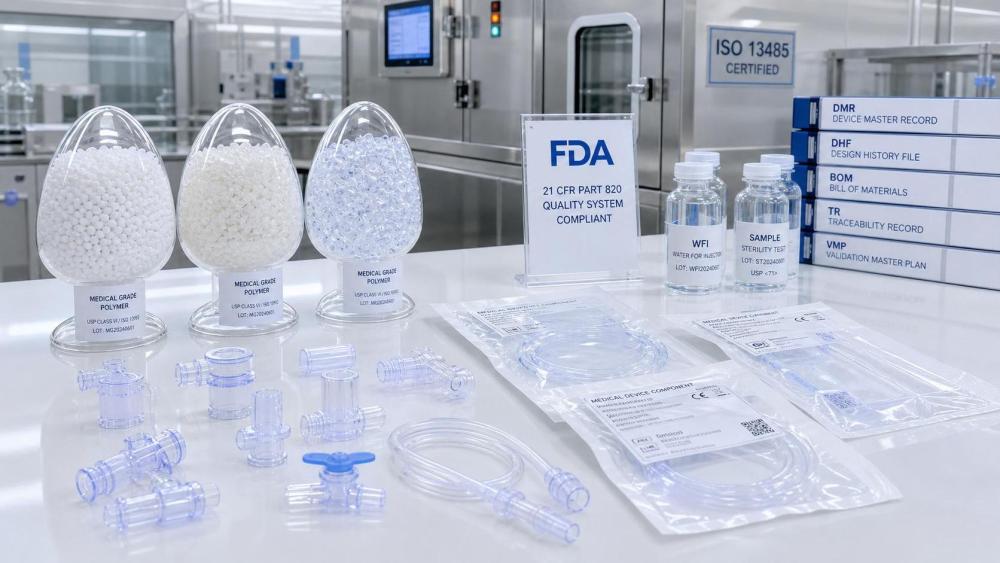
Medical products now face tighter scrutiny on extractables, trace contamination, and supplier controls. That trend has pushed high purity medical polymers into broader quality discussions.
The issue also extends beyond healthcare. Advanced polymer supply chains serve electronics, packaging, specialty films, adhesives, and industrial applications with similar expectations for consistency.
APIM tracks this wider materials landscape closely. That cross-industry view matters because medical compliance often depends on processing discipline developed in high-performance industrial materials production.
In practice, a polymer used in a catheter hub, diagnostic housing, or fluid path component must perform under stress while remaining chemically controlled and traceable.
What High Purity Medical Polymers Really Mean
The phrase usually refers to polymers produced with strict control over residual monomers, additives, particulates, bioburden risk, and unintended contaminants.
It also implies reliable batch behavior. A material cannot be considered suitable for regulated medical use if purity changes from lot to lot.
Common examples include medical grades of PEEK, PC, PE, PP, TPU, and certain specialty elastomers. The exact grade depends on the contact profile and device risk.
Purity alone is not enough. FDA compliance checks also consider how the polymer behaves after molding, sterilization, assembly, storage, and real-use exposure.
The FDA Checks That Usually Matter Most
Most reviews focus on a connected set of evidence rather than one certificate. The strongest files show control from raw material input to finished component output.
1. Material identity and composition control
The first check is simple but critical: confirm exactly what the polymer is, which additives are present, and whether the formulation is locked.
This includes resin family, grade code, colorants, stabilizers, processing aids, fillers, and any regrind policy. Unclear composition creates immediate regulatory weakness.
2. Biocompatibility support
A medical-grade claim does not replace device-specific evaluation. Still, prior testing under ISO 10993 can provide an important starting point.
The key is relevance. Test history must align with contact duration, tissue pathway, sterilization method, and final part processing conditions.
3. Extractables and leachables risk
High purity medical polymers are often selected to minimize chemical migration, especially in drug delivery, diagnostics, and fluid handling systems.
FDA reviewers typically expect a rationale for why extractables are controlled, how they were studied, and which process variables could change the result.
4. Manufacturing environment and contamination prevention
Purity is shaped by production discipline. That includes material transfer, packaging, filtration, cleaning validation, and protection from foreign matter.
In extrusion and compounding, residence time, screw design, degassing, melt filtration, and temperature control can influence degradation and contamination levels.
5. Change control and traceability
An FDA-ready material program must show what happens if the supplier changes raw inputs, production location, formulation details, or test methods.
Without formal notification procedures, even a technically sound polymer can become a long-term compliance risk.
A Practical Review Table for Material Qualification
The table below summarizes the checks that often separate a usable resin file from a weak one.
Where Problems Usually Appear in Real Programs
Many compliance failures do not start with dramatic defects. They start with small documentation gaps around high purity medical polymers.
A supplier may offer a clean resin, yet provide limited extractables data. Another may have good test records, but weak change notification language.
Processing can also introduce risk after resin approval. Drying errors, black specks, line clearance failures, and packaging exposure can defeat upstream purity controls.
This is where APIM’s broader coverage becomes useful. Medical materials do not exist in isolation from compounding quality, extrusion settings, additive behavior, or supply chain discipline.
How to Read Supplier Information More Critically
A polished technical data sheet should never be the end of the review. It is only the opening layer.
- Check whether the medical designation is global or region-specific.
- Confirm whether test data applies to resin, molded plaque, or final device geometry.
- Review sterilization compatibility for gamma, EtO, steam, or e-beam exposure.
- Look for impurity limits, not only average values.
- Ask how recycled content, rework, or line carryover are controlled.
- Verify retention samples, lot coding, and investigation procedures.
These questions are especially relevant for high purity medical polymers used in fluid contact, implant-adjacent, or diagnostic applications.
Linking Material Compliance to Business Decisions
The value of strong FDA checks is not limited to regulatory files. Better control often leads to fewer deviations, smoother audits, and more predictable product release.
It also improves supplier comparison. When two grades appear similar on paper, the better choice is often the one with stronger traceability and cleaner change management.
For global supply networks, this is increasingly important. Material availability, secondary sourcing, and regional qualification strategy now influence compliance planning from the beginning.
Useful Next Steps for a Stronger Review Process
A workable next step is to build a short internal checklist for high purity medical polymers before new grade approval or supplier renewal.
Start with composition transparency, biological evidence, impurity limits, sterilization fit, contamination controls, and written change notification terms.
Then compare those findings against actual device exposure conditions, processing steps, and packaging requirements rather than general material claims.
When the review becomes more structured, high purity medical polymers can be assessed with less uncertainty and far better support for long-term FDA compliance.
Have questions about this sector analysis, or seeking best practices specific to your niche? Drop us a line below and let the senior consultants at APIM assist you.
We respect your privacy. Your information is strictly confidential.
Related News
- 00
0000-00
NAPCOR Report: US PET Bottle Recycling Rate Fell to 29% in 2025 - 00
0000-00
How does washing affect contamination in post-consumer recycled PP resins? - 00
0000-00
How does feedstock affect depolymerization equipment selection? - 00
0000-00
US Sets 213.44% Preliminary Antidumping Deposit on Chinese PTMEG - 00
0000-00
When should epoxy be used as a thermal interface material for semiconductors?