




High CTI Electronic Insulation Materials: What to Check for Compliance and Safety
Why are high CTI electronic insulation materials under closer compliance review?
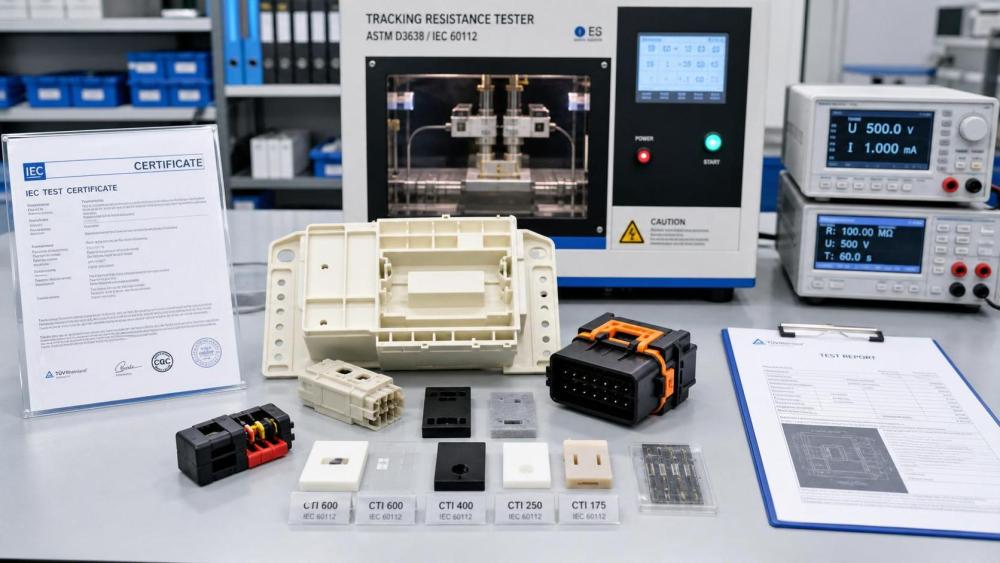
High CTI electronic insulation materials are often selected for compact electrical designs, tighter creepage distances, and higher reliability targets.
That sounds straightforward on paper, but compliance review rarely stops at one attractive CTI number.
In practice, electrical safety depends on how the material behaves under contamination, heat, humidity, and long service exposure.
This is why high CTI electronic insulation materials should be checked through a wider lens than datasheet marketing claims.
For many industrial and electronics applications, the real question is not only whether a resin reaches a high CTI class.
The more useful question is whether that performance stays stable after compounding, molding, aging, and supply changes.
Across advanced polymers, this issue appears in connectors, housings, busbar supports, charging components, relays, sensors, and insulated structural parts.
APIM often tracks these material decisions in the broader context of engineering plastics, flame-retardant compounds, extrusion quality, and long-term application risk.
A high CTI grade may still become a poor compliance choice if the formulation is unstable or the certification scope is narrow.
What does a high CTI rating really tell you, and what does it not tell you?
CTI stands for Comparative Tracking Index.
It measures a material’s resistance to surface tracking when exposed to moisture and conductive contamination under electrical stress.
A higher CTI value usually supports shorter creepage distance requirements, depending on the product standard and pollution degree.
That is the reason high CTI electronic insulation materials attract attention in compact devices and dense assemblies.
Still, CTI is only one part of insulation performance.
It does not automatically confirm dielectric strength, glow-wire behavior, flame resistance, thermal endurance, or mechanical retention after aging.
It also does not prove that every color, filler level, or reinforced version performs the same.
A black flame-retardant PA may differ from a natural grade.
A glass-filled PBT may not behave like the unfilled version.
This is where many approval mistakes begin.
A practical reading of high CTI electronic insulation materials should combine CTI with thermal class, RTI, UL flammability, GWFI or GWIT where relevant, and process consistency.
A quick decision table helps separate strong claims from usable compliance evidence
This kind of review is especially useful when several high CTI electronic insulation materials appear similar in supplier presentations.
Which standards and documents should be checked before approval?
The answer depends on the end product, but several references appear repeatedly in real approvals.
IEC 60112 is central because it defines the CTI test method.
UL 94 remains important for flammability classification.
UL 746 series is also relevant for polymeric materials used in electrical equipment.
For appliance or household components, glow-wire requirements may point to IEC 60695 related checks.
Some sectors will also ask for RoHS, REACH, halogen status, or customer-specific restricted substance declarations.
The document set should go beyond a generic technical datasheet.
- UL yellow card or equivalent recognition record
- Latest CTI test report with method reference
- Flammability certificate by thickness
- RTI or long-term heat aging information
- Material change control statement
- Processing guide tied to the certified grade
One common problem is relying on outdated certificates.
Another is assuming family approval covers all modified versions.
For high CTI electronic insulation materials, grade-level traceability matters more than broad material family language.
That is also why structured technical platforms such as APIM are useful.
They help compare material claims against processing methods, formulation logic, and cross-industry qualification expectations.
Where do safety risks usually hide when the datasheet looks acceptable?
Most failures do not start with an obviously wrong material choice.
They start with small mismatches between certified data and production reality.
Moisture-sensitive resins are a good example.
If drying is poorly controlled, hydrolysis or surface defects may reduce long-term insulation performance.
Flame-retardant packages can also drift in effect when compound dispersion is inconsistent.
This matters for high CTI electronic insulation materials because fillers, additives, and reinforcement often influence both electrical and thermal behavior.
Several hidden risks appear repeatedly:
- Colorant changes without rechecking certification scope
- Supplier transfer that keeps the same trade name but changes the plant
- Use of regrind beyond validated limits
- Wall thickness below the tested flammability range
- Assembly contamination from flux, oil, dust, or cleaning residues
In actual field use, contamination can undermine the benefit of choosing high CTI electronic insulation materials.
That is why electrical safety review should include process, assembly, and environment, not only resin specification.
How should high CTI materials be compared when several grades seem equivalent?
The better comparison method is to score by application fit, not by headline value alone.
For example, two high CTI electronic insulation materials may both reach a strong CTI class.
One may process cleanly in thin-wall connectors.
The other may offer better heat aging for power modules or charging hardware.
A balanced comparison usually includes the following:
- Certified CTI range, not just nominal value
- Flame rating at the actual part thickness
- Mechanical retention after thermal aging
- Dimensional stability and warpage control
- Chemical resistance to cleaning agents or service fluids
- Batch consistency from compounding and molding
This broader method is common in engineering plastics review.
It reflects the reality that a material is an engineered system, not only a resin name.
APIM frequently organizes material analysis in this way, linking formulation, processing, and application outcomes.
That makes it easier to judge why one high CTI grade works in a relay base while another is better for insulated automotive electronics.
What is a sensible approval workflow before release to production?
A useful workflow starts with the end-use environment, not the catalog shortlist.
Map the voltage level, pollution degree, thermal profile, expected contaminants, and life requirement first.
Then connect those conditions to material evidence.
- Define electrical and environmental exposure for the real part.
- Screen high CTI electronic insulation materials by certified scope.
- Review molding, drying, and thickness sensitivity.
- Run part-level validation, not only raw material checks.
- Freeze change control rules for supplier, color, plant, and regrind.
That last point deserves attention.
Many compliance gaps appear after launch, when sourcing or production adjustments happen quietly.
For high CTI electronic insulation materials, post-approval discipline is part of the safety case.
If traceability, certification review, and processing control are not maintained, the original approval loses value.
So what should be checked first when time is limited?
If a fast decision is needed, start with four checks that remove the biggest blind spots.
Confirm the exact grade identity.
Match CTI and flame data to the actual thickness and color.
Review the recognized standard documents.
Then assess whether molding and assembly conditions can preserve the claimed performance.
That sequence keeps attention on compliance and safety before cost pressure takes over.
High CTI electronic insulation materials can create real design and reliability advantages, but only when the full evidence chain is intact.
A practical next step is to build a short approval checklist covering standards, certification scope, processing limits, and change control triggers.
That gives future material comparisons a consistent basis and reduces avoidable electrical risk across industrial applications.
Have questions about this sector analysis, or seeking best practices specific to your niche? Drop us a line below and let the senior consultants at APIM assist you.
We respect your privacy. Your information is strictly confidential.
Related News
- 00
0000-00
Do polyolefin hot melt adhesives bond well to polyethylene? - 00
0000-00
Korean Study Finds PLA Barely Degrades in Landfill After 320 Days - 00
0000-00
How to assess batch consistency from a thermal potting compounds supplier - 00
0000-00
How much weight can carbon fiber reinforced plastics save in cars? - 00
0000-00
Switching from PS to ABS Sheet Extrusion: Equipment Checks