




Food-Contact Packaging: Which Migration Tests Are Needed Before Launch?
Migration testing is not a single laboratory exercise that can be applied uniformly to every food-contact package. The required test programme depends on what the package is made of, which side contacts food, the food category, filling and storage conditions, foreseeable misuse, and the market in which the product will be sold.
The central compliance question is whether substances from the packaging can transfer into food at levels that create a safety concern, exceed a legal limit, or alter food in an unacceptable way. For a multilayer pouch, printed carton, coated tray, lidded cup, or recycled-plastic bottle, the potential sources are broader than the base polymer alone: they can include monomers, additives, solvents, catalyst residues, colorants, printing inks, adhesives, coatings, degradation products, and non-intentionally added substances (NIAS).
A launch decision should therefore be based on a migration test plan tied to the finished article and its intended use—not on a generic test certificate for a resin, film, ink, or adhesive.
Start with the regulatory market and the packaging’s declared use
In the European Union, the general legal foundation is Regulation (EC) No 1935/2004. It requires food-contact materials and articles, under normal or foreseeable conditions of use, not to transfer constituents into food in quantities that could endanger human health, cause an unacceptable change in food composition, or impair organoleptic characteristics.
For plastic food-contact materials, Commission Regulation (EU) No 10/2011 is the main harmonised measure. It establishes the Union list of authorised substances, specific migration limits (SMLs) for relevant substances, overall migration limits, testing rules, and food simulant selection principles. Good manufacturing practice is addressed by Regulation (EC) No 2023/2006.
In the United States, food-contact substances are assessed under the U.S. Food and Drug Administration framework, including applicable provisions in Title 21 of the Code of Federal Regulations and, where relevant, Food Contact Notifications. This system does not use the EU-style overall migration limit as a universal legal requirement. A test report prepared solely to EU overall migration rules should therefore not be treated as automatic evidence of U.S. compliance.
Other markets may apply national rules, positive lists, restrictions for specific packaging types, or documentation requirements. The first quality-control task is to identify the destination market before approving the test matrix. A package intended for the EU, United Kingdom, United States, Gulf markets, Japan, China, or several export destinations may require separate regulatory review even when the physical package is unchanged.
Declared use must be specific. “Suitable for food contact” is not a sufficient use description. The laboratory needs to know whether the article is intended for dry foods, aqueous foods, acidic products, alcoholic beverages, dairy products, fatty foods, frozen foods, hot-fill products, microwave reheating, oven use, or long-term ambient storage. A tray used for chilled ready meals and reheated in a microwave is not assessed under the same conditions as a film used for dry snacks.
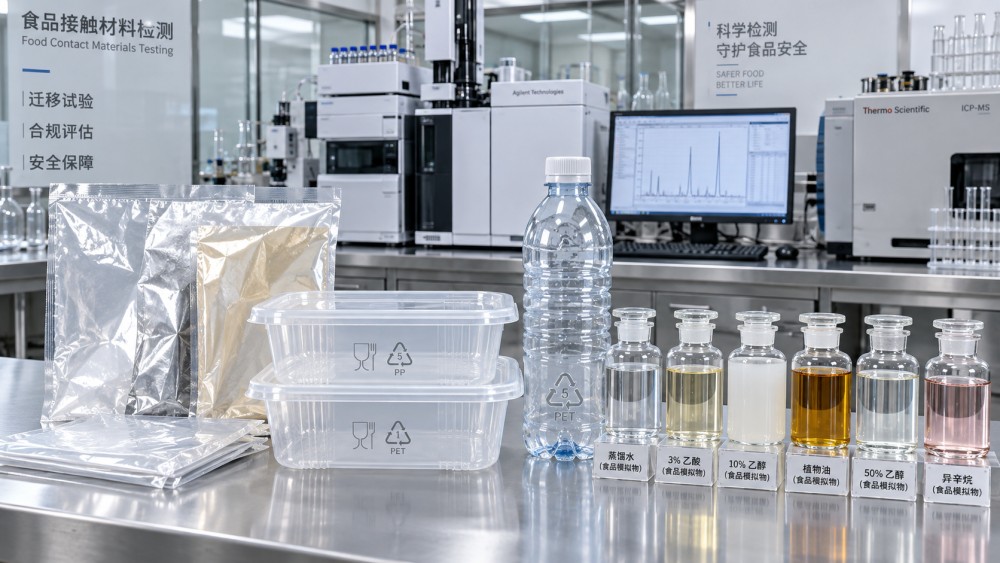
Overall migration: the broad screening test for plastic layers
Overall migration testing measures the total quantity of non-volatile substances transferred from a food-contact plastic material into a food simulant. Under EU plastic rules, it is generally used to confirm that the material does not exceed the overall migration limit of 10 mg of total constituents per dm² of food-contact surface, subject to the regulation’s defined conditions and certain application-specific provisions.
This test does not identify the substances that have migrated. A compliant overall migration result does not prove that every restricted substance is below its own specific limit. It answers a different question: whether total non-volatile transfer from the plastic food-contact material is within the permitted overall threshold.
Overall migration is particularly relevant for plastic packaging such as monolayer films, trays, tubs, caps, bottles, plastic-coated articles, and the food-contact side of multilayer structures. The appropriate simulant and test conditions are selected according to intended food type and contact conditions. Under EU rules, commonly used food simulants include:
- Simulant A: ethanol 10% v/v, representing hydrophilic foods;
- Simulant B: acetic acid 3% w/v, representing acidic foods;
- Simulant C: ethanol 20% v/v, used for certain alcoholic foods;
- Simulant D1: ethanol 50% v/v, representing foods containing alcohol and some emulsified foods;
- Simulant D2: vegetable oil or specified substitutes, representing fatty foods;
- Simulant E: poly(2,6-diphenyl-p-phenylene oxide), commonly called Tenax, representing dry foods.
Selection is not merely a laboratory preference. A fatty food can extract lipophilic additives that would not be revealed by testing only with aqueous simulants. Conversely, a package for dry food may be tested with a dry-food simulant where that is appropriate, rather than subjected automatically to conditions intended for oily foods.
The contact time and temperature must reflect the worst reasonably foreseeable use. Long-term room-temperature storage, hot filling, pasteurisation, microwave exposure, and oven heating can require very different test conditions. Over-testing can produce misleading failures that do not represent actual use; under-testing can create a false compliance conclusion. The correct approach is not to choose the harshest possible condition in isolation, but the legally applicable condition that covers the product’s real contact profile.
Specific migration testing: where formulation and chemistry matter
Specific migration testing measures identified substances against their applicable SMLs or other restrictions. It is usually the most important analytical element where a material contains regulated constituents with low permitted migration limits.
A specific migration programme should be built from a full composition and supply-chain review. Relevant substances may include plasticisers, antioxidants, stabilisers, UV absorbers, slip agents, processing aids, residual monomers, oligomers, metal-based catalysts, primary aromatic amines, epoxy derivatives, substances used in coatings, and components associated with inks or adhesives.
For EU plastic food-contact materials, the starting point is the Union list in Regulation (EU) No 10/2011 and the restrictions attached to listed substances. Suppliers should provide sufficient technical information to determine whether any listed substance with an SML is present or could migrate from the finished article. A declaration of compliance is important, but it should be supported by relevant compliance documentation rather than accepted as a substitute for risk assessment.
Specific migration testing is particularly necessary when one or more of the following conditions applies:
- the formulation includes a substance with an SML;
- the packaging contacts fatty, acidic, alcoholic, or high-moisture food;
- the article will be heated, hot-filled, sterilised, microwaved, or used for prolonged storage;
- a functional additive is used at a level that could generate measurable migration;
- the package contains recycled plastic, a coating, adhesive, printing system, or multilayer structure with incomplete exposure data;
- the food-contact layer is thin, highly permeable, or exposed to mechanical or thermal stress during converting or use.
Analytical methods must be fit for the required limit. A result reported as “not detected” is not meaningful unless the detection and quantification capability is below the relevant legal threshold or otherwise sufficient for the risk assessment. Quality review should confirm the method, analyte list, limit of quantification, simulant, exposure conditions, and laboratory accreditation scope.
Multilayer packaging cannot be assessed layer by layer alone
Food-contact packaging frequently combines a sealant layer, barrier layer, tie layer, printed outer web, adhesive, lacquer, and sometimes paper or aluminium. The food may touch only one internal polymer layer, but migration can occur through that layer from adjacent components. Small molecules can diffuse through polymers, especially during long storage or elevated temperature.
This is why a food-contact declaration for the inner sealant film does not necessarily clear the finished laminate. The adhesive and ink may be on the non-food-contact side, yet low-molecular-weight constituents, residual solvents, breakdown products, or impurities may migrate through the structure if the barrier is insufficient.
EU rules recognise the concept of a functional barrier in certain circumstances, but it is not a blanket exemption. The barrier must prevent migration of substances behind it into food at levels above 0.01 mg/kg, subject to the applicable legal conditions, and substances classified as mutagenic, carcinogenic, or toxic to reproduction cannot be justified through this route. Functional-barrier claims require evidence based on the complete structure, substance properties, thickness, diffusion behaviour, intended contact time and temperature, and the food involved.
For laminated flexible packaging, migration assessment should examine the cured adhesive system, ink placement, residual solvent control, reverse-printing design, barrier performance, and the time between conversion and filling. Inadequate curing or insufficient drying may create a problem even if each supplied component is accompanied by a compliance statement.
Printing inks, adhesives, coatings, and NIAS require a separate risk lens
Not every relevant source substance is covered by a single harmonised EU positive list. Printing inks and many adhesive and coating systems are governed by the general safety requirements, applicable national measures where they exist, and the responsibility of the business operator to demonstrate compliance of the finished article.
For these materials, a supplier letter stating “low migration” is not enough unless it is connected to the actual design and use conditions. Ink coverage, print orientation, cure chemistry, adhesive coat weight, substrate barrier, storage time, food type, and heat exposure all affect the final assessment.
NIAS deserve particular attention. They may arise from impurities in raw materials, reaction by-products, oligomers, degradation during extrusion or curing, contaminants, or interactions between packaging components. NIAS assessment is not necessarily a demand to identify every chromatographic signal. The practical requirement is a documented risk assessment that identifies and evaluates substances that may be present and relevant to safety.
Where screening reveals unknown peaks or elevated extractables, the correct response is not automatically to release the package because no listed SML has been exceeded. The source must be investigated: raw material variability, recycled feedstock, over-processing, curing conditions, contamination, or an interaction between layers can all be relevant.
Recycled plastic changes the evidence required
Recycled content does not make a food-contact package non-compliant by definition, but it changes the assessment. Mechanical recycling can introduce contamination from previous use, collection streams, additives, labels, inks, and process carryover. The key safety question is whether the recycling process and resulting material control contaminants adequately for the intended food-contact application.
In the EU, recycled plastic food-contact materials are subject to Regulation (EU) 2022/1616. The regulatory status of the recycling technology, the permitted input stream, decontamination capability, traceability, and intended application all matter. A conventional migration test on the final package may be part of the evidence, but it does not replace the compliance requirements applicable to the recycling process itself.
For recycled PET bottles, trays, films, or multilayer constructions, quality documentation should establish the source of recyclate, approved use conditions where applicable, batch traceability, percentage and location of recycled content, and any restrictions on food type, temperature, or contact duration. Recycled material in a non-food-contact layer can still require migration consideration if diffusion through the food-contact layer is possible.
Test the finished article under a controlled sampling plan
Testing only a raw resin pellet or an unprinted substrate is rarely sufficient for launch approval. The preferred test specimen is the final food-contact article, manufactured using representative commercial materials and processing conditions. This is especially important where thermal conversion, printing, lamination, coating, curing, or sterilisation may alter the migration profile.
Sampling must represent the production configuration: approved suppliers, current formulation, target thickness, maximum ink coverage where relevant, highest adhesive or coating weight, and the intended sealing or forming process. A test report from a development sample can lose relevance after a resin substitution, pigment change, different adhesive grade, altered curing window, or downgauging of the contact layer.
For repeated-use articles, testing rules may differ from single-use packaging because migration can change across successive contacts. For articles intended to contact food several times, the appropriate repeated-use test protocol must be selected rather than relying on a single extraction result.
Organoleptic evaluation may also be necessary when packaging could transfer odour or taste to food. Chemical compliance does not automatically guarantee acceptable sensory performance, particularly for high-aroma foods, low-fat dry foods, or packages containing inks, coatings, recycled content, or volatile residues.
What a defensible pre-launch file should contain
A compliant launch file is a controlled evidence package, not simply a laboratory certificate. It should link product design, intended use, supplier information, test conditions, conclusions, and change-control requirements.
At minimum, the file should contain the packaging specification and layer structure; a precise food-contact use statement; supplier declarations and supporting compliance information; formulation or substance data necessary to assess applicable restrictions; overall and specific migration reports where required; NIAS and functional-barrier assessments where relevant; evidence for recycled-content compliance; and the final Declaration of Compliance where EU plastic rules require one.
The conclusion should state the boundaries of compliance clearly. For example, a package may be compliant for aqueous and acidic foods at ambient storage but not validated for fatty foods, hot fill, microwave heating, or alcoholic products. Such limitations need to appear in technical specifications, customer documentation, and internal product-release controls.
Migration compliance is also subject to change control. A new ink supplier, revised masterbatch, different recycled-content source, modified adhesive, thinner barrier layer, higher processing temperature, or expanded food application can invalidate the assumptions behind existing tests. The relevant question is not whether the package looks unchanged, but whether the change could alter chemical transfer into food.
The most reliable pre-launch decision is therefore based on a use-specific migration strategy: identify every plausible source of transfer, select legally appropriate simulants and exposure conditions, test both total and substance-specific migration where required, assess multilayer and recycled-content risks, and retain documentation that remains traceable to the commercial product. That approach prevents a common but costly failure—treating food-contact packaging compliance as a material certificate rather than a property of the finished package in its real food application.
Have questions about this sector analysis, or seeking best practices specific to your niche? Drop us a line below and let the senior consultants at APIM assist you.
We respect your privacy. Your information is strictly confidential.
Related News
- 00
0000-00
Do polyolefin hot melt adhesives bond well to polyethylene? - 00
0000-00
Korean Study Finds PLA Barely Degrades in Landfill After 320 Days - 00
0000-00
How to assess batch consistency from a thermal potting compounds supplier - 00
0000-00
How much weight can carbon fiber reinforced plastics save in cars? - 00
0000-00
Switching from PS to ABS Sheet Extrusion: Equipment Checks