




Flame Retardant Compounds Price Trend: Risks, Supply, and Margin Pressure
Flame Retardant Compounds Price Trend Is No Longer a Short-Term Disturbance
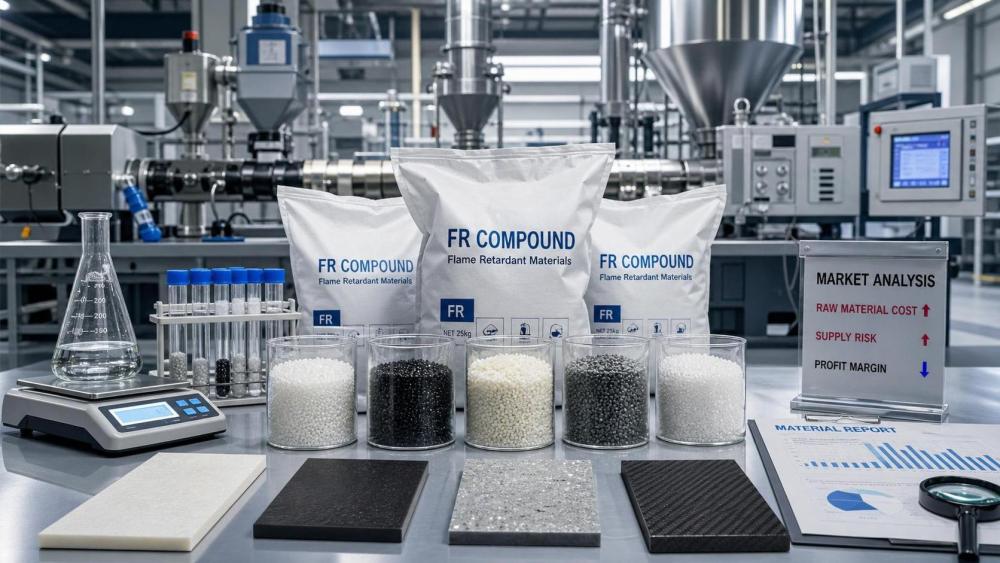
The flame retardant compounds price trend has moved beyond routine quarterly fluctuation.
What looks like a pricing issue is increasingly a wider materials strategy question.
Across electrical, automotive, electronics, construction, and industrial equipment markets, compound costs are being pushed by several forces at once.
Feedstock volatility remains important, but it is no longer the only signal worth tracking.
Supply concentration, formulation changes, compliance demands, and thinner conversion margins are reshaping negotiations throughout the chain.
That matters because flame-retardant compounds sit at the intersection of safety, processing stability, certification, and cost discipline.
In practice, the flame retardant compounds price trend now affects product design timing, qualification cycles, and the economics of high-performance polymer applications.
For businesses following engineered plastics, modified compounds, extrusion, and downstream conversion, the main task is not predicting one number.
The real task is understanding which cost pressures are temporary and which have become structural.
Recent Market Signals Are Pointing in the Same Direction
From recent market activity, a clearer pattern has emerged.
Prices are not simply rising in a straight line, but they are becoming harder to stabilize.
That instability is especially visible in compounds based on PC, PA, PBT, ABS, and other engineering resins used in regulated applications.
Flame retardant masterbatch costs, synergist availability, and base resin movement are increasingly arriving at different speeds.
This creates a lag between upstream change and downstream quoted pricing.
More noticeably, suppliers are protecting margin through shorter quote validity, tighter specification control, and selective contract allocation.
The flame retardant compounds price trend therefore reflects not only cost pass-through, but also confidence in replenishment and technical substitution.
In high-specification applications, buyers may accept higher pricing when qualification risk is greater than unit cost pressure.
In mid-range applications, however, price resistance tends to appear faster and forces reformulation discussions earlier.
What is making the trend more difficult to manage
- Halogen-free systems often depend on more complex additive packages and narrower processing windows.
- Antimony, phosphorus derivatives, brominated systems, and mineral fillers do not move with the same supply rhythm.
- Compounding energy, drying control, filtration, and pellet quality are adding cost where consistency requirements are strict.
- Qualification delays make switching suppliers slower, which reduces purchasing flexibility during tight periods.
Why the Flame Retardant Compounds Price Trend Is Being Rebuilt by Structure
A useful way to read this market is to separate cyclical pressure from structural pressure.
Cyclical pressure still comes from crude-linked chemicals, resin swings, and regional logistics imbalance.
Structural pressure is more durable, and it is shaping the future flame retardant compounds price trend more decisively.
This is where APIM-style market reading becomes useful.
In advanced polymer markets, cost cannot be separated from formulation logic, processing behavior, and end-use approval requirements.
A flame-retardant PA or PC compound is not interchangeable in the same way as a generic commodity resin.
That is why the flame retardant compounds price trend often looks more resilient than buyers initially expect.
The Impact Is Spreading Across More Than One Business Layer
The effect is not limited to raw material purchasing.
It moves through product planning, compounding operations, certification schedules, and downstream conversion economics.
In electrical and electronics applications, flame performance is tied directly to compliance and reliability.
A delayed additive shipment can affect housing parts, connectors, insulation systems, and approval timing.
In automotive and industrial equipment, the flame retardant compounds price trend also interacts with weight reduction and thermal management goals.
When parts shift from metal to engineered polymers, material savings can still be attractive.
Yet the margin case becomes less straightforward if compound pricing turns volatile during launch phases.
More worth noting is the pressure on converters and equipment users.
A formulation with different filler loading or additive balance may alter melt flow, drying behavior, screw wear, or surface quality.
So the flame retardant compounds price trend can create hidden process costs even before unit resin prices are reviewed.
Where the hidden costs usually appear
- Longer machine setup and trial time after material change.
- Higher scrap risk when color, dispersion, or UL performance drifts.
- Additional testing costs for thickness, glow wire, CTI, or mechanical retention.
- Lower inventory flexibility when approved grades are tightly limited.
The Next Signals to Watch Are on the Demand Side Too
Supply explains much of the current pricing behavior, but demand is also changing in ways that matter.
Electrification, compact electronics, battery-adjacent parts, and denser power systems all raise material expectations.
These applications do not only need flame resistance.
They need dimensional control, dielectric reliability, heat aging stability, and predictable molding performance.
That makes the flame retardant compounds price trend more sensitive to performance premiums.
At the same time, sustainability expectations are changing formulation choices.
Low-halogen systems, recyclable design pathways, and traceability expectations can reduce the number of commercially acceptable options.
This does not always push prices up immediately.
But it often reduces the market’s ability to fall back on cheaper substitutes during supply stress.
That is one reason the flame retardant compounds price trend should be read together with application upgrades, not in isolation.
A Better Response Starts with Sharper Segmentation
Not every flame-retardant material should be managed with the same sourcing logic.
The more effective approach is to divide exposure by technical criticality and switching difficulty.
That shifts the conversation from simple price comparison to risk-adjusted material planning.
- Map compounds by certification dependency, not only annual volume.
- Separate base resin volatility from additive package volatility in cost models.
- Check whether current formulations have secondary additive or resin pathways already validated.
- Review processing sensitivity before approving any lower-cost substitute.
- Monitor compounding lead times together with raw material availability.
This is also where structured technical market intelligence becomes practical rather than theoretical.
APIM’s coverage logic is relevant because flame-retardant compounds sit inside a wider ecosystem of engineered plastics, extrusion conditions, additive systems, and industrial applications.
When price signals are read alongside processing and application requirements, decision quality usually improves.
What Looks Most Likely from Here
The flame retardant compounds price trend is unlikely to return soon to a simple low-volatility pattern.
Short periods of easing may appear when resin costs soften or demand slows.
Even then, structurally constrained formulations may remain firm.
The more probable scenario is a market with uneven pricing, selective tightness, and continued pressure on converter margins.
That means the best next step is not broad reaction, but disciplined tracking.
Watch additive supply concentration, qualification lead times, and changes in application standards.
Review whether product lines exposed to flame-retardant materials still carry enough margin to absorb technical cost shifts.
Compare alternative formulations only after checking process impact, not before.
Most importantly, treat the flame retardant compounds price trend as a business signal linked to supply resilience and product strategy.
That perspective makes it easier to build phased response plans instead of reacting to each quote in isolation.
Have questions about this sector analysis, or seeking best practices specific to your niche? Drop us a line below and let the senior consultants at APIM assist you.
We respect your privacy. Your information is strictly confidential.
Related News
- 00
0000-00
NAPCOR Report: US PET Bottle Recycling Rate Fell to 29% in 2025 - 00
0000-00
How does washing affect contamination in post-consumer recycled PP resins? - 00
0000-00
How does feedstock affect depolymerization equipment selection? - 00
0000-00
US Sets 213.44% Preliminary Antidumping Deposit on Chinese PTMEG - 00
0000-00
When should epoxy be used as a thermal interface material for semiconductors?