




FDA and BfR Requirements for Food-Contact Packaging Coatings Explained
For quality-control and safety managers, understanding food contact packaging coatings FDA BfR requirements is essential for protecting consumers, maintaining market access, and reducing compliance risk.
This guide explains how FDA and BfR expectations apply to coating formulation, migration testing, raw-material documentation, manufacturing control, and supplier verification for packaging teams.
The practical conclusion is straightforward: neither FDA compliance nor BfR alignment can be established through a product label alone.
Teams must connect the coating composition, intended food-contact conditions, curing process, substrate, migration evidence, and supplier documentation into one defensible compliance file.
Food-contact coatings include varnishes, lacquers, overprint coatings, heat-seal layers, can coatings, functional barriers, release coatings, and protective layers applied to paper, metal, plastic, or multilayer packaging.
Although a coating may be visually thin, it can directly contact food or transfer low-molecular-weight substances into food during filling, storage, heating, or use.
That transfer risk is why quality teams should assess the finished packaging structure rather than reviewing resin certificates in isolation.
The coating supplier, converter, ink supplier, adhesive supplier, substrate producer, and food packer may each hold part of the required evidence.
Successful control depends on collecting those pieces before commercial production, not after a customer, regulator, or retailer requests proof.
FDA and BfR are often discussed together because both influence global packaging decisions, especially for suppliers serving North American and European-oriented customers.
However, they are different systems with different legal roles, documentation practices, and methods of demonstrating suitability for food-contact applications.
Quality managers should therefore avoid asking whether a coating is simply “FDA and BfR approved.”
A better question is whether the specific formulation and finished package are supported for the intended food, temperature, contact time, and processing conditions.
What FDA and BfR Requirements Actually Mean for Coatings
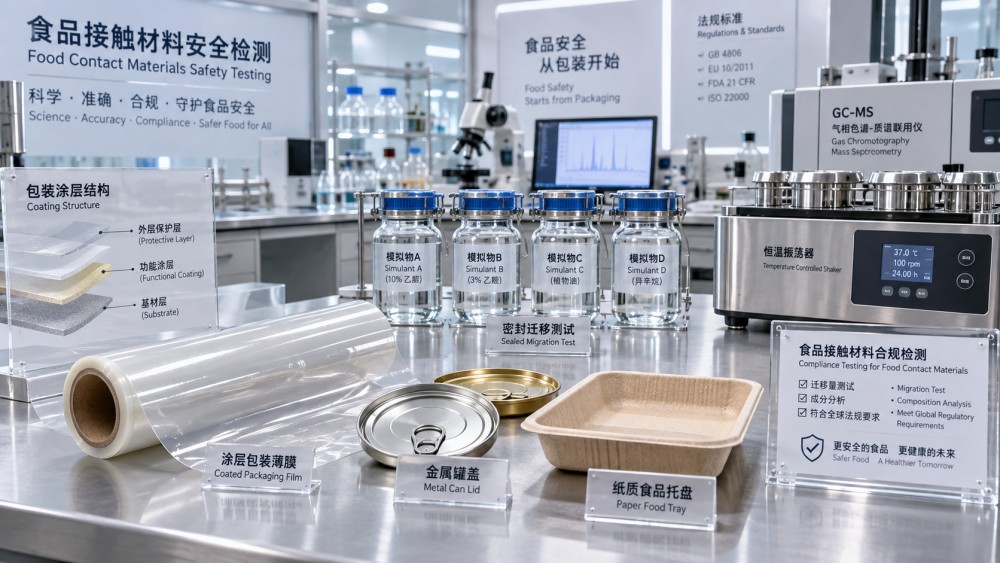
In the United States, food-contact substances are regulated under the Federal Food, Drug, and Cosmetic Act and related FDA regulations.
For many packaging coatings, compliance depends on whether individual components are authorized for their intended food-contact use under applicable provisions of Title 21 of the Code of Federal Regulations.
Relevant FDA sections may include 21 CFR 175 for adhesives and coatings, 176 for paper and paperboard components, and 177 for certain polymeric materials.
For example, 21 CFR 175.300 addresses resinous and polymeric coatings intended for food-contact surfaces under specified limitations and extraction conditions.
That does not mean every coating can automatically rely on 21 CFR 175.300.
The supplier must verify that the actual resin system, additives, curing agents, pigments, solvents, and use conditions fit the relevant regulatory basis.
Some substances may instead be supported by an effective Food Contact Notification, a Threshold of Regulation exemption, a prior-sanctioned status, or another applicable FDA authorization.
An FDA Food Contact Notification is specific to the notifier, substance, use conditions, and limitations described in that notification.
Quality teams should not assume that a generic reference to an FCN covers another supplier’s chemically similar material or a different end-use scenario.
BfR, the German Federal Institute for Risk Assessment, publishes recommendations widely used as technical reference points for food-contact materials in Europe.
BfR recommendations are not, by themselves, a universal market authorization or a substitute for binding European Union and national legal requirements.
They nevertheless matter because customers, auditors, laboratories, and packaging buyers often use them to evaluate formulation suitability and supporting documentation.
For coatings, the relevant BfR recommendation depends on the material category, such as polymer dispersions, paper coatings, silicone systems, or other specialized applications.
Each recommendation may define permitted starting substances, purity expectations, residual limits, extraction conditions, or restrictions related to final use.
A BfR declaration should identify the exact recommendation and revision used, rather than making a broad statement that the product is “BfR compliant.”
For European supply, BfR assessment must also be considered alongside framework requirements such as Regulation (EC) No 1935/2004 and good manufacturing practice requirements.
Where a packaging structure includes plastic layers, EU Regulation No 10/2011 may also be relevant, depending on the material and contact arrangement.
The governing rules can differ between the coating itself, its substrate, and the complete multilayer article.
Start Compliance with the Real Conditions of Use
The most common documentation failure begins when a coating is approved for a vague application instead of a defined food-contact scenario.
Before requesting declarations, the packaging team should document whether the coating has direct contact, indirect contact, or functional-barrier separation from food.
Direct contact generally requires the strongest evidence because food can contact the coated surface without a separating compliant layer.
Indirect contact may still create migration concerns when substances pass through films, paper, adhesives, or other package layers during storage.
A functional barrier can reduce exposure, but it must be technically demonstrated for the specific package construction and foreseeable use.
Food type is equally important because aqueous, acidic, alcoholic, fatty, dry, and high-temperature foods extract substances differently.
A coating suitable for dry bakery packaging may not be suitable for fatty confectionery, retort pouches, hot-fill products, or microwaveable trays.
Quality teams should define the highest reasonably foreseeable temperature, filling process, storage duration, reheating conditions, and repeated-use exposure before selecting materials.
Contact time matters because a short filling operation and twelve months of shelf storage present very different migration opportunities.
The same is true for surface area-to-food ratios, package geometry, coating weight, and whether the coating contacts food across the entire package surface.
FDA extraction tests and BfR-related evaluations often rely on defined conditions that may not represent every commercial package automatically.
Ask suppliers which food simulants, test temperatures, contact periods, and sample preparations supported their declaration.
Then compare those conditions directly with the intended product specification rather than accepting a general certificate at face value.
This use-profile approach prevents a frequent error: purchasing a technically compliant coating that is compliant only under less demanding conditions.
How to Review a Supplier Declaration Properly
A useful declaration of compliance is a controlled technical document, not a marketing statement or an undated email from a sales representative.
It should clearly identify the product name, grade, manufacturing site where relevant, document revision, issue date, and responsible supplier contact.
The declaration should state the intended food-contact status and cite the applicable FDA regulation, effective FCN, BfR recommendation, or other legal basis.
References without restrictions are incomplete because food-contact authorizations commonly include conditions related to food type, temperature, concentration, or coating thickness.
Request confirmation that all intentionally added ingredients are supported for the declared use, including additives not visible in a technical data sheet.
These may include catalysts, crosslinkers, defoamers, wetting agents, preservatives, photoinitiators, slip additives, pigments, stabilizers, and residual processing aids.
For UV-, electron-beam-, or radiation-cured coatings, pay particular attention to unreacted monomers, oligomers, photoinitiator fragments, and cure-dependent residuals.
A compliant formulation can become unsuitable when inadequate energy delivery, excessive coating weight, oxygen inhibition, or line-speed changes reduce curing performance.
Supplier declarations should also address relevant restrictions, such as specific migration limits, residual monomer limits, extraction limits, or purity conditions.
Do not expect every confidential substance to be disclosed by name.
Instead, require the supplier to provide enough regulated-use information for your company to verify suitability without compromising legitimate confidential business information.
Where non-intentionally added substances may be relevant, ask how the supplier controls impurities, reaction by-products, degradation products, and contaminants.
This question is especially important for recycled-content structures, printed packaging, multilayer systems, and coatings exposed to high curing or sterilization temperatures.
Documentation should also include change-control obligations, requiring advance notice of formulation, raw-material, site, process, or regulatory-status changes.
Without formal change notification, a declaration can become outdated while production continues under an assumption of unchanged compliance.
Migration Testing: When Documents Are Not Enough
Migration testing is not automatically required for every coating project, but it becomes critical when formulation evidence does not fully address the finished article.
Testing is most valuable when a coating is directly food-contacting, newly formulated, heavily pigmented, unusually thick, heat processed, or used with fatty foods.
It is also appropriate when a functional barrier claim depends on the complete package construction rather than the coating composition alone.
Overall migration measures the total amount of nonvolatile material transferred under defined test conditions, while specific migration targets identified substances.
Neither test should be selected mechanically without understanding the relevant regulatory framework and risk profile.
A low overall migration result does not prove that every toxicologically relevant constituent remains below its applicable specific restriction.
Likewise, a favorable specific migration result for one substance does not validate unknown contaminants, other restricted substances, or incomplete curing.
The laboratory should receive an accurate description of the package, food type, contact side, coating weight, substrate, intended temperature, and storage conditions.
Sending only a flat coated sample without application details can produce results that are difficult to defend during an audit.
Testing plans should explain why chosen food simulants and conditions represent the worst foreseeable commercial use.
For FDA-facing evaluations, extraction testing may follow the conditions linked to the applicable regulatory authorization rather than a European migration protocol.
For BfR-related or EU-facing work, the appropriate legal requirements and recognized test methods should be confirmed with a qualified laboratory or regulatory specialist.
Quality managers should retain raw reports, sample traceability, methods, detection limits, calculations, and conclusions rather than storing only a one-page summary.
A report is meaningful only when the tested sample remains representative of the commercial coating, curing conditions, and package structure.
Manufacturing Controls That Protect Compliance
Food-contact compliance can be lost after formulation approval if factory controls do not consistently reproduce the conditions represented in the supporting evidence.
Incoming raw-material control should confirm approved supplier status, correct material identity, lot traceability, specification conformity, and valid food-contact documentation.
Batch-to-batch variation in solvents, pigments, additives, recycled content, or residual monomers can change migration behavior even when product names remain unchanged.
Production instructions should define mixing order, viscosity range, solids content, coating weight, oven profile, UV dose, line speed, and minimum cure requirements.
These are food-safety controls when they influence residual substances or the integrity of the coating layer.
Operators should record the parameters that demonstrate compliance, especially for cure-sensitive coatings and high-temperature drying operations.
Periodic verification can include coating-weight measurement, solvent-residual testing, cure checks, adhesion testing, extraction screening, or targeted migration analysis.
Cleaning procedures also require attention because non-food-contact lubricants, cleaning agents, inks, or previous products can contaminate coating equipment.
Segregation, line-clearance checks, validated cleaning, and controlled rework practices reduce this risk.
Rework should not be introduced into food-contact coatings unless its composition, traceability, contamination status, and regulatory support are clearly established.
For printed packaging, control the printed side, reverse-side contact potential, set-off risk, winding pressure, and storage temperature.
A food-contact coating may be acceptable in isolation but become part of a problematic system when inks or low-migration components transfer through the web.
A Practical Approval Workflow for Quality and Safety Teams
The most effective approval process begins with a written application brief created jointly by quality, product development, purchasing, production, and regulatory personnel.
The brief should specify food type, contact mode, package structure, coating location, coating weight, processing temperatures, storage period, and intended markets.
Next, obtain a current supplier declaration and compare every limitation against the application brief.
Do not release the material based solely on a supplier’s statement that it is suitable for “food packaging.”
Assess whether the declaration covers the full package or only the supplied coating.
When multiple components are involved, collect compatible declarations for the coating, substrate, adhesive, ink, laminate, sealant, and any recycled-content layer.
Document gaps in a compliance matrix that links each requirement to the supporting evidence, responsible owner, document revision, and expiry or review date.
Where evidence is incomplete, define whether the solution is additional supplier information, migration testing, reformulation, a lower-risk application, or material rejection.
Before production launch, approve the manufacturing specification and identify critical control parameters that could affect food-contact suitability.
After launch, maintain lot traceability and review supplier changes, customer complaints, regulatory updates, and test results through the normal quality-management process.
This workflow gives procurement teams a clear basis for supplier comparison while helping safety managers avoid undocumented assumptions.
It also makes customer questionnaires and third-party audits easier because the evidence is organized around actual use conditions.
Common Mistakes That Create Avoidable Risk
One frequent mistake is treating an FDA reference as proof of worldwide compliance.
FDA authorization does not automatically establish conformity with BfR recommendations, EU requirements, national rules, retailer specifications, or customer-specific restrictions.
Another mistake is relying on a declaration written for direct food contact when the actual package uses higher temperatures, longer storage, or more aggressive foods.
Quality teams also underestimate the impact of downstream conversion, particularly when coating cure, coating weight, drying efficiency, or lamination conditions differ from supplier assumptions.
Broad statements such as “free from harmful substances” should never replace regulatory citations, use limitations, and objective supporting evidence.
Finally, companies often fail to review documents after a formulation change, supplier-site transfer, new pigment, recycled-material introduction, or revised customer application.
Food-contact packaging coatings FDA BfR requirements are not a one-time purchasing check; they are a controlled lifecycle obligation.
Conclusion: Build Evidence Around the Finished Package
For quality-control and safety managers, the central task is to prove that a specific coating remains suitable within a specific food-contact packaging system.
FDA requirements provide legally relevant authorization pathways in the United States, while BfR recommendations offer important technical benchmarks for many European-facing applications.
Neither framework should be reduced to a generic approval claim or a supplier certificate filed without technical review.
The strongest compliance position combines defined conditions of use, complete supplier documentation, appropriate migration evidence, controlled manufacturing parameters, and disciplined change management.
When those elements are connected, packaging teams can make faster material decisions, answer customer questions with confidence, and reduce the risk of costly reformulation or market disruption.
Have questions about this sector analysis, or seeking best practices specific to your niche? Drop us a line below and let the senior consultants at APIM assist you.
We respect your privacy. Your information is strictly confidential.
Related News
- 00
0000-00
How does washing affect contamination in post-consumer recycled PP resins? - 00
0000-00
How does feedstock affect depolymerization equipment selection? - 00
0000-00
US Sets 213.44% Preliminary Antidumping Deposit on Chinese PTMEG - 00
0000-00
When should epoxy be used as a thermal interface material for semiconductors? - 00
0000-00
US Midterm Results Unlikely to Quickly Shift Recycled Plastics Market or Legislation
Tag