




FDA-Approved Plastics for Medical Devices: Material Selection by Device Use
Material selection for a medical device should begin with the device’s use, not with a search for a universally “FDA-approved” resin. The phrase is common in procurement discussions, but it can create a false sense of certainty. FDA does not generally approve a plastic resin as a stand-alone material for all medical uses. A polymer may be available in a medical-grade formulation, supported by biocompatibility data, listed in a device master file, or used in previously marketed devices. None of those facts automatically qualifies it for a new device.
For project leaders, the practical question is narrower: can this specific grade, in this specific part, survive its intended environment and support the regulatory case for the finished device? The answer depends on patient-contact category and duration, sterilization route, exposure to drugs or cleaning agents, mechanical demands, manufacturing method, and the supplier’s ability to maintain documented formulation control through production.
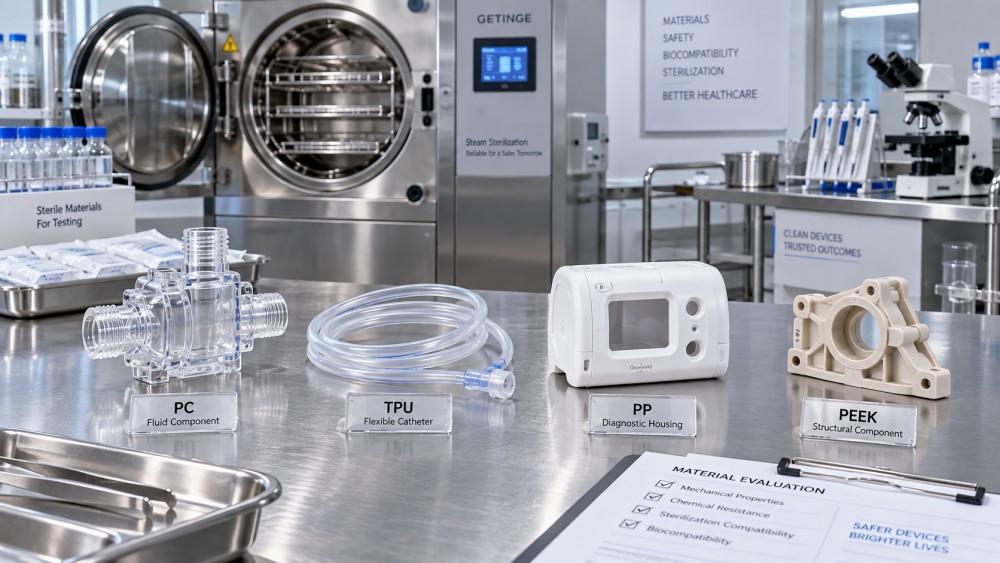
That distinction changes the selection process. A polypropylene housing for a single-use diagnostic cartridge, a transparent polycarbonate fluidic component, a TPU catheter element, and a PEEK implantable component may all be described as medical plastics. They do not carry the same performance requirements, testing burden, or change-control risk.
Start with the device-use profile
The most efficient material reviews begin by defining how the polymer will function in the finished device. “Medical device” is too broad to be a useful material requirement. A non-patient-contact enclosure has a different risk profile from a blood-contacting disposable, and both differ substantially from a long-term implant.
Project teams should establish the use profile before comparing resin families:
- Contact type: no patient contact, intact skin contact, mucosal membrane contact, externally communicating contact, or contact with circulating blood, tissue, or bone.
- Contact duration: limited, prolonged, or long-term contact. Duration can change the biological evaluation strategy even when the device geometry and polymer family remain unchanged.
- Single-use or reusable: reusable devices must withstand repeated cleaning, disinfection, and sterilization without unacceptable loss of performance or surface integrity.
- Functional role: structural housing, fluid path, seal, flexible tube, optical component, electrical insulator, instrument handle, implant, or drug-contacting container.
- Exposure environment: body fluids, lipids, disinfectants, solvents, cleaning agents, temperature cycling, load, abrasion, radiation, and moisture.
This exercise often removes unsuitable options quickly. A resin that performs well in a non-contact instrument cover may be inappropriate in a fluid path because extractables, chemical compatibility, or stress-cracking behavior become more important. Similarly, a polymer selected for its strength can create problems later if it cannot tolerate the sterilization process or if its additives complicate biological evaluation.
Medical-grade labeling is useful only after the use profile is defined. It signals that a supplier may offer tighter controls, documentation, and a more stable formulation than a general-purpose grade. It does not remove the need to evaluate the finished part, including its colorants, processing aids, adhesives, lubricants, printing inks, and residues from manufacturing.
Choose the polymer family around the use case
There is no universal ranking of FDA-approved plastics for medical devices because each material family solves a different set of problems. The initial shortlist should reflect the part’s job rather than the material’s reputation.
These categories overlap. Polycarbonate, for example, can offer excellent transparency and strength for many components, yet its suitability may be limited by chemical stress cracking, sterilization conditions, or a particular drug formulation. TPU can provide flexibility and abrasion resistance, but hardness, chemistry, processing history, and additives vary materially among grades. PEEK can deliver high thermal and mechanical performance, but its cost, machining or molding requirements, and validation burden may be disproportionate for a short-life external component.
The useful comparison is therefore between qualified grades in the final use environment, not between generic polymer names. A data sheet gives a baseline, but it rarely represents the combined effects of molded-in stress, weld lines, aggressive disinfectants, repeated sterilization, and real assembly tolerances.
Sterilization can overturn an otherwise good choice
Sterilization is often treated as a downstream validation item. For medical plastics, it should be a selection input from the first material screen. The resin, additives, pigments, part thickness, residual stress, packaging configuration, and number of sterilization cycles all affect the outcome.
Ethylene oxide sterilization is widely compatible with many polymer systems, but teams still need to consider residual management, package permeability, and whether the material or assembled device retains absorbed compounds. Gamma and electron-beam irradiation can cause chain scission, crosslinking, discoloration, embrittlement, or property drift depending on the polymer and formulation. Steam sterilization demands resistance to heat and moisture; it can distort lower-temperature thermoplastics or accelerate hydrolytic degradation. Some devices also encounter chemical disinfection in service, which may be more damaging than the initial sterilization process.
A project should define the sterilization route before tooling is frozen. If the route remains open, the material decision remains open as well. It is risky to qualify a component under one method and assume another will be a straightforward commercial substitution. Even when tensile properties remain acceptable, changes in clarity, surface finish, seal performance, or dimensional tolerance can make an assembly fail its functional requirements.
For reusable products, test planning should reflect the claimed service life. The relevant question is not whether a part survives one autoclave cycle, but whether it continues to meet functional requirements after the expected sequence of washing, disinfection, handling, storage, and sterilization. A resin with a higher unit price may reduce total project risk if it avoids an early redesign caused by progressive cracking or warpage.
Biocompatibility is a finished-device question
A common selection error is treating a favorable material statement as a substitute for device evaluation. Biological safety is influenced by the exact formulation and by everything introduced during conversion. Two grades from the same polymer family may use different stabilizers, pigments, lubricants, impact modifiers, or processing aids. The same grade can also produce different outcomes when molded, extruded, solvent-bonded, overmolded, laser-marked, coated, or cleaned using different processes.
For patient-contact applications, the development team should build a material evidence package early. It should identify the exact commercial grade, manufacturing site where relevant, additives and colorants, intended contact category, sterilization method, and processing steps. Supplier documents can help determine whether existing information is relevant, but they should be reviewed for scope: was the testing performed on raw resin, a plaque, a finished component, or a device with a comparable contact type?
Biological evaluation needs to be aligned with the device’s nature and duration of contact. Material history can support a risk-based assessment, but it should not be stretched across a new route of exposure simply because the base polymer is familiar. Drug-contacting components require additional scrutiny for chemical compatibility, adsorption, leachables, and extractables. A resin that is biologically acceptable for an external handle may be a poor choice for a reservoir, infusion pathway, or component exposed to a sensitive formulation.
Documentation and change control deserve the same attention as resin properties
For many programs, the material choice fails in supply-chain control rather than in initial laboratory testing. A technically capable polymer can become a regulatory and operational liability when the supplier cannot provide traceability, consistent grade identification, controlled manufacturing, or timely notice of formulation changes.
Procurement and engineering should ask for documentation that matches the project’s risk level. Useful items may include technical data, lot traceability, statements on material composition and intended medical use, processing guidance, sterilization compatibility information, change-notification practices, and relevant biological test summaries. The value lies in the consistency and applicability of the package, not in the volume of certificates collected.
Do not assume that a resin sold under a medical-oriented trade name has identical status across all regions, production sites, colors, or supply channels. A transparent natural grade, a colored version, and a compounded or filled derivative can require separate review. Regrind policy also matters. In a tightly controlled application, introducing internally generated regrind may change traceability and contamination risk even when mechanical properties appear unchanged.
Supplier qualification should also include commercial resilience. A project leader needs to know whether the selected grade has a credible production history, reasonable lead-time visibility, alternative manufacturing locations where appropriate, and an agreed path for handling change notices. Dual sourcing can reduce supply risk, but replacing a medical resin with a nominally equivalent alternative may trigger engineering, biological, and regulatory work. “Equivalent” should be defined through the device requirements, not through a resin family label.
A practical gate sequence before committing to tooling
Material selection moves faster when decisions are staged. The first gate is use and exposure: define contact, duration, function, loads, chemicals, and sterilization. The second is manufacturability: assess molding or extrusion behavior, flow, shrinkage, weld-line performance, joining method, tolerances, and cosmetic requirements. The third is evidence: determine what documentation and testing are necessary for the finished device. The final gate is supply control: confirm grade availability, lot traceability, change management, and the commercial implications of qualification.
At each gate, eliminate candidates that fail a non-negotiable requirement. It is usually more productive than assigning a weighted score to materials that are fundamentally unsuitable. For example, a low-cost resin that cannot retain performance after the required sterilization cycle should leave the shortlist early, regardless of its attractive moldability. A premium polymer with extensive medical documentation may also leave early when the device has no patient contact and the incremental evidence does not justify its cost or supply constraints.
The final selection should be recorded as a device-specific rationale: why this exact grade was chosen, what operating assumptions it depends on, which properties were critical, what testing will confirm them, and what supplier changes would require reassessment. That record is more useful than a generic statement that the device uses an FDA-approved plastic. It gives engineering, quality, regulatory, and procurement teams a shared basis for managing the material through validation, launch, and future change.
Have questions about this sector analysis, or seeking best practices specific to your niche? Drop us a line below and let the senior consultants at APIM assist you.
We respect your privacy. Your information is strictly confidential.
Related News
- 00
0000-00
Do polyolefin hot melt adhesives bond well to polyethylene? - 00
0000-00
Korean Study Finds PLA Barely Degrades in Landfill After 320 Days - 00
0000-00
How to assess batch consistency from a thermal potting compounds supplier - 00
0000-00
How much weight can carbon fiber reinforced plastics save in cars? - 00
0000-00
Switching from PS to ABS Sheet Extrusion: Equipment Checks