




Does RoHS compliance make low-outgassing plastics vacuum compatible?
RoHS compliance does not make a plastic vacuum compatible, even when the same material is described as low outgassing. RoHS addresses restricted hazardous substances in electrical and electronic equipment. It does not establish how much moisture, gas, or condensable material a polymer releases under vacuum, or whether those emissions will interfere with a particular process.
A RoHS-compliant polymer may work well in a vacuum fixture and still be unsuitable beside an optical coating surface, an electron source, or a contamination-sensitive detector. For engineers evaluating vacuum compatible low outgassing plastics, acceptance depends on the exact formulation, its preparation, the operating environment, and the contamination budget. Regulatory documentation and vacuum-performance evidence answer separate questions; both may be necessary, but neither replaces the other.
What a RoHS declaration actually establishes
The EU RoHS framework restricts specified hazardous substances in electrical and electronic equipment within its scope. Its concentration limits apply at the homogeneous-material level, subject to applicable exemptions. A supplier declaration can support a compliance assessment, but its usefulness depends on which material or product it identifies, which requirements it addresses, and whether any exemptions are involved.
Nothing in that assessment measures vacuum behavior. A formulation can meet restricted-substance requirements while containing absorbed water, residual processing aids, unreacted constituents, or additives that become significant contamination sources under vacuum. Conversely, favorable outgassing results do not establish compliance with restricted-substance rules.
Consider an electrically insulating spacer made from a flame-retardant engineering plastic. Its RoHS documentation may address the restricted substances relevant to its formulation. It does not establish whether the flame-retardant package, colorant, lubricant, or molding residues will release material during chamber bakeout. The spacer therefore needs a separate technical assessment for its intended vacuum service.
The distinction matters when reviewing supplier language. “RoHS compliant,” “low outgassing,” and “vacuum compatible” should each have their own supporting evidence. If all three claims point to the same declaration, the vacuum-performance claim remains unsupported. A regulatory declaration should not be treated as a vacuum qualification certificate.
How much does an ASTM E595 result tell you?
ASTM E595 provides a standardized method for measuring material mass loss and collected volatile condensable material under specified vacuum and temperature conditions. It is useful for screening materials and comparing results obtained under comparable conditions. It does not reproduce every industrial vacuum environment or certify universal suitability.
The familiar test exposure uses a specimen temperature of 125°C for 24 hours, with a collector maintained at approximately 25°C. Those conditions provide a defined basis for comparison. They also create limits: a material operating at a different temperature, beside a colder surface, or over a much longer period may behave differently from the test specimen.
Three reported quantities deserve separate attention:
- Total mass loss, or TML: the percentage of the specimen’s initial mass lost during the specified exposure. This indicates overall mass release but does not identify the emitted substances.
- Collected volatile condensable material, or CVCM: the percentage of initial specimen mass collected as condensable material on the collector under the test conditions. This helps assess deposition risk, within the limits of the collector temperature and test geometry.
- Water vapor regained, or WVR: the mass regained after prescribed exposure to humidity following the vacuum test. It helps interpret the contribution of moisture to the measured mass loss.
TML of no more than 1.0% and CVCM of no more than 0.10% are widely cited spacecraft-material screening criteria associated with this test. They are not universal limits imposed by ASTM E595 on every vacuum application. A project specification may use different acceptance rules, address water regain separately, or require additional contamination testing.
A report described simply as an “ASTM E595 pass” therefore leaves an essential question unanswered: pass against which acceptance specification? The measured values, test conditions, specimen preparation, and applicable acceptance criteria should be available for review.
A low CVCM value also does not establish zero deposition risk. Material that remains gaseous at the test collector temperature may collect on a colder surface. A small deposit that is acceptable on a structural bracket may change the transmission of an optical element. The consequence depends on where the released material travels and what it reaches.
Likewise, TML is an integrated mass measurement, not a measurement of operating gas load over time. It cannot, by itself, predict pumpdown duration, the ultimate pressure of a chamber, or which residual gases will remain after conditioning. Converting a mass-loss percentage directly into an expected chamber pressure would require information the result does not contain.
Published outgassing databases can help identify candidates, but the entry must match the proposed material closely enough to support the decision. A result for an unfilled natural resin does not automatically qualify a black, reinforced, lubricated, or flame-retardant version sold under the same polymer family.
Vacuum compatibility belongs to the application and the finished part
“Vacuum compatible” has little practical meaning without an operating envelope. A plastic support in a briefly evacuated handling fixture faces a different requirement from a component inside a continuously pumped analytical instrument. Even at similar pressures, their allowable gas loads and surface-contamination limits can differ substantially.
Start with the failure mechanism that the material could create. If the concern is reaching pressure within a specified cycle time, moisture release and the decay of gas load may dominate. If the concern is contamination of a wafer or mirror, the identity and transport of condensable species may matter more than total mass loss. If an instrument responds to particular chemical species, residual-gas composition becomes part of qualification.
Temperature deserves particular scrutiny. Outgassing changes with temperature, and a component can become hotter than the chamber’s nominal ambient condition through radiation, electrical losses, or nearby process equipment. Its qualification envelope should include both operating exposure and cleaning or bakeout cycles. Vacuum can also affect heat removal, so a temperature estimate based only on atmospheric operation may be inadequate.
Geometry changes the assessment as well. Exposed area contributes to gas release, while thickness and diffusion paths affect how quickly absorbed species escape. Blind holes, enclosed cavities, and poorly vented joints can retain gas and prolong pumpdown. A small test specimen cannot establish the behavior of every finished geometry made from the same resin.
Moisture absorption, internal gas release, and permeation require different remedies. Drying may reduce absorbed water. It does not eliminate gas permeation through a polymer barrier, nor does it correct a trapped volume in an assembly. If the part separates atmospheric pressure from vacuum, permeation and sealing performance require explicit evaluation.
Mechanical performance remains part of compatibility. The polymer must maintain alignment, insulation, or load-bearing function through the relevant thermal exposure. Creep, dimensional change, thermal expansion, and changes in surface conductivity can undermine a component even when its contamination performance is acceptable.
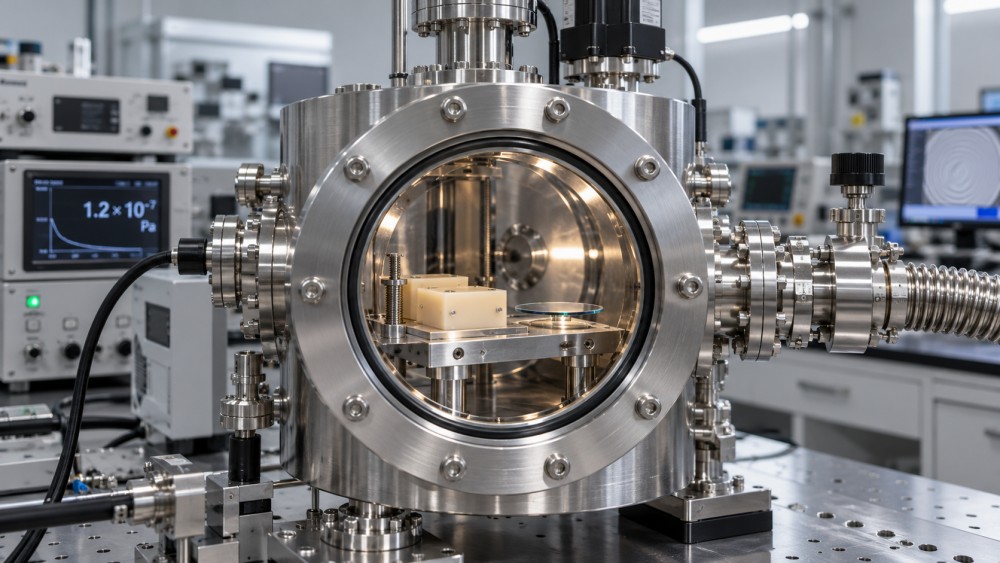
For these reasons, selecting a familiar high-performance polymer is only a starting point. PEEK, polyimides, and fluoropolymers can be candidates for particular vacuum applications, but their names do not qualify every grade or component. Fillers, additives, manufacturing routes, and surface condition can materially change the result.
The finished part may also carry contamination absent from a resin specimen. Machining fluids, mold-release agents, fingerprints, cleaning residues, adhesive joints, and packaging materials can all affect vacuum performance. Qualification evidence should follow the component through its actual manufacturing and preparation route.
Build an evidence package around the acceptance decision
A defensible review begins with a short application specification. Record the target pressure range, permitted pumpdown time, maximum component temperature, bakeout conditions, exposed polymer area, and contamination-sensitive surfaces. State whether acceptance concerns total gas load, condensable deposition, specific chemical species, mechanical stability, or a combination of these.
This gives the supplier a concrete requirement to address. Asking only for “vacuum-grade plastic” leaves too much room for interpretation. The useful documentation package should connect the material identity, test evidence, and preparation process:
- Exact material identification: manufacturer, commercial grade, color, reinforcement, additive package where disclosed, and traceability to the supplied stock or finished part.
- Separate regulatory documentation: a RoHS declaration with clear scope and any applicable exemptions, assessed independently of vacuum suitability.
- Outgassing evidence: the test method and revision, measured results, laboratory identity, specimen description, conditioning history, and relevant deviations from the method.
- Processing and handling information: molding or machining route, cleaning agents, drying or bakeout procedure, storage conditions, and packaging controls.
- Change notification: an agreement covering changes to formulation, feedstock, manufacturing location, or preparation steps that could affect the qualified condition.
Traceability is particularly important when the test report identifies a broad resin family while the purchase order specifies a proprietary compound. If the supplier cannot connect the tested specimen to the proposed grade, the report can support initial screening but provides a weak basis for final acceptance.
Conditioning must also be reproducible. A favorable result after an intensive bakeout is relevant only if that treatment can be applied to production parts without damage and maintained through assembly. A dried polymer may reabsorb moisture during storage or handling. The time and environment between conditioning and installation therefore belong in the process specification.
Additional testing should resolve the remaining uncertainty. A rate-of-rise test on a clean, representative assembly can help assess gas load, provided chamber background and leaks are accounted for. Residual gas analysis can help characterize evolved gases, although interpretation requires appropriate controls. Witness surfaces or a quartz crystal microbalance may be more relevant when deposition is the primary concern.
These methods answer different questions. An assembly pumpdown test does not identify every contaminant, and a favorable material-screening result does not demonstrate that a machined assembly reaches its pressure target. Select the verification method according to the failure mechanism and test representative parts after the intended cleaning and conditioning process.
For a low-sensitivity fixture, grade-specific screening data and a controlled preparation procedure may provide sufficient evidence. A component near precision optics, an electron source, or a cold detector can justify tighter contamination limits and testing under representative thermal conditions. The level of qualification should follow the consequence of failure.
The resulting approval should be bounded: a particular grade and finished-part process, accepted for a defined pressure, temperature, preparation procedure, and contamination requirement. RoHS documentation remains in the compliance record. Vacuum approval rests on evidence that the material, in its installed condition, can meet the application’s operating limits.
Have questions about this sector analysis, or seeking best practices specific to your niche? Drop us a line below and let the senior consultants at APIM assist you.
We respect your privacy. Your information is strictly confidential.
Related News
- 00
0000-00
NAPCOR Report: US PET Bottle Recycling Rate Fell to 29% in 2025 - 00
0000-00
How does washing affect contamination in post-consumer recycled PP resins? - 00
0000-00
How does feedstock affect depolymerization equipment selection? - 00
0000-00
US Sets 213.44% Preliminary Antidumping Deposit on Chinese PTMEG - 00
0000-00
When should epoxy be used as a thermal interface material for semiconductors?