




Choosing Poultry Farm Equipment for Ethiopian Production Conditions
Equipment Decisions Begin with the Production System, Not the Catalogue
Farm equipment choices in Ethiopia are often constrained less by the theoretical capacity of a machine than by the conditions around it: site access, power stability, water quality, climate variation, labor availability, feed handling practices, and the technical support available after installation. A cage line, feeder, drinker, brooder, fan, or manure system can appear suitable on a specification sheet yet become difficult to operate if its utility requirements and maintenance demands do not match the farm.
For technical evaluators, the practical question is not simply whether equipment is modern or low-cost. It is whether the selected system can maintain bird welfare, hygiene, feed access, water availability, and egg or meat output under the actual conditions of the proposed site. That requires evaluating equipment as an integrated production system rather than as a list of separate purchases.
Ethiopia includes highland, midland, and warmer lowland environments, and local conditions can differ substantially between farms. A design that works in a relatively cool, elevated area may need different ventilation, insulation, drainage, and water-management provisions in a hotter location. Seasonal rain can also affect access roads, building drainage, litter condition, and the storage of feed ingredients. Equipment selection should begin with a site-specific operating brief that records these variables before supplier quotations are compared.
Define the Farm’s Operating Conditions Before Selecting Equipment
A technical review should document the intended flock type, production objective, housing layout, expected stocking arrangement, and replacement cycle. Layers, broilers, pullets, breeders, and dual-purpose birds do not place the same demands on feeding, egg collection, nesting, lighting, ventilation, or manure handling.
For example, a commercial layer operation may prioritize reliable access to feed and water, egg protection, manure removal, and the ability to inspect birds quickly. A broiler unit may place greater emphasis on brooding, floor management, drinker height adjustment, airflow, litter dryness, and turnaround cleaning between flocks. A pullet facility needs equipment that can be adjusted as birds grow, while breeder operations may require more careful control of nesting, feed allocation, and bird movement.
The site review should also identify what is dependable and what is uncertain. Electrical supply may be available but interrupted. Water may be sufficient during part of the year but limited during dry periods. A farm may have access to skilled welders but not to specialized electronic controls or imported replacement parts. These realities do not automatically rule out automated systems, but they change the level of redundancy, simplicity, and local serviceability required.
- Power profile: Record outages, voltage variation, generator capacity, fuel logistics, and the equipment that must remain operational during a disruption.
- Water profile: Check source reliability, storage capacity, pressure consistency, visible sediment, and the likely need for filtration or treatment.
- Climate exposure: Assess daytime heat, night temperatures, humidity, wind direction, dust, rainfall, and direct solar load on the building.
- Access and logistics: Review road conditions, unloading space, internal farm routes, spare-parts lead times, and the ability to move feed, birds, eggs, and manure.
- Labor and supervision: Consider the number of trained operators available for daily checks, cleaning, adjustment, and fault reporting.
These inputs should be included in the equipment request document. Without them, suppliers may quote a generic configuration that shifts too much adaptation work to the installer or farm manager.
Housing Choice Determines the Rest of the Equipment Package
The largest early decision is often whether to use a floor-based system, a cage system, or a combination of approaches for different stages of production. Each option changes building dimensions, ventilation design, labor routines, cleaning methods, biosecurity pathways, and capital requirements.
Floor-based housing
Deep-litter or other floor-based systems can be comparatively straightforward to establish where local materials, labor, and practical flock supervision are available. Their performance depends heavily on litter management, drainage, drinker control, bird density, airflow, and cleaning discipline. Wet litter can increase ammonia, encourage disease pressure, reduce bird comfort, and complicate manure removal. Equipment selection for this model should focus on dependable drinker lines, feeders that minimize wastage, brooders suited to the house volume, and a layout that lets workers inspect every area without disturbing the flock excessively.
Floor systems are not “low-tech” by default. A poorly designed manual water arrangement can create more operational risk than a properly installed nipple-drinker line. Likewise, inadequate feeder distribution may lead to uneven bird access and inconsistent growth. The objective is to match the level of automation to the farm’s ability to monitor and maintain it.
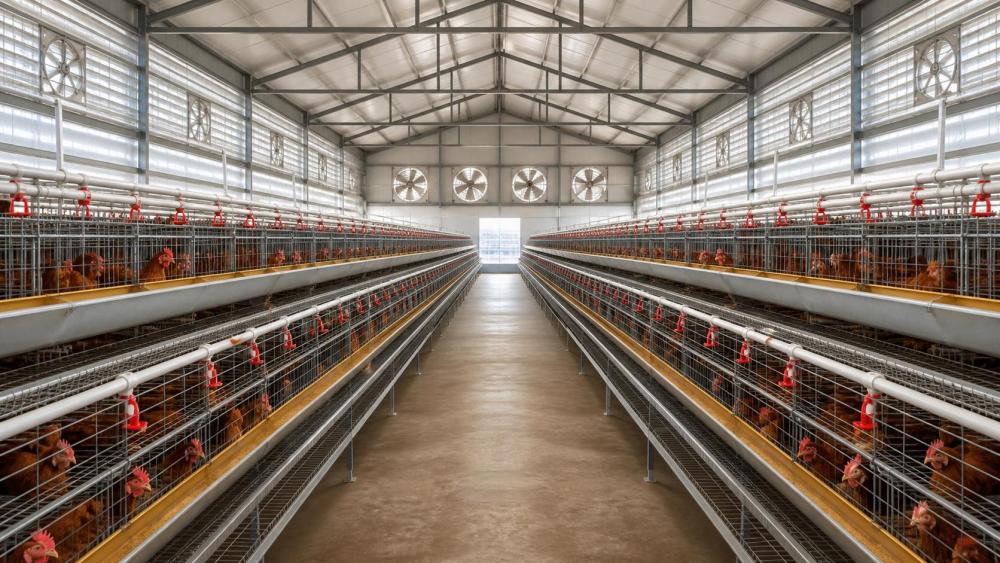
Cage-based layer housing
Cage systems can support organized egg collection, reduce egg contact with litter, and make individual rows easier to observe. However, they require greater precision in installation and utilities. The building floor must be level, structural supports must be adequate, water pressure must remain within the drinker system’s operating range, and manure handling must be planned from the outset. Installing cages before confirming drainage, pit depth, access routes, and manure-removal practices can create costly rework.
When reviewing cage quotations, technical teams should look beyond the number of birds accommodated. Cage wire quality, corrosion protection, floor slope, door operation, feed trough accessibility, nipple placement, drinker-line flushing provisions, frame rigidity, and egg-collection arrangement all affect daily use. A cage system that is difficult to clean or repair can lose its apparent advantage quickly.
Buyers assessing cage configurations, equipment cost categories, and business-planning considerations can use this practical resource on poultry farming in ethiopia as a supplementary reference while developing a site-specific technical specification. Its value is in framing the purchase as part of a complete farm setup rather than treating cages as an isolated item.
Evaluate Materials for Corrosion, Cleaning, and Repairability
Poultry-house equipment operates in a demanding environment. Moisture, manure gases, dust, repeated washing, feed residues, and disinfectants can degrade metal parts and plastic components over time. The appropriate material is not always the heaviest or the most expensive one; it is the one with protection and construction appropriate to the expected exposure.
Galvanized steel is widely used for frames, cages, and feeding components, but technical evaluators should ask how the coating is applied and where cut edges, welds, fasteners, and joints may be vulnerable. Painted surfaces can be acceptable in sheltered applications, yet they should not be assumed to offer the same durability in wet or corrosive zones. Plastic equipment should be checked for wall thickness, resistance to cracking, ease of cleaning, and compatibility with local cleaning chemicals.
Repairability deserves equal attention. Can a damaged nipple, feeder section, cage door, valve, belt, or fan bearing be replaced without dismantling an entire line? Are standard tools sufficient? Does the design rely on proprietary fittings that may be difficult to obtain? Equipment with simple service access may be more suitable than a more sophisticated alternative if local maintenance support is limited.
Ventilation and Heat Control Need a Building-Level Review
Fans should not be selected solely by motor rating or unit count. Their effectiveness depends on house length, width, ceiling height, bird density, inlet design, obstructions, dust accumulation, and the path air follows through the building. A powerful fan cannot correct a layout with poorly located inlets, major air leaks, or dead zones behind equipment rows.
In warm conditions, the objective is to remove heat and moisture while maintaining meaningful airflow at bird level. In cooler highland areas, uncontrolled cold drafts can be as problematic as insufficient airflow, especially for young birds. Curtains, adjustable inlets, roof insulation, ridge ventilation, and brooding zones should be evaluated as a package. Where automated controls are proposed, operators should also be able to run essential ventilation manually if sensors or controllers fail.
Dust affects fan performance, electrical panels, bearings, and worker comfort. Designs that allow safe cleaning of fan guards, blades, and shutters are more practical than units that are difficult to reach once installed. If a farm expects frequent dust exposure, inspection and cleaning schedules should be included in the operating plan rather than treated as occasional maintenance.
Water Delivery Is a Production System, Not Just Plumbing
Water interruptions can affect feed intake, bird comfort, medication delivery, and cleaning routines. A robust design usually includes storage, pressure management, filtration suited to the water source, and a means to flush lines. The required storage arrangement depends on flock size, intended use, supply reliability, and whether water is also needed for washing or cooling.
Before purchasing drinker equipment, farms should test or otherwise assess the source water for visible solids and conditions that may affect filters, pipes, or nipples. The purpose is not to over-specify treatment equipment; it is to prevent a mismatch between water quality and the selected system. A basic filter that is easy to inspect and clean may be more useful than a complex unit that operators cannot service consistently.
Drainage around tanks, houses, and wash-down points should be considered at the same time. Standing water near poultry buildings attracts pests, worsens access conditions, and can complicate hygiene. Rainwater routing, surface grading, and separation of clean and dirty water flows are construction details with direct implications for equipment life and farm sanitation.
Automation Should Be Chosen by Failure Consequence
Automated feeding, egg collection, manure removal, climate control, and lighting can reduce repetitive manual work and improve consistency. Yet each motor, sensor, controller, gearbox, or conveyor introduces a possible failure point. The proper evaluation is not whether automation is desirable in general, but what happens when a component stops working and how quickly the farm can recover.
For systems with high failure consequences, the technical specification should identify backup arrangements. Ventilation may need generator support. Water systems may need bypass capability. Motorized feeding should allow safe manual intervention if practical. Critical spare parts may need to be held on site, especially when transport delays are possible. A supplier’s installation scope should also be clear: equipment delivery, assembly, electrical connection, commissioning, operator instruction, and post-installation support are separate responsibilities unless explicitly included.
Over-automation can be a risk where control panels are poorly protected from dust or moisture, electrical troubleshooting capacity is limited, or spare electronics are difficult to source. Under-automation can also create risk when labor-intensive routines make it hard to feed, water, collect eggs, or inspect birds consistently. The right balance depends on the farm’s scale, staffing model, utility reliability, and management discipline.
Use Procurement Documents to Expose Hidden Gaps
A well-prepared equipment comparison should normalize what each quotation includes. One supplier may quote cages and feeders only, while another includes drinker lines, tanks, motors, installation hardware, and electrical controls. Comparing headline totals without a common scope can lead to an inaccurate budget and an incomplete facility.
Technical evaluators can request a line-by-line bill of materials, layout drawing, utility requirements, foundation or support assumptions, packing list, installation instructions, recommended spare parts, and warranty terms. These documents help identify omissions before equipment reaches the site. They also give the farm a reference for receiving inspection.
At delivery, verify quantities, visible damage, component labeling, fasteners, motors, electrical enclosures, and the consistency of supplied parts with the approved bill of materials. During commissioning, test water flow across the full line, feeder movement, fan direction, safety guards, lighting circuits, manual overrides, and drainage. A system should not be accepted solely because it has been assembled; it should be accepted after key operating functions have been demonstrated under realistic conditions.
Make the Selection Decision Around Total Operating Fit
The least expensive equipment package may require more labor, more repairs, or earlier replacement. The most automated option may demand stronger electrical infrastructure and more specialized maintenance than the farm can support. A sound decision weighs purchase cost against installation needs, expected cleaning effort, utility consumption, spare-parts access, operator capability, and the consequences of downtime.
For Ethiopian production conditions, the most durable choice is usually equipment that fits the farm’s climate, building design, water and power realities, flock plan, and maintenance capacity. When those elements are evaluated together, procurement shifts from buying hardware to building an operating system that can be inspected, repaired, cleaned, and managed throughout its service life.
Have questions about this sector analysis, or seeking best practices specific to your niche? Drop us a line below and let the senior consultants at APIM assist you.
We respect your privacy. Your information is strictly confidential.
Related News
- 00
0000-00
How does washing affect contamination in post-consumer recycled PP resins? - 00
0000-00
How does feedstock affect depolymerization equipment selection? - 00
0000-00
US Sets 213.44% Preliminary Antidumping Deposit on Chinese PTMEG - 00
0000-00
When should epoxy be used as a thermal interface material for semiconductors? - 00
0000-00
US Midterm Results Unlikely to Quickly Shift Recycled Plastics Market or Legislation
Tag