




Certified Post Consumer Recycled Plastics: What Documents Matter Before You Buy
Certified post consumer recycled plastics: why documents matter more than claims
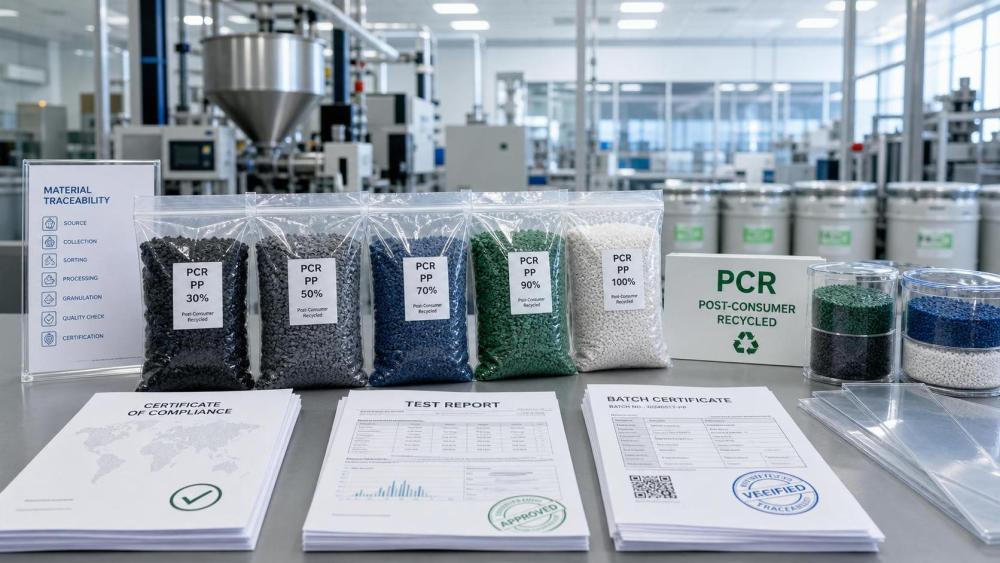
Buying certified post consumer recycled plastics looks simple until the paperwork starts to matter.
A supplier may promise recycled content, stable pricing, and fast delivery. That still does not prove traceability, legal compliance, or batch consistency.
In practical sourcing, the real cost often appears later. A missing certificate can delay approvals, block exports, or create disputes over material origin.
That is why certified post consumer recycled plastics should be reviewed as a document package, not only as a resin offer.
Across packaging, automotive, electronics, films, and industrial parts, recycled polymers are now tied to compliance, sustainability targets, and performance risk.
APIM often frames this issue clearly. Material selection is never just about resin name or price level. It is about evidence behind the material.
What exactly counts as certified post consumer recycled plastics?
The phrase usually refers to plastics made from waste collected after consumer use, then reprocessed into usable resin, compounds, sheets, films, or molded feedstock.
The word “certified” is the important part. It means an independent system has checked recycled content, chain of custody, or process controls.
Without that certification, “PCR” may only be a supplier statement. That can be acceptable for some low-risk applications, but not for many regulated programs.
Common examples include recycled PET, recycled PP, recycled PE, and compounds blended with virgin resin for mechanical stability or appearance control.
In real buying decisions, certified post consumer recycled plastics are usually evaluated in three layers:
- Proof of recycled content and source category.
- Proof of legal and application compliance.
- Proof that the material performs consistently in production.
If one of those layers is weak, the “certified” label may not reduce actual sourcing risk.
Which documents should be checked before placing an order?
This is the question that usually separates a workable deal from an expensive problem.
A reliable supplier of certified post consumer recycled plastics should be able to provide a basic but complete document set. The list below is the practical minimum.
Some applications need more. Food contact, medical, electrical, or automotive uses usually require extra declarations and tighter testing records.
If the supplier sends only a marketing datasheet, treat that as an opening conversation, not as documentary proof.
Is a recycled content certificate enough on its own?
Usually no. A recycled content certificate answers one question, but sourcing decisions involve several others.
For example, a certificate may confirm 30% or 50% post consumer input. It may not confirm odor level, contamination risk, color drift, gel count, or extrusion stability.
That gap matters in films, cosmetic packaging, appliance housings, electrical components, and precision parts where appearance or processability is critical.
A practical review should connect the certificate with technical and quality evidence.
- Does the PCR percentage match the quoted grade?
- Do the tested properties match your process window?
- Are there restrictions on direct food contact or electrical use?
- Can the supplier maintain the same formulation over repeat orders?
Certified post consumer recycled plastics reduce credibility risk, but they do not remove conversion risk. That second part still needs technical evidence.
How do you judge traceability and batch consistency without overcomplicating the process?
The simplest approach is to ask whether each shipment can be traced backward and each performance claim can be traced forward.
Backward traceability means knowing which certified site, waste stream, and production batch supplied the material.
Forward traceability means being able to match each delivered lot with a COA, invoice, label, and internal receiving record.
This does not need a complex audit on day one. A short supplier document review often reveals whether the system is mature.
Useful checks include:
- Lot numbering format stays consistent across documents.
- COA values reflect realistic variation, not repeated copied numbers.
- Certification scope matches the actual manufacturing site.
- Complaint handling and reissue records exist for past lots.
APIM often highlights that compounding quality and process control directly affect final performance. That is especially true for recycled compounds.
If the source mix changes, melt flow, odor, color, ash content, or mechanical properties may shift. Documents should help you see that risk early.
Where do buyers usually make mistakes with certified post consumer recycled plastics?
Most mistakes happen when people assume a sustainability claim automatically covers compliance, performance, and supply continuity.
A few patterns appear again and again.
Mistake 1: accepting a logo without checking scope
A certificate may belong to a parent company, while the quoted resin comes from another site or toll compounder.
Mistake 2: comparing only price per kilogram
Lower resin price can be offset by higher scrap, slower cycle time, more drying, or tighter filtration needs.
Mistake 3: skipping application-specific declarations
This is common in packaging, electronics, and export programs where restricted substance rules differ by market.
Mistake 4: treating one approved sample as long-term proof
Certified post consumer recycled plastics can vary more than virgin materials. One successful trial does not replace lot control.
A more reliable buying model is to approve the grade, the document set, and the acceptable variation range together.
How should cost, lead time, and supply risk be evaluated before commitment?
This is where document review becomes a commercial tool, not just a compliance exercise.
Certified post consumer recycled plastics can carry extra costs from sorting, washing, reprocessing, certification, and testing.
But the bigger question is whether those costs are stable and predictable over a contract period.
Before confirming an order, it helps to check the following points in writing:
- Quoted PCR percentage tolerance and any substitution rules.
- Normal lead time and surge lead time.
- Minimum order quantity by grade and color.
- Retest policy for disputed lots.
- Notice period if feedstock source changes.
In broader materials sourcing, APIM tracks how processing methods, additive selection, and global supply conditions shape real material value.
That perspective is useful here. Cheap PCR resin with unstable supply can become more expensive than a higher-priced but better-documented grade.
What should be on your pre-purchase checklist?
If the goal is a practical decision, keep the checklist short enough to use and strict enough to prevent avoidable surprises.
That checklist will not answer every technical detail. It will, however, filter out weak offers quickly and improve discussion quality with shortlisted suppliers.
The best next step is to align document review with actual application needs. Start with traceability, compliance, and lot control, then compare cost and processing impact side by side.
When certified post consumer recycled plastics are evaluated this way, sustainability claims become easier to verify, and purchasing decisions become far less uncertain.
Have questions about this sector analysis, or seeking best practices specific to your niche? Drop us a line below and let the senior consultants at APIM assist you.
We respect your privacy. Your information is strictly confidential.
Related News
- 00
0000-00
How does washing affect contamination in post-consumer recycled PP resins? - 00
0000-00
How does feedstock affect depolymerization equipment selection? - 00
0000-00
US Sets 213.44% Preliminary Antidumping Deposit on Chinese PTMEG - 00
0000-00
When should epoxy be used as a thermal interface material for semiconductors? - 00
0000-00
US Midterm Results Unlikely to Quickly Shift Recycled Plastics Market or Legislation