




Building a Medical Polymer Regulation Monitoring System for Global Markets
Building a Medical Polymer Regulation Monitoring System for Global Markets
A medical-grade polymer can be technically excellent and still become a commercial problem. A resin may meet mechanical requirements, survive sterilization, mold cleanly, and have a long history in a supplier’s portfolio. Yet a change in chemical restrictions, device documentation expectations, biological evaluation guidance, or market-specific registration practice can turn that familiar material into a project delay.
That is why medical polymer regulation monitoring should not be treated as a legal-news subscription. For companies supplying, compounding, converting, or specifying materials for medical devices, diagnostics, pharmaceutical packaging, and healthcare equipment, it needs to function as an operating system. The purpose is not merely to know that a rule has changed. The purpose is to identify which material families, formulations, processes, documents, suppliers, and customer programs may be affected before the impact reaches a launch gate or an audit.
The difficult part is that regulation rarely arrives in the same language used by engineering or procurement. A regulatory notice may concern a substance category, a restricted use, a reporting obligation, or a device classification principle. The business impact may sit elsewhere: in a color masterbatch, a stabilizer package, a processing aid, an adhesive layer, a recycled feedstock stream, or an outdated declaration in a technical file. A usable monitoring system must bridge that gap.
Why scattered compliance tracking fails in medical polymer projects
Many organizations already receive regulatory alerts. The usual failure is not lack of information; it is lack of connection. Regulatory staff may monitor official publications, while R&D holds formulation knowledge, quality owns change control, procurement manages supplier declarations, and commercial teams learn about customer requirements only when a quotation is already under discussion.
This separation is especially risky for polymers because a material name is rarely enough to assess compliance. “TPU,” “polycarbonate,” “silicone,” or “PEEK” does not reveal the additives, pigments, residual monomers, processing conditions, sterilization history, or contact duration that may matter in a medical application. Even a grade sold under the same trade name can require renewed assessment if its production site, stabilizer system, colorant, or post-processing route changes.
Consider a simple example: a converter uses a multilayer film in a healthcare packaging format. The compliance question may not rest with the base PET or PE layer. It may concern the tie layer, printing ink interaction, adhesive chemistry, residuals after curing, or whether the final article has the intended contact conditions documented correctly. A monitoring system that records only the primary resin will detect changes too late.
The same issue appears in injection-molded components. A PA, PC, POM, PPS, or high-performance polymer may be selected for strength, dimensional stability, chemical resistance, or heat exposure. But the regulatory file must still reflect the actual finished configuration: the grade, color, additives, molding process, cleaning method, sterilization approach, and clinical or non-clinical contact scenario. Material selection and compliance monitoring cannot be run as unrelated workstreams.
Start with a material-to-market map, not a list of regulations
The first practical step is to map the company’s exposure. This is more useful than attempting to monitor every global development with equal urgency. Build a register that links each relevant polymer or material system to its application, supply chain position, and target market.
For each material, the register should distinguish between the commercial grade and the real composition under review. That usually means recording the polymer family, grade designation, manufacturer, production location where relevant, additive package where disclosed, colorants, fillers, reinforcement, recycled or bio-based content, and any bonded or laminated companion materials. For compounds, this detail matters even more. Glass fiber, carbon fiber, flame retardants, impact modifiers, lubricants, and heat stabilizers can change both performance and regulatory exposure.
Then connect the material to use conditions. Is it used in a reusable surgical instrument handle, a single-use fluid path component, an electronics enclosure in a clinical environment, a diagnostic cartridge, a drug-contact package, or a non-patient-contact piece of capital equipment? Is it exposed to steam, gamma irradiation, ethylene oxide, cleaning agents, lipids, alcohols, or repeated mechanical stress? These questions do not replace formal assessment, but they determine which alerts deserve immediate review.
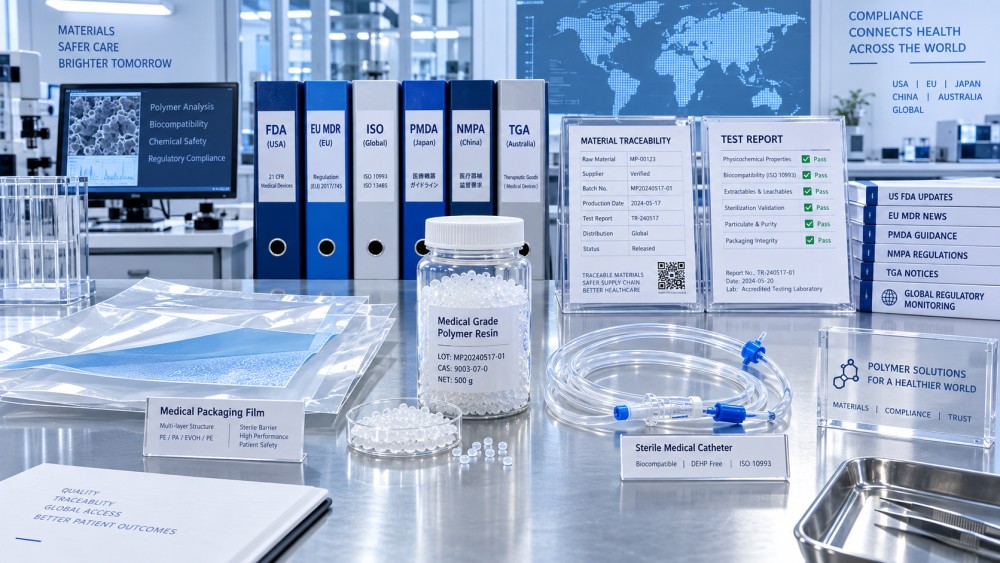
A compact material-to-market map should also identify where the company sits in the chain. A resin producer may need to provide composition and change notifications to compounders. A compounder may need to control raw material traceability and formulation changes. A device manufacturer needs evidence suitable for its own technical documentation and risk management process. The same regulatory development may create different obligations and different response times for each party.
The fields that make monitoring actionable
Monitor source material in layers
A strong system uses a source hierarchy. Official legislation, regulator publications, and recognized standards bodies should sit at the top. In major markets, organizations commonly watch developments related to medical device requirements, chemical management, restricted substances, packaging rules, and product stewardship obligations. For biological evaluation, the ISO 10993 series is frequently relevant, but its application depends on the finished device, nature and duration of contact, and a documented evaluation plan. It should not be reduced to a generic claim that a polymer is “ISO 10993 compliant.”
Below primary sources, use credible technical interpretation from industry associations, notified or testing organizations where appropriate, specialist legal and regulatory advisers, and supplier communications. These sources help teams understand what may change operationally, but they should not replace verification against the original requirement. A supplier newsletter can be useful. It is not enough on its own when a customer’s technical file or market access decision is at stake.
The monitoring workflow should classify every update before distributing it widely. A practical triage question is: does this item affect our materials, our applications, our markets, or our evidence package? If the answer is no, retain it in the archive without creating noise. If the answer may be yes, assign an owner and define the next fact to obtain. This is where many systems become more efficient: they stop treating all alerts as emergencies.
Translate alerts into engineering and commercial decisions
An alert becomes useful only when it produces a decision record. The record does not need to be elaborate, but it should answer five questions: what changed, which materials or projects could be affected, what evidence is currently available, what gap remains, and who owns the response.
For instance, an update concerning a chemical substance may trigger a formulation confirmation from the resin producer, an inquiry to the color masterbatch supplier, a review of prior declarations, and perhaps a customer communication plan. It does not automatically mean the material must be replaced. Premature substitution is a common and expensive reaction. A replacement polymer can introduce new molding behavior, shrinkage, warpage, extractables, sterilization response, bonding issues, or supply risk. The better sequence is to establish relevance, assess evidence, and only then decide whether reformulation, additional testing, documentation revision, or no action is appropriate.
This is particularly important for specialty compounds and functional materials. A conductive compound, radiopaque formulation, reinforced polymer, antimicrobial additive package, UV-stabilized film, or silicone adhesive may solve a demanding design problem while introducing a more complex evidence burden. Procurement teams should not approve an alternative solely because the base polymer family appears equivalent. In medical work, equivalence is usually tied to the complete material system and intended use, not to a broad resin label.
Use a risk-based review clock
Not every update needs the same response deadline. A sensible internal model separates immediate review items from planned reviews. Immediate review may be appropriate when a change concerns an active market, a known ingredient, a device under submission, or a customer commitment. Planned review may be sufficient for an early-stage concept, an inactive market, or an item with no material match after initial screening.
The key is to document why the item was assigned a lower priority. In a later audit, “we did not think it mattered” is weak. “The review found no use of the relevant substance across the identified grades and no current sales into the affected product category” is much more defensible, provided the underlying material inventory is reliable.
Supplier management is the pressure point
Most medical polymer compliance systems are only as good as their supplier-change discipline. Material suppliers may legitimately modify manufacturing equipment, raw material sources, additives, production sites, packaging, or quality-control methods. Some changes have no meaningful effect on a customer application; others may require a formal impact assessment. The challenge is that downstream companies often learn about the change after inventory has already moved.
For critical materials, commercial agreements and supplier quality arrangements should clarify what counts as a notifiable change, how much advance notice is expected, what supporting documentation is available, and how lot traceability will be maintained. This is not limited to resin manufacturers. It also applies to compounders, adhesive formulators, film converters, pigment suppliers, sterilization providers, and contract molders.
There is a practical distinction worth protecting: a supplier’s statement of regulatory status is not automatically a complete device-level justification. It is valuable input, often essential input, but the finished-product manufacturer generally remains responsible for deciding whether the evidence fits the intended use. Teams get into trouble when supplier documentation is stored without checking its scope, date, grade reference, and exclusions.
Build the system around real material decisions
The most durable medical polymer regulation monitoring system is not a separate compliance spreadsheet maintained once a quarter. It is connected to material approval, supplier onboarding, engineering change control, product development reviews, and customer documentation requests. When a new TPU, PEEK, PA, PC, PET film, silicone, or bonded assembly enters evaluation, its regulatory profile should be captured at the same time as tensile performance, thermal behavior, chemical resistance, processing window, and supply availability.
This is also where structured materials intelligence becomes useful. Platforms such as the Global Advanced Polymers & Industrial Materials Intelligence Network can help teams organize technical context across engineering plastics, modified compounds, specialty films, industrial adhesives, biomaterials, recycled polymers, and processing technologies. Regulatory monitoring is stronger when decision-makers can see how formulation design, extrusion conditions, molding behavior, surface treatment, or bonding chemistry may affect the final application rather than viewing compliance as an isolated document exercise.
Global expansion adds another layer. A company should avoid assuming that a compliance package prepared for one market transfers unchanged to another. The underlying material may be identical, but local device rules, chemical obligations, language requirements, reporting expectations, and customer practices can differ. Maintain a common global evidence library, then create market-specific assessment paths rather than duplicating every document from scratch.
A system that people will actually use
Complexity is not proof of control. A small cross-functional review group, a disciplined material register, defined sources, clear escalation rules, and a decision log will usually outperform an oversized dashboard with no ownership. Regulatory, quality, R&D, procurement, and commercial teams need different views of the same information, but they should work from one controlled version of material identity and project status.
The most useful measure is not the number of alerts received. It is whether the organization can answer a difficult customer or auditor question quickly: Which products use this material? Which markets are involved? What changed? What evidence supports the current position? What action was taken, and why?
If those answers depend on searching old emails, requesting emergency declarations, and reconstructing formulation history from several suppliers, the monitoring process is not yet doing its job. Build it around traceable material decisions, and it becomes a practical safeguard for product development rather than another administrative burden.
Have questions about this sector analysis, or seeking best practices specific to your niche? Drop us a line below and let the senior consultants at APIM assist you.
We respect your privacy. Your information is strictly confidential.
Related News
- 00
0000-00
Do polyolefin hot melt adhesives bond well to polyethylene? - 00
0000-00
Korean Study Finds PLA Barely Degrades in Landfill After 320 Days - 00
0000-00
How to assess batch consistency from a thermal potting compounds supplier - 00
0000-00
How much weight can carbon fiber reinforced plastics save in cars? - 00
0000-00
Switching from PS to ABS Sheet Extrusion: Equipment Checks