




Are certified post-consumer recycled resins safe for food contact?
Certified post-consumer recycled resins can be suitable for food contact, provided the evidence covers the recycling process, the material supplied, and the packaging’s intended use. A certificate confirming recycled content does not, by itself, establish food-contact safety. For quality and safety teams, approval depends on whether potential contaminants are controlled and whether the finished packaging complies with the rules of its destination market.
The practical question is therefore specific: can this resin, from this recycling operation, be used at the proposed recycled-content level for this food, temperature, and contact duration? A material suitable for a refrigerated beverage bottle may require a different assessment before use in a hot-filled container, a fatty-food tray, or packaging intended for reheating.
Start by identifying what the certificate actually proves.
The word “certified” can describe several different claims. A recycled-content certificate may support the proportion or origin of recycled material. Chain-of-custody certification may document how material or attributed recycled content moves through a supply chain. A management-system certificate may demonstrate that an organization follows defined procedures. These documents can support supplier qualification, but their scope does not automatically include contaminant removal, migration into food, or regulatory permission for a particular application.
Before accepting a certificate, read its scope, covered sites, material descriptions, validity, and applicable scheme requirements. Check whether the claim concerns physically present recycled material or an allocation method such as mass balance. Either requires accurate interpretation; neither independently answers whether a packaging article is suitable for food contact.
Food-contact evidence has a different purpose. It should connect the material to an applicable regulatory route, describe relevant use restrictions, and support the safety of substances that may transfer into food. A supplier’s statement that a resin is “food grade” is too broad unless supporting documents define the grade, production source, composition, and intended conditions.
A useful initial review separates three questions:
- Does the sustainability documentation support the recycled-content claim being made?
- Does the regulatory documentation cover the recycling process and supplied material in the destination market?
- Does the technical assessment cover the finished package under its intended food-contact conditions?
A positive answer to one question cannot fill a gap in another. Keeping these reviews distinct also prevents a purchasing specification from treating a sustainability logo as the sole acceptance criterion.
Regulatory evidence must match the market and the application.
In the United States, the Food and Drug Administration evaluates recycling processes through its recycled-plastics review program and may issue a letter of no objection based on the information submitted. Such a letter concerns the described process and intended uses. It should not be interpreted as unrestricted approval of every resin, production facility, or package associated with the supplier.
When reviewing an FDA letter, compare its process description, feedstock assumptions, and use conditions with the proposed supply. Look for limitations involving food types, temperatures, recycled-content levels, or other conditions. A letter addressing a particular recycling process does not establish compliance for every additive, colorant, or subsequent formulation change. Applicable requirements for the packaging’s constituents still need to be addressed.
The European Union uses a different framework. Regulation (EC) No 1935/2004 establishes general requirements for food-contact materials, while Regulation (EU) No 10/2011 addresses plastic food-contact materials and articles. Regulation (EU) 2022/1616 specifically addresses recycled plastic materials and articles intended for food contact. Good manufacturing practice requirements under Regulation (EC) No 2023/2006 are also relevant.
Within that framework, the applicable requirements depend on the recycling technology and regulatory route. Where a process authorization is required, a favorable scientific opinion alone should not be treated as equivalent to that authorization. The quality team should establish the applicable legal status, required registrations or authorizations, operating conditions, and compliance documentation for the actual supply arrangement. An FDA letter does not establish EU compliance, and EU documentation does not automatically satisfy another market.
Regulatory references are most useful when they lead to a defined decision. Instead of accepting a statement that a grade “meets international standards,” request a declaration that identifies the destination market, applicable requirements, restrictions, and supporting documents. For packaging sold into multiple jurisdictions, maintain a separate assessment of each market’s requirements.
Food-contact safety depends on controlling what enters—and survives—the recycling process.
Post-consumer packaging can carry residues from its original contents, labels, adhesives, printing inks, and collection or sorting operations. Misuse can introduce substances unrelated to the original food application. Sorting reduces unwanted inputs, but a material’s previous use as food packaging does not guarantee that every recovered item has remained uncontaminated.
A credible assessment therefore starts with feedstock specifications. These should define accepted sources, sorting requirements, contamination limits, and how deviations are managed. The supplier should be able to explain how incoming material stays within the assumptions used to evaluate the recycling process. Expanding collection sources or increasing the share of unsuitable inputs can undermine an assessment even when the resin retains similar appearance and mechanical properties.
Decontamination validation examines whether the recycling process can remove potential contaminants sufficiently for the intended use. Depending on the applicable assessment approach, a challenge test may introduce selected surrogate contaminants and measure their removal under defined conditions. The evidence should explain why the surrogates represent relevant contamination behavior and how the results support acceptable exposure under the proposed application.
Challenge-test results apply to the process conditions evaluated. Temperature, residence time, pressure or vacuum, throughput, and other operating variables can affect removal efficiency. A production line must operate within the validated conditions, with monitoring and controls capable of detecting departures. Passing a challenge test does not remove the need for routine process control.
Conventional melt filtration primarily removes particles; it does not establish removal of dissolved chemical contaminants. Odor, color, clarity, and pellet cleanliness can flag problems, but they cannot demonstrate chemical safety. Some substances of concern may have no obvious sensory signature.
Polymer type also matters. PET, PE, and PP differ in their interactions with contaminants and in the recycling processes available to control them. Evidence supporting one polymer and process cannot simply be transferred to another. Even within a polymer family, the input stream and treatment conditions can materially change the assessment.
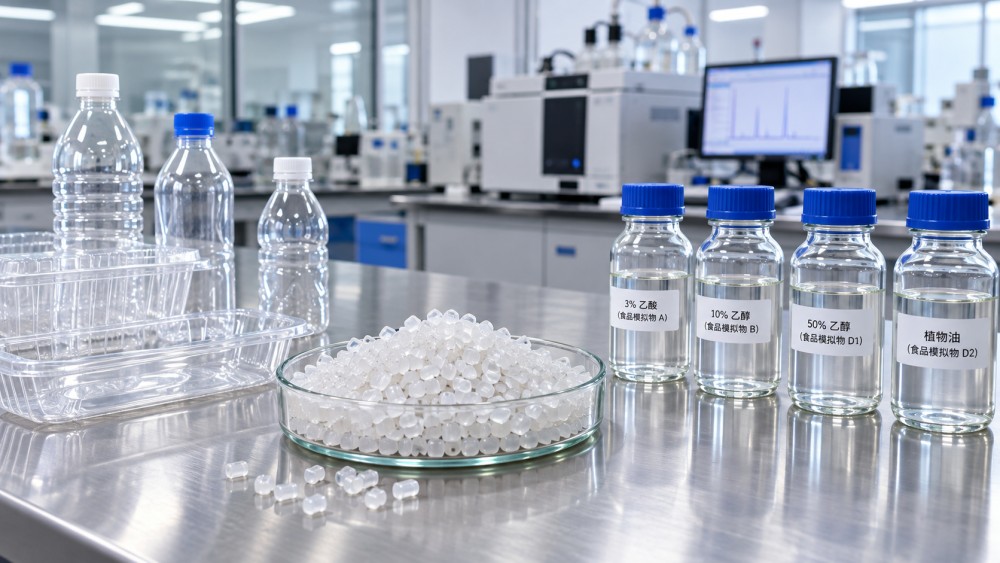
The package’s actual use determines whether the evidence is sufficient.
Migration is the transfer of substances from packaging into food. It depends on the substances present, the polymer, food characteristics, temperature, contact duration, and package geometry. Qualification should begin with a written use specification that captures these variables. “Food packaging” is not a sufficiently precise description for selecting test conditions or interpreting supplier restrictions.
Consider a recycled resin proposed for a chilled-food container. Evidence supporting refrigerated storage may leave unanswered questions about hot filling, consumer reheating, or prolonged ambient storage. Fatty or alcoholic foods can also interact differently with a material than aqueous foods. The assessment must cover reasonably foreseeable conditions across filling, distribution, storage, and use.
The conversion process can introduce additional considerations. Thermal processing may generate degradation products, while colorants, additives, printing, and adhesives can contribute substances requiring assessment. A resin-level report therefore needs to be connected to the final formulation and article. Where supporting data come from a different construction or representative sample, the technical justification should explain why they cover the proposed package.
Migration testing must follow the applicable rules for food simulants, time, temperature, and interpretation. Overall migration, where required, measures the total amount transferred under specified conditions. Specific migration addresses particular substances with relevant restrictions. Compliance with one type of limit does not automatically establish compliance with the other or resolve every possible contaminant concern.
Non-intentionally added substances, including impurities, reaction products, and degradation products, require appropriate consideration. Analytical screening can help identify potential concerns, but it has detection and identification limits. A defensible assessment combines suitable testing with knowledge of feedstocks, formulation, processing, and toxicological relevance. A report stating “not detected” needs context: which substances were sought, by what method, and at what reporting limits?
Recycled-content level must also remain within the supporting evidence. A qualification covering one blend ratio cannot automatically support a higher proportion. Likewise, placing recycled material behind a functional barrier requires evidence that the barrier controls migration throughout the intended service conditions, including relevant thickness, temperature, and contact duration. The presence of a virgin food-contact layer alone does not establish that result.
Turn the evidence into a usable release decision.
A qualification file should let a reviewer follow the connection from the recycling operation to the finished package without relying on marketing descriptions. The essential records are:
- Material identity: the exact grade, polymer, manufacturing site, recycled-content specification, and relevant formulation details.
- Regulatory basis: applicable declarations, process evaluations or authorizations where required, and clearly stated use restrictions.
- Safety support: decontamination validation, migration evidence, and relevant assessments of impurities and non-intentionally added substances.
- Production controls: feedstock acceptance criteria, validated operating limits, deviation handling, traceability, and change-notification commitments.
- Application match: documented coverage of the proposed food types, temperatures, contact duration, package construction, and recycled-content level.
Not every supporting study must appear in a public certificate. Some evidence may be confidential, but the supplier still needs a workable route for providing sufficient assurance, whether through controlled disclosure, appropriate technical summaries, or qualified review. Confidentiality does not resolve an unexplained mismatch between the claimed use and the available evidence.
Routine batch release serves a narrower purpose than initial safety qualification. Certificates of analysis can confirm agreed material properties and help detect variation. Process records can demonstrate operation within validated limits, while traceability connects deliveries to production. Neither a mechanical-property check nor a limited batch screening program should be treated as a substitute for the underlying food-contact assessment.
The approval should state its boundaries in language production and purchasing teams can use: approved grade and source, permitted recycled-content range, packaging construction, food categories, temperature limits, and contact duration. Changes to feedstock, recycling equipment, critical operating conditions, formulation, or intended use should trigger a documented review proportionate to their potential effect.
If the available evidence supports only chilled contact, the release decision should preserve that restriction. If a proposed hot-fill application falls outside the documented conditions, additional supporting work is needed before extending approval. Certified post-consumer recycled resins become a defensible food-contact choice when the certificate, regulatory basis, process controls, and package assessment all support the same clearly defined use.
Have questions about this sector analysis, or seeking best practices specific to your niche? Drop us a line below and let the senior consultants at APIM assist you.
We respect your privacy. Your information is strictly confidential.
Related News
- 00
0000-00
How does washing affect contamination in post-consumer recycled PP resins? - 00
0000-00
How does feedstock affect depolymerization equipment selection? - 00
0000-00
US Sets 213.44% Preliminary Antidumping Deposit on Chinese PTMEG - 00
0000-00
When should epoxy be used as a thermal interface material for semiconductors? - 00
0000-00
US Midterm Results Unlikely to Quickly Shift Recycled Plastics Market or Legislation